
- ► Essential France
- ► Practical visitor info
- ► Where to go
- ► What to see and do

A
Dictionary of France
G
G
What does GDF stand for ? What was the Gaspi ? Who are the Gilets Jaunes? What is the function of the Garde des sceaux ?
And when did General de Gaulle step down from power ? Look no further, here are the answers to these and other questions about French words or names beginning with G| A | B | C | D | E | F | G | H | I |
| J | K | L | M | N | O | P | Q | |
| R | S | T | U | V | W | X | Y | Z |
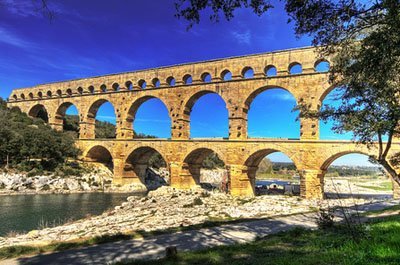
Photo top of page: the Pont du Gard
Gamma: From its founding in 1966, the Agence Gamma rapidly established itself as the leading French independent photo agency, specialising in news and reporting. Its position was undermined by the digital revolution, and the development of tabloid / people journalism, and at the end of the 1990’s the agency was taken over by France’s media giant Hachette-Filipacchi Media
Garabit, Viaduc de. Perhaps the most impressive French railway viaduct of the nineteenth century, designed by Gustave Eiffel. The Viaduct crosses the deep valley of the river Truyère in the Cantal department in Auvergne, at an altitude of approximately 1000 metres. The bridge can be viewed from a purpose-built visitor centre beside the A75 motorway
Gard, Pont du. One of the most famous surviving Roman aqueducts, located in the Gard Department, near Nîmes, in the Languedoc region of France.
Garde des Sceaux : the Guardian of the Seals, the official title of the French Minister of Justice. This medieval title is still used today, since the official seal of the French republic is kept in the office of the Minister of Justice.
Gaspi, le Cartoon figure that became well known in the nineteen seventies. The Gaspi, from the French verb gaspiller, to waste, was a sort or gremlin whose main joy in life was to waste energy, particularly petrol or other forms of fuel. Government campaigns encouraged citizens to ‘Chasser le gaspi’, i.e. to avoid wastage.
Gauche, la The political left - word commonly used to designate the whole spectrum of politics anywhere to the left of centre, from moderate socialism to the far left (extrême gauche). A term used either with pride or pejoritively, depending on the standpoint of the user.
Gauche Caviar - the French equivalent of "Champagne socialism" or "armchair socialism" ; pejorative term used to describe people professing left-wing opinions that are somewhat in contradiction with their own lifestyle.
Gaulle ,
General Charles de
(Derivatives. Gaulliste,
a
follower of de Gaulle, and
gaullien, in
the manner of De Gaulle ) :
1890-1970. Prime
minister 1944-1946, President 1958-1969.
De
Gaulle was without doubt the most influential French politician of the
twentieth century.
Leader of the Free French forces in World War 2, General de Gaulle went
on to become the instigator, and the first president, of France's fifth
republic. He oversaw French decolonisation of Algeria and
other colonies, but was also a strong nationalist, who believed in
France's independent nuclear deterrent, and withdrew France from NATO's
military command in a move to affirm France's independence with regard
notably to the USA. He was one of the leading proponents of the
European Economic Community, the EEC, precursor of the European Union,
but memorably blocked Britain's application for membership in 1960,
considering that Britain was too aligned with the USA.
A firm believer in strong central power, he
designed the constitution of the Fifth
Republic to give very great powers to the President (far
greater than in any other major western democracy), leaving the French
Parliament as second fiddle. He also sought to model the European
Community in the same way, concentrating power in the hands of the
Commission, and opposing the extension of the powers of the
European Parliament.
Notwithstanding, de Gaulle remains
an iconic figure in the life of modern France,
and a point of reference for politicians, notably those on the right.
For over thirty years, French conservative political parties have vied
with each other to portray themselves as the true bearers of Gaullist
values; but with the passing of time, de Gaulle's influence on French
politics, and the emblematic value of his name, are declining. The
modern UMP party,
the party of Presient Sarkozy,
may be descended in direct lineage from de Gaulle's RFP
and UDR
parties, and may define itself as being
"gaullist", but the meaning of the word, in that case, has changed.
Gauloises: the archetypal French cigarette, Gauloises were once the most widely smoked brand of cigarette in France, the preferred cigarette of 1960's and 1970's icons such as Jean-Paul Sartre or Serge Gainsbourg. They were the most popular of the French brands of "brown" tobacco (see Tabac brun) cigarettes, at a time when less than 20% of French smokers preferred blondes - cigarettes with light Virginia-style tobacco. The production of Gauloises cigarettes in France ceased in 2005.
Gaz de France (GDF) - the former state-owned French gas company. The company was privatized in 2005 and subsequently merged with Suez to form GDF-Suez, since renamed Engie
GDF-Suez : A CAC 40 company now known as Engie (q.v.).
Géant - One of the big hypermarket chains in France, part of the Casino group of retail outlets.
Gendarmerie (see also police). One of the two main branches of the police in France, the Gendarmerie is a national police force, responsible notably for policing the French road network, small towns and rural areas. It is also responsible for civil protection duties. Technically, the Gendarmerie is one of the French armed services. The policing of towns and cities is the responsibility of the Police Nationale, a different service.
Gilets
jaunes - The Gilets Jaunes, or Yellow Vests were
a populist protest movement that sprung up in France in October 2018.
At the outset the movement was triggered by increases in fuel prices.
Thousands of men and women, particularly in rural France and provincial
cities, donned fluorescent yellow hi-viz vests, and occupied various
strategic points on France's road network, causing minor disruption for
a few days. In November the movement escalated with the organisation of
weekly protest marches each Saturday, notably in Paris. The first few
of these attracted over 100,000 demonstrators, and degenerated into the
worst street violence in Paris since 1968.
In an attempt to calm the situation, President
Macron organised a national consultation on the state of France and its
problems. Among the paradoxical outcomes of this was that people were
demanding on the one hand more and better public services, but on the
other hand less taxation.
The Yellow Vest movement morphed into a general
anti-establishment protest against perceived elites and
against the government of President Macron, and the weekly protest
marches, particularly in Paris, drew in violent extremists from the
ultra left and ultra right, intent on causing mayhem. During these and
other smaller protests elsewhere in France, at least ten people were
killed, notably due to traffic accidents.
Weekly Saturday protests continued until the
middle of 2019, in Paris and here and there in different French cities,
with the number of participants slowly dwindling. By mid-May the number
of Saturday demonstrators had fallen to around 15,000 in the whole of
France, and popular support for the movement had dropped off.
The Gilets Jaunes fielded candidates in the
European Parliamentary Elections of May 2019, but gathered only just
over 1% of votes between them.
By autumn 2019, weekly presence at Gitets Jaunes
events throughout France had fallen to well below 10,000, mostly
left-wing, anarchist or right-wing militants
Giscard
d'Estaing,
Valéry (adj.
Giscardien)
- Born 1926: President of France
from 1974 to 1981. Valéry Giscard
d'Estaing succeed
Georges Pompidou as French president, thereby putting an end
to 16 years of Gaullist presidency. Though a conservative, Giscard was
from the UDF, the centre right party in the conservative coalition of
the time.
On becoming president, Giscard promised change
after a decade and a half of Gaullist rule: more Atlanticist and
pro-European than previous presidents, he nevertheless failed to embody
the change that many people wanted, and was not reelected for a second
term. He tried to give the French presidency more popular
appeal than it previously enjoyed, and make it seem closer to ordinary
Frenchmen, but his changes were more symbolic than real, and included
walking down the Champs Elysées in a sweater rather than a
suit, and inviting himself to dinner with ordinary French families from
time to
time.
After his defeat at the 1981 Presidential
election, Giscard returned to politics as an ordinary Député
(MP), and
also became strongly involved in local politics in his region, the Auvergne,
becoming President of the Regional Council from 1986 to 2004.
Gîte d'étape - fairly simple overnight accommodation for hikers and trekkers.
Gîte équestre - the same as a gîte d'étape, but providing stabling and facilities for horses.
Gîte. A self-catering holiday home or apartment, generally run by the owners. Gîtes can vary massively in quality, from small cramped studios in Alpine resorts or seaside developments, to luxurious small chateaux in the midst of spacious parks. As owners are free to fix their own rates, the cost is not always a guide to the quality of a gite on offer - much depending on location, local facilities and the local market. However very cheap gîtes tend to offer very basic facilities or suffer from other disadvantages that may not be evident from tourist brochures or information made available to prospective customers. See also Gîte d'Etape, Gîtes de France, Gîte Equestre.
Gîtes de FranceA national though not official organisation that registers and classifies gîtes, and also publishes an annual register and offers a centralised booking service. Registration of gîtes with Gîtes de France is optional and also fee-paying, and the Gites de France guide is thus, contrary to an "idée reçue", in no way a complete guide to holiday property available.
Goncourt, Le Prix : The most famous of all French annual literary prizes, established in the nineteenth century. See Prix littéraires
Grand Canal, le - A proposed ship canal from the Rhine to the Rhone, via the valley of the river Doubs. The project caused bitter opposition from ecologists and environmentalists, and was finally shelved in 1995. Despite this, some conservative politicians and business interests along the projected route of the canal still hope to see the project go through.
Grand cru - top classification of Bordeaux wines. Also used for the top wines from Burgundy and Alsace. The classification of Grands crus in the Bordeaux area was first established over 150 years ago, in 1855, and is divided into five levels, from Premier cru to Cinquième cru.
Grandes Ecoles: The French higher education system is different from that of other developed countries, and the pinnacle of the system is represented not by universities, but by classically French institutions known as “Grandes Ecoles". Unlike most university departments, which are open to all students with a relevant baccalaureate,Grandes Ecoles operate a highly competitive selection process. The classic way to train for these competitive entrance exams (concours) is to take two years’ extra classes, known as Classes Préparatoires, in Lycée, after the Baccalaureate. See higher education in France.
Grands ensembles : Housing projects, large tower block developments of social housing, usually in the suburbs. See ZUP and les Banlieues.
Grenelle.
The name
of a boulevard in Paris, on which is situated the French Ministry of
Labour. In 1968, at the height of the "events", talks were held in the
Ministry between the labour unions and the government, to hammer out an
agreement which would end the strikes and strife. Agreement was
reached, but the "Accords
de Grenelle" were never signed, as they were rejected by
workers on the shop floor, and three days later the tide turned in
favour of General de Gaulle, leading to the end of the social crisis.
Grenelle
de l'Environnement :
major gathering called by Nicolas Sarkozy shortly after his election as
President in 2007, designed to establish a road map for the greening of
French government policy. The initial gathering brought together
politicians, civil servants, business and the representatives of the
main environmental lobbies. Since then, the Grenelle de l'Environnement
has become an ongoing forum for debate on the adaptation of government
policy to environmental imperatives. The main sectors concerned are
building regulations, town and country planning, transport, energy,
biodiversity, water resources and agriculture.
Grèves : Strikes, see under Conflits sociaux.
Gruyère, best known as a cheese from Switzerland, Gruyère has been a Swiss Appellation Contrôlée (AOC) cheese since 2001. It was designated as an AOC cheese in France too, in 2007; however while the quality criteria for the production of Gruyère in France are strict, the area of production is huge, stretching from the Alps to parts of Burgundy, and Lorraine.
Guadeloupe - French overseas department (DOM) in the Caribbean.
Guides verts, Les : Popular tourist guidebooks to the regions of France, published by Michelin.
Guignols de l'Info Satirical TV current affairs programme, featuring puppets, inspired by Spitting Images. the programme is credited with having an undue influence on votre behaviour.
Guyane - French overseas territory on the south American mainland.
Check out the About-France.com
Online French Grammar
Free, full , clear explanations and lots of examples
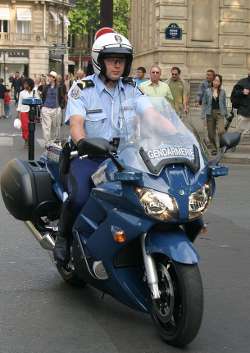
G is for Gendarme
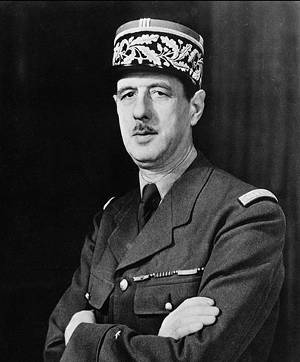
General de Gaulle
Website and text © About-France.com 2003 - 2021 except where otherwise indicated.
Photo of gendarme by Rama - creative commons licence