
- ► Essential France
- ► Practical visitor info
- ► Where to go
- ► What to see and do

An
A-Z
Dictionary of France
P
P
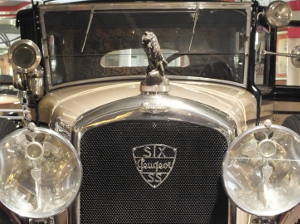
Photo above: French car manufacturer Peugeot has a long history
Who are the Partenaires sociaux in France? And what is a PME ? Or what is a PV ? And where is Picardy ?
Answers to these and other questions on this page of the dictionary of France.P.V. : see Procès Verbal below.
PACA - Provence Alpes Côte d'Azur : south eastern region of France, lying betwen the Rhone valley and the Italian border. Capital Marseille. This region includes the historic region of Provence, plus the French Riviera and southern Alps, and stretches from the Rhone valley in the west to the Italian border in the east. It is bordered on the north by the region of Rhône-Alpes, and on the south by the Mediterranean sea. It consists of the departments of Bouches du Rhône, Var, Vaucluse, Alpes Maritimes and Alpes de Haute Provence. See regional guide to Provence .
PACS
Pacte Civile de
Solidarité. In
legal and fiscal terms, a contract of civil partnership including most
of the features of a marriage contract, but open to both heterosexual
and homosexual couples. While originally introduced in 1999 to allow
same-sex couples to formalise their union, ten years later, in 2009,
over 90% of couples signing up to a PACS were heterosexual.
Pacte Civile de Solidarité, see PACS.
PAF - Paysage Audiovisuel Français - term used to describe the structure, or ‘landscape’, of TV and radio broadcasting in France
Panthéon - Former church of St. Genevieve, in the 5th Arondissement of Paris, next to the Sorbonne. One of the finest neo-classical churches in Europe, it has been used, since the French Revolution, as the burying place for many of the great of the nation, "les Immortels", including Voltaire, Victor Hugo and Emile Zola.
Parc Astérix, see Astérix
Parc National: National Park, protected natural area. There are six National Parks in Metropolitan France: French National Parks are characterised by their structure, since they are divided into two areas. At the centre of the Park lies a highly protected area, where visitors are discouraged, known as the heart (Coeur du Parc); outside this heart lies the peripheral area (called Aire d'Adhésion), which people are free to visit at leisure.
Parc Naturel Régional: A regional area of outstanding natural beauty, or environmental value. Natural Regional Parks are frequently but erroneously described as National Parks; it is however true to say that the environmental constraints and legislation applied in many Natural Regional Parks are similar to those applied in the peripheral areas of National Parks, or in non-wilderness national parks in other countries (such as Exmoor in the U.K.). There is no intrinsic reason why the "Cevennes" hills should have the status of National Park, but the "Parc des Volcans" just north of them be designated as a regional park; but that is the way it is. As "regional parks", the PNRs are the responsibility of the regions, not of the state.
Paris : the French capital city, on the river Seine. ► See Paris
Paris Match: Popular French weekly newsmagazines, Paris Match was founded in 1949. Originally a photonews magazine, concentrating more on well illustrated reports on national and international affairs, it has progressively moved in the direction of a showbiz and people magazine, though with a particular interest in the private lives of politicians and other public figures.
Paris-Nice : One of the great annual cycling races in France
Paritarism : a French democratic principle, whereby many important decisions in the world of business or public affairs must be taken by a commission paritaire, in which different interested parties (such as employees and employers, or the administration and users of a service) are represented, and have certain decision-making powers.
Parlement. The French Parliament, made up of the Senate and the National Assembly.
Partenaires sociaux : The various supposedly representative bodies that must by law be consulted during the preparatory phase of certain types of social and industrial legislation, and together manage certain institutions such as parts of the social security system. In short, the partenaires sociaux can be described as lobbies or pressure groups, representing on the one hand employers, and on the other hand trade unions. It can be argued that trade unions are not "representative" bodies in modern France, where union membership is down to just 7% of the workforce. Yet they continue to play a major role as partenaires sociaux, and in the absence of any more representative body, will doubtless continue to do so.
Partie civile; as in "se constituer partie civile". Legal expression. The concept does not exist in English or American law. A partie civile is a private party, individual or group, suing for damages or redress against the accused, in the context of a criminal prosecution brought by the public prosecutor (le procureur).
Pasqua, Charles born 1927 : French conservative politician, Minister of the Interior (home secretary) from 1986 to 1988, and again from 1993 to 1995. Pasqua enjoyed the reputation of being a hard-line no-nonsense conservative
Pasteur, Institut - Famous private medical and biological research institute, founded in 1887, by Louis Pasteur, the man who discovered the technique of vaccination. The institute is one of the world's leading research laboratories in its field, and was the first to identify the HIV virus. Pasteur researchers have received the Nobel Prizes on eight occasions.
Pastis: Aniseed-flavoured beverages have long been popular in France, particularly since the banning, for health reasons in 1915, of the popular and similar drink Absinthe. To this day, Pastis, of which there are two main brands, Pernod and Ricard, is still a very popular apéritif, particularly in the south of France. Pastis, which is a translucent amber colour when in the bottle, is generally diluted with about five parts of water, before being drunk. On dilution, it becomes a cloudy cream colour.
Pâté de foie gras : See Foie gras.
Patron: the word basically means the person in charge, and not a patron. Thus, the patron in a business context is the boss, and in a restaurant is the manager or owner. Les Patrons in the plural, or le patronat, means company directors. See also MEDEF.
Patrouille de France : the aerobatic display unit of the French airforce, similar to the UK's Red Arrows.
Paysan : This word is commonly used in contemporary French, and is not usually pejorative like the English word "peasant". It simply means ‘small farmer’. A synonym is agriculteur.
PCF, Parti Communiste Français: the French communist party, which in the late sixties was the principal party of the left in French politics, receiving over 20% of the popular vote. It has been in decline since the end of the Cold War. See Political Parties in France
PEA Plan d'Epargne en Actions : an investment portfolio savings account, in which holdings can be bought and sold without incurring capital gains tax until the account is closed.
Péage, section à péage: toll, or a section of toll road, on motorways or occasionally on bridges.
PEE See Poste d'expansion Economique
PEEP : the Fédération des Parents d'élèves de l'Enseignement Public is the second largest parents association in the state education system in France, with some 300,000 members (2008). Though it has almost as many members, it has far fewer delegates elected to school boards than the largest federation, the FCPE. The PEEP is generally reputed to be a right-wing, or conservative parent's association.
PEL Plan d'Epargne Logement: Savings account which, on closure, provides a loan at preferential rates for home-buyers, dependent on the amount of savings in the account and the time for which they have been held.
Pen, le. See Le Pen
Permis, le: Permit or licence or authorisation. The word is often used as a contraction of "permis de conduire", meaning a driving licence or drivers license. Passer le permis means to sit one's driving test. Do not confuse Permis de conduire with Permis de construire, which means a building permit.
Pernod-Ricard : In 2008, with the acquisiton of a Swedish company, Pernod-Ricard became the world’s leading wines and spirits company. The original founding companies of the group, Pernod and Ricard, are the two main manufacturers of Pastis.
Pétain,
Maréchal Philippe .
A First World War national hero, Pétain
was called
to the
rescue to form an "independent" government for the "free"
southern half of France, while the north was under direct Nazi
occupation. At the end of the war, members of
Pétain's
"collaborationist" Vichy government were arrested and put on trial for
helping the Nazis; Pétain himself was condemned to death,
but his
sentence was reduced to life emprisonment, on account of his age and
his earlier stature.
Pétanque.
The most popular form of the game known as boules,
pétanque is the French version of the English game
of bowls.
It
has been played in a fairly similar form since Roman times, and is
particularly popular in the south of France. The modern game is played
on a gravel surface using solid metal boules
about the size of a tennis ball. Unlike in the English game where the
balls are rolled, in pétanque they are usually lobbed. The
aim of the
game is to get one's boule
as close as possible to the jack, known as the cochonnet in
French. Though the game can be played on any patch of gravel surface,
many towns have special boules
areas known as boulodromes.
Petit déjeuner: Breakfast, à la française. The classic French breakfast consists of a mug or bowl of café-au-lait or hot chocolate, with tartines – bread, butter and jam – or croissants. In the last thirty years, cereals have also made their appearance on the breakfast table in a big way. It is very unusual for people in France to take a cooked breakfast, and hot dishes are not usually provided, even in hotels.
Peugeot : One of France's major automobile manufacturers. Peugeot, whose roots are in Montbéliard, in the Franche Comté region of eastern France, is today part of the PSA Peugeot-Citroën group, and is one of the biggest car manufacturers in Europe.
Pharmacie de garde : in most French towns, there is a pharmacie de garde, a chemists (pharmacists) shop that remains open at night and at weekends to deal with emergencies. the job rotates among chemists shops in a given area, and the address of the pharmacie which is "de garde" is normally indicated at weekends in each chemists shop.
Philippe, Edouard. Born 1970. Since 2017, prime minister of France, under president Macron. A socialist in his youth and early career, Edouard Philippe later joined the conservative UMP Party to work with moderate Conservative leader Alain Juppé, a former prime minister. He was elected as mayor of Le Havre on the UMP ticket. He was part of Juppé's team in the runup to the 2017 presidential election, and began by supporting François Fillon when the latter won the primary. However he quit the Fillon campaign when Fillon was accused of financial irregularities, and privately expressed support for Emmanuel Macron, the former economy minister in the Socialist government of François Hollande, who was running for the presidency on a cross-party ticket.
Picardie - Picardy : Picardie is a former region in northern France, lying between the Paris region and the English Channel. Its capital is Amiens. It is now part of the larger region of Hauts de France.
Pierre, l'Abbé 1912 - 2007 - Born Henri Grouès, Abbé Pierre (Abbot Pierre) was a French cleric, and founder of the Communautés d'Emmaüs, associations for the reinsertion of long-term unemployed and social misfits. He also founded the Abbé-Pierre Foundation, to provide housing for the socially excluded. He was by all acounts the most famous and popular Catholic priest of his generation in France, and was respected by all for his unceasing battle for human rights and dignity, and against social exclusion, and homelessness. When he died in 2007, it was suggested that he should receive a state funeral; but his supporters and family requested just a "national hommage". His funeral was celebrated in Notre Dame cathedral, in the presence of President Chirac and former President Valéry Giscard d'Estaing, and thousands lined the route of his funeral procession.
Pigalle - the red light district of Paris, at the foot of Montmartre. It is famous for its bars, striptease joints and cabarets, such as the world-famous Moulin Rouge.
PJ – (sometimes written Pégie) See under Police Nationale
p.j. - In an email, pièce jointe, or attachment.
Pivot, Bernard - Born 1935. French intellectual, literary critic, and presenter of a number of erudite but popular cultural programmes on French television, notably Apostrophes and Bouillon de Culture. In 2004, he was elected to the Goncourt Academy, the first non-author to receive this honour.
Plan DSK - Special type of savings and investment account, launched by Dominique Strauss Kahn, former socialist Finance Minister, and former (2008-2011) president of the International Monetary Fund.
Plan social - A redundancy limitation plan. Any firm larger than 50 employees that wishes or needs to lay off more than 10 employees is obliged to draw up a plan social aimed at limiting the number of redundancies and finding alternative opportunities for those that are laid off. A plan social must be drawn up following discussions between management and workforce representatives. It must be approved by the Labour Inspectorate (Inspection du travail) and may be challenged in court by employees, as often happens.
Platini, Michel, Footballer, captain of the French national team from 1979 to 1987, and team manager from 1988 to 1992. Platini played for the French first division clubs of Nancy and Saint-Etienne, before moving on to an international career at Juventus. He later went on to serve as chairman of UEFA.
PLM - Compagnie des Chemins de fer de Paris à Lyon et à la Méditerranée - the name of the most famous French railway company, which became part of the national SNCF in 1938.
PMA Procréation médicalement assisté - Assisted reproductive technology. PMA has been available in France since 2004 as a means of getting round infertility issues. In 2018 it accounted for some 3% of births in France. In 2018 and 2019 PMA has been a hotly debated issue as new legislation is put forward to open the process up to same-sex couples
PME - PMI - Petites et moyennes entreprises, petites et moyennes industries, the French designation of companies that, in English, would be referred to as 'small firms', or 'small and medium-sized companies', or - using the Euro-English expression formed from the French expression, 'SME's'. A petite entreprise is a company with less than 50 employees and a turnover of less than 10 million euros, and a moyenne entreprise is one with between 50 and 250 employees and a turnover not exceeding 50 million euros.
PMU : Centralised horse-race betting system. France does not have off-course bookmakers. Betting is done in cafés displaying the PMU logo.
Poher, Alain : (1909 - 1996) - Interim president of France following the resignation of General de Gaulle in 1969, and again following the death of Georges Pompidou in 1974. He acceded to the Presidency in his function of leader of Sénat, the the upper house in the French parliament.
Point, Le - Popular French weekly newsmagazine, founded in 1972 by a breakaway group of journalists from L'Express (q.v.). Very similar in presentation and look to l'Express, it is now established as one of the leading French political and general interest weeklies. In political terms it is centre-right, and in recent years has been a strident voice in favour of major reforms in French society and the economy.
Poivre d'Arvor, Patrick - see PPDA below.
Pole Emploi: the French network of Job Centres, or employment centres, created in January 2009 from the merger of the former ANPE and the Assédic.
Police: There are three main types of police in France, the Police Nationale (a civilian force), the Gendarmerie (a branch of the armed services), and the Police Municipale (local structures). The first two are national forces, under the control of the Interior Ministry. See individual entries for each service.
Police Municipale (see also Police) : Local police forces, under the orders of the local mayor, Municipal Police exist to ensure the maintenance of order in towns and cities, and the application of local bylaws. They have traffic duties, civil protection duties (often on bicycles), and community liaison operations. They also carry out certain legal and administrative formalities for citizens, in municipal offices. They can issue fines and parking tickets, and take statements.
Police Nationale (see also Police) : The main national police force in France. The principal remit of the Police National in France is the maintenance of law and order in French towns and cities (In rural areas, this is the responsibility of the Gendarmerie (q.v.)). The National Police force comprises six main operational divisions: Public security (the DCSP), by far the largest division, and responsible for everyday policing duties. The riot police (CRS, Compagnie Républicaine de Sécurité), the Police Judiciaire (PJ, or "Pégie"), responsible for criminal investigations, the border police (Police aux Frontières), the Police training service, and the surveillance department, known since 2008 as the DCRI (Direction Centrale du Renseignement Intérieur).
Polynésie Française, see French Polynesia
Polmar, plan Plan d'intervention contre la Pollution Maritime : contingency plan thet can be rapidly applied in the event of any serious indicent of marine pollution, such as an oil spillage, off or on the French coastline.
Polytechnique - One of the most prestigious and selective of France's "Grandes Ecoles", to all intents and purposes a super-university, which ranks among the best in the world. See Higher Education in France
Pompidou, Georges(1911 - 1974) President of France from 1969 until his death in 1974, successor to General de Gaulle. Conservative (Gaullist) Prime minister 1962-1968. The Pompidou years were the final phase of the truly Gaullist Fifth Republic; Pompidou was succeeded (after the brief caretaker presidency of Alain Poher) by Valéry Giscard d'Estaing who, although a conservative, was an Independent Republican, not a member of the Gaullist party.
Pompidou
Centre - Centre Georges
Pompidou : Also known popularly as "Beaubourg". Located
on Place Beaubourg, in the Marais district of Central Paris, the Centre Pompidou is
one of the most visited museums in Paris, thanks to its collection of
modern and contemporary European art, and its large public
reference library with facilities for over 2,000 readers, its theatres
and its lecture rooms. The glass steel and concrete building, designed
by the Richard Rogers partnership, and opened in 1977, is one of the
most remarkable examples of 1970's architecture. It is distinguished by
having most of its service infrastucture (lifts, escalators, utility
ducts) on the outside of the building.
In 2010, a satellite of the Pompidou
Centre
opened in the city of Metz, in Lorraine.
This brand-new museum shows a selection of works from the Paris
collection, including some of the finest, and also stages its own
exhibitions.
Pompiers: The French fire service or fire brigade. In rural France, les pompiers are the front-line emergency service, providing a rapid response to all kinds of accident, from fires to people breaking a leg on a hike. There are thousands of local fire brigades staffed by volunteers trained in first aid and essential rescue techniques; they are usually first on the spot in any rural emergncy. They will be aided by professionals from the nearest town, if this is necessary. Urban fire services are staffed by full-time professionals.
Pont l'Eveque - a type of soft cheese manufactured in Normandy; it is not unlike a square version of Camembert
Pont. A pont is a working day that happens to fall between a public holiday, jour férié, and a weekend. For example, if the Quatorze Juillet were a Tuesday, millions of French employees would "faire le pont" by taking the Monday off and making a long weekend .
Population: In 2001 the population of France was 60.7 million inhabitants, with an average density of 107 people per square kilometre, close to the European average. France contains 52 urban areas of over 150,000 inhabitants, the five largest being Paris (9.8 million), Lyons (1.4 million), Marseille/Aix en Provence (1.4 million), Lille (1.1 million) and Toulouse (0.9 million).
Porte de Versailles : one of the historic gates of the city of Paris, and now the location of the capital’s main exhibition ground, the site of many of France’s most important consumer and trade shows, known in French as “salons". One of the biggest annual events is the Salon de l’Agriculture.
POS - Plan d'Occupation des Sols - zoning or planning regulations applicable in a town or commune, specifying the type of building or construction acceptable in given areas - residential, commercial, industrial, none at all, or mixed. POS are supposed to be phased out and replaced by PLU's (local urban plans), but the changeover is not yet underway.
Poste, la. The French post office and mail delivery service. A nationalised service, today's La Poste was known, until recently, as les PTT, Poste, Télégraphe et Télécommunications; the PTT was divided up into its two principal constituents, the postal service and telecommunications, in order to prepare France Telecom for partial privatisation. La Poste benefits from a national monopoly in delivery of letters, but has become increasingly subject to competition from specialised companies for the delivery of parcels, and has now been transformed into a private company (S.A.). La Poste also runs a banking service, known as the Banque Postale (formerly the CCP).
Poste d'Expansion Economique (PEE) Name given to the Commercial Services of French diplomatic missions - embassies, consulates - abroad. French trade commissions.
Pousse-café: See under Marc.
PPDA,
Patrick Poivre
d'Arvor -
Long time anchor of the main evening news programme on TF1 television,
Poivre d'Arvor was for many years France's most respected and trusted
newsreader. He was replaced, amid much controversy, in 2009, by
Laurence Ferrari.
Précarité, les Précaires : Literally 'precarity", people in a precarious situation. The word précaires is used to describe people in France who live in a precarious working or social environment. The words are particularly, though not only, used in the language of the far left, for whom la précarité is seen as the byproduct of liberal economics, an inadmissable situation, applicable to anyone who does not have a secure job, a decent place to live, or enough money.
Préfecture (see also Préfet). Residence of a Préfet (Prefect), and building housing local offices of national government services. The word is also used to denote the chief town or capital of a Department or a region. For example, the city of Montpellier is described as the "Préfecture" of the department of Hérault, and the "Préfecture de région" for the Languedoc-Roussillon region .
Préfet …. (see also Préfet de Police, Préfet Maritime): the Prefect, the chief representative of central government in a French department. His official residence is the Préfecture. Until the Decentralisation Law of 1982, the Prefect was the appointed chief executive of local government in each department and region of France; since decentralisation, and the passing of powers and financial responsibilities to departmental and regional councils , the role of prefects has been greatly diminshed. Nonetheless, Prefects retain considerable powers in matters of public order, immigration, and emergencies. The prefect is also responsible for the organisation of territorial and national elections, and for ensuring that local authorities do not exceed their powers, but act within the framework of the law. Prefects are in theory required to be a-political and neutral, but many appointments are politically inspired.
Préfet Maritime: A special Prefect, in charge of France's coastal waters. Responsible for policing, coastal defence, environmental protection, and the general administration of coastal waters. There are three préfets maritimes, based in Cherbourg, Brest and Toulon.
Prélèvement: (banking) : Direct debit. Suppliers of ongoing services (utilities, insurance etc.) which are billed for varying amounts according to consumption, frequently suggest payment by prélèvement.
Premier Mai - May 1st, Labour Day, a public holiday in France, marked by processions in most towns, organised by trade unions.
Premier Ministre. The role of Prime Minister in France is not the same as that of the Prime Minister of Britain. While the British Prime Minister is politically (though not constitutionally) Britain's head of state, the French Prime Minister is only the head of the French government, and nominated as such by the President. Weekly meetings of the French cabinet (see Conseil des Ministres) are therefore presided over by the President, not by the Prime Minister. When President and Prime Minister are of the same political leaning ("left" or "right"), government policy will tend to be lead by the two; when they are from different political families (a situation known as cohabitation), the Prime Minister's role and decision-making power are considerably strengthened. The Prime Minister is responsible for forming the government, but the list of names has to be approved by the President. See Balladur, Barre, Chaban Delmas, Chirac, Jospin, Raffarin, Rocard, etc.
Première communion : First communion, the French Catholic rite of initiation into the faith, corresponding to the ceremony of confirmation in the Anglican church. Traditionally, girls dress in white, and boys in a smart suit for the ceremony.
Prépas: See under Classes Préparatoires
President.
The head of state, under the constitution of the French Fifth Republic (Cinquième république)
. The French
president is elected by direct universal suffrage, for a term of five
years in office. Since the 2008
constitutional reform introduced by President Sarkozy,
a president may serve no more than two five-year terms in office.
Election by universal suffrage was first introduced following a
referendum organised by General de Gaulle in 1962.
Originally the presidential term in office was seven years, with one
president, F. Mitterrand,
serving a full two terms. With presidential and legislative elections
operating according to different calendars, swings in the popularity of
parties and their leaders led in the mid eighties to situations or "Cohabitation",
with presidents and parliamentary majorities from different sides of
the political spectrum. In 2002, presidential and legislative elections
were held within two months of each other, each leading to five year
terms in office for those elected; thus president Chirac
emerged for a second term in office with a
solid parliamentary majority of his own supporters.
The president is responsible for choosing his
Prime Minister (see Premier Ministre),
who proposes a team of government ministers which the president must
approve. He is the chief of the executive, who oversees weekly cabinet
meetings (see Conseil des ministres), and
promulgates new laws. He is also the commander in chief of French
forces. He has the power to dissolve the National Assembly
and call legislative elections – a power used rather
disastrously in
1997 by Jacques Chirac, who
dissolved the Assembly in attempt to give his "presidential majority" a
rather less slender majority, only to see the Socialist
opposition voted into power.
In exceptional cases of national emergency,
Article 16 of the Constitution gives the president
the power to rule without the consent of parliament.
See
also Giscard d'Estaing,
Pompidou
Prestalis , known until 2009 as NMPP (Nouvelles Messageries de la Presse Parisienne) is a private company holding a virtual monopoly over the distribution of newspapers and magazines in France. Set up in 1947 with the aim of ensuring that all publications so wishing could benefit from guaranteed national or regional distribution, it today distributes over 100 dailies and over 3500 magazines, representing some 80% of the market - to some 29,000 points of sale in France. Prestalis's dominant position in press distribution has its drawbacks; the company has been attacked for abusing its position and for fixing minimum quantity levels for magazine distribution, making its services too costly for many niche market publications. Prestalis is a joint-venture owned by Hachette (49%) and France's main magazine publishers.
Priceminister.com
Leading
French peer-to-peer e-commerce site, founded in 2000.. Used by private
individuals as well as distributors offloading surplus stock, the site
is a haven for bargain hunters. Growth has been spectacular and by
early 2010 the company was employing 200 people at its Paris
headquarters, and the website attracting 23 million visits per month.
Since 2008 the company has expanded its activities to the UK and Spain.
Prime Minister, see Premier Ministre.
Prix littéraires, literary prizes : France has a long history of literary prizes, and today there are dozens of such awards. The oldest and most prestigious is the Prix Goncourt, first awarded in 1903 by the Académie Goncourt, a literary society established according to the terms of the will of the famous nineteenth century critic Edmond de Goncourt. Other famous prizes include the Prix Femina, created in 1904, and the Prix Renaudot, created in 1926.
Procès Verbal (P.V.) : A written record of something, most commonly the written notification of a fine (for instance, a parking ticket), or the minutes of a meeting.
Progrès de Lyon, Le : regional daily newspaper, founded in 1859, published in Lyon, and distributed in Lyon and the surrounding departments. Formerly part of the Hersant media empire, the newspaper currently belongs to the Est Républicain (EBRA) group. See Newspapers in France.
Promenade des Anglais. The seaside esplanade at Nice, on the Côte d'Azur. The esplanade took its name in the early nineteenth century, when the little fishing port of Nice (Nissa) began to become popular with the first tourists from England. Whereas the local population had seen the sea as a source of their livelihood, the first Anglais who came to stay saw it as leisure facility, and the sea front as a place to be admired. The beach being pebbly and difficult to walk on, the first tourists chose instead to walk back and forth just above the beach line, thus creating one of the world's first seaside promenades.
Prost, Alain. Racing driver. The most successful French Formula One driver of the second half of the twentieth century.
Protestantism, see also Eglise Réformée de France. Since the spread of Protestantism in the 16th century, France has always had a Protestant minority, sometimes tolerated, sometimes persecuted. The Revocation of the Edict of Nantes in 1685 led to a mass exodus of French Protestants (some estimates put the figure as high as a million), to neighbouring countries, and to the New World. Pockets of Protestantism survived in the Cévennes mountains of southern France, and in Alsace and the region of Montbéliard, in eastern France. These are France's main Protestant areas today.
Provence Alpes Côte d'Azur - (PACA) South eastern region of France, lying betwen the Rhone valley and the Italian border. Capital Marseille. See regional guide to Provence
Prudhommes. Conseils des.. : Local arbitration and conciliation committees, composed of elected representatives of employers and employees, and responsible for passing judgement in cases of workplace litigation, or claims of unfair dismissal.
PS - Parti Socialiste : the French socialist party, formed betwen 1969 and 1971, from the fusion of existing non-communist left-wing parties in France. Between the seventies and 2017, following the fading of the Communist Party, the PS was the principal party of the left in France, and formed a number of governments, the most recent of which was under the Hollande presidency, from 2012 to 2017. One of the founding members of the party was François Mitterrand, who was President of France from 1981 to 1995. During the presidency of François Hollande, the party became increasingly split between its radical left wing and its social-democratic centre-left faction. Between 2016 and 2017 it achieved a spectacular decline, going from being the party in power to a new position as one of a number of competing left-wing parties. In primary elections to choose a presidential candidate for 2017, party membership chose the left-wing Benoît Hamon; but Hamon had little appeal to the electorate, and could only manage fifth place in the Presidential election, taking just 6.7% of votes. A large number of the party's centrist membership left the P.S. to join Emmanuel Macron's En Marche movement, which then became the centrist LREM party, leaving the Socialists, who had been in power until 2017, as a fringe party of the left. See Political Parties in France
PSA The holding company of the Peugeot-Citroën automobile group.
PSU Parti Socialiste Unifié . Left-wing political party that existed from 1960 to 1989. On the political spectrum, the PSU was betwen the Socialists and the Communists, and as such was always a small movement. It's most prominent member was Michel Rocard (q.v.), who later, after joining the Socialist Party, became Prime Minister under François Mitterrand.
PTT, see Poste, la above.
P.V. : see Procès Verbal above.
Publicis : the biggest and most famous French communications and advertising company, founded in 1926. It is the third largest communications group in the world, and currently owns Saatchi & Saatchi, Bartle Bogle Hegarty, and other major advertising companies.
.
Check out the About-France.com
Online French Grammar
Free, full , clear explanations and lots of examples
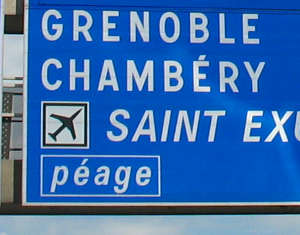
P is for Péage - indicating a toll motorway or bridge
Copyright notice: