- Explore France ►
- Essential pages
- Travel in France
- Tourism
- More about France
About-France.com
-
the connoisseur's guide to France
Political
parties in France
with a comparison to political parties in Britain and in the USA
Last update: April 2026
In 2027, France goes to the polls to elect a new President and a new parliament. The stakes are seen as extremely high, with the "worst case scenario" looking seriously likely in the eyes of many of the pundits.
2027: the worst case scenario
In the worst case scenario, the second round of the presidential election (in which the two highest-scoring candidates from the first round fight it out) will present French voters with a Cornelian dilemma, choosing between a candidate from the far right, and a candidate from the far left - with all moderate candidates ousted in the first round. Whether this will happen depends completely on how many candidates are fielded by the multiple parties that are between the far right Rassemblement National (RN) and the far left La France Insoumise (LFI).However, even if this does happen, it is likely - though not certain - that in the parliamentary elections that follow a month later, massive tactical voting (which has previously happened in second rounds) will deny an RN of LFI president anything close to a parliamentary majority to support him or her.
More
info: ► ► Understand the pivotal
French elections of 2027
2025-26 -
Nomination
of Sebastien Lecornu . After the
ousting of centrist PM François Bayrou in a no-confidence vote in late
2025,
President Macron rapidly nominated as his new prime minister Sebastien
Lecornu, a Macron loyalist from the start. Lecornu inherited
a very
poisoned chalice; voters were expecting cuts,
but not to be made poorer as a result. Bayrou had proposed a
raft of measures
designed to slightly reverse the decline (nothing radical, just a
reduction of the deficit from 5.8% to 5.4% next year), but the
measures,
including reductions to health care reimbursements and the suppression
of two of France's public holidays, were very unpopular,were
strongly opposed by both the right (National Rally and Republican
party) and the far left (France Insoumise), and led to a vote of no
confidence.
Bayrou was replaced by Lecornu. Four months later, Lecornu was proving to be an able Prime Minister, successfully getting measures through parliament and defeating no confidence votes from the left and the right.
Bayrou was replaced by Lecornu. Four months later, Lecornu was proving to be an able Prime Minister, successfully getting measures through parliament and defeating no confidence votes from the left and the right.
To outsiders, the French political system can often seem bewildering and difficult to follow. And that is hardly surprising; it is bewildering, even to most people in France.
Compared to Britain or the USA, France seems to have a plethora of political parties. Politicians, supposedly of the political right, may be heard defending positions more often held by political parties of the left in many other countries, and in recent French history, a good proportion of the economic liberalisation that has taken place in France has been pushed through by governments of the left. Even before the financial meltdown of 2008, French conservative governments were far more keen on economic intervention than their counterparts in the main English-speaking countries; and in 2008, some months after retiring as British prime minister, Labour's Tony Blair was enthusiastically received at a party political rally in Paris organised by the right-wing UMP party of President Sarkozy.
If you are already confused, that is not too surprising.
Yet perhaps even more confusing to outsiders is the fact that in France, a country that prides herself as a model of democracy, over a third of voters vote for extremist parties, either of the left or of the right.
Here therefore is a short guide designed to help outsiders understand the main French political parties, what they stand for, how they reached their current situation, and how they compare to apparently similar parties in the UK and the USA.
Most minor political parties are omitted from this overview. Such parties and movements come and go with a disconcerting regularity in France, sometimes lasting a decade or two, sometimes less than a year. For outsiders, they mainly serve to blur the main picture of politics in France. This article therefore only deals with the principal and most recognised political parties in contemporary France, to the exclusion of many small parties; even so, the situation may still seem a little hard to follow !
Important
note:
the word "liberal"
is used, in French politics, and therefore in this
article, in the sense of "economically liberal", or "free market
liberal"; "le
libéralisme", in contemporary French
political
vocabulary, is thus often seen as the opposite of "socialisme", and
the
Left in France use the word "libéral" as a term of abuse to
denigrate
the perceived "anti-social" policies of their right-wing opponents. In
this context, it is more or less the equivalent of "neo
conservative".... making it pretty much the opposite of the word
"liberal" as used in the context of US politics.
The mainstream right
The main "conservative" party is now known as "Les Républicains" - the Republicans. The then party leader Nicolas Sarkozy engineered a name change in 2015, designed to distance the new party from the old, the UMP - Union pour un Mouvement Populaire, which had been in turmoil since the 2012 election defeat.This is one of the largest political parties in France, and the reason that it has achieved this status is that like Britain's Conservatives and America's Republicans, it is a party that encompasses a fairly broad range of political opinion, including traditional conservatives, social liberals, and also a Thatcherite or neo-conservative right. It also projects itself as a "Gaullist" party, and the flagbearer of "Gaullism" in French political life. Gaullism can best be briefly summed up as a peculiarly French type of benevolent social conservatism, strongly patriarchal and nationalistic; but the Gaullism of the UMP and now of the Républicains, has moved well on from that.
In parliament, the Républicains were traditionally allied with the centrist (moderate) federation called the "UDI"; this was formed in 2012 from an alliance of the Radical Party and the "Nouveau Centre" , the latter being the rump of the UDF, the liberal-conservative party of former President Valéry Giscard d'Estaing, together with half a dozen smaller centre right and centre left parties. However in 2022, the UDI parliamentary group was dissolved, and though the party still exists, it does so as part of a centre right grouping calling itself Ensemble, with at its head former PM Gabriel Attal.
In recent years the Républicains have been in the doldrums. The party moved to the right when party militants in 2017 chose as the new party chairman Laurent Wauquiez, the furthest right of the candidates in the running. Wauquiez's election came after many more moderate party members went over to support Emmanuel Macron, who appointed as his first prime minister the moderate Républicain Edouard Philippe. While the party has tried to return to a more centre right stance since Wauquiez was replaced in 2019, it is still divided and has lost a lot of electoral support since the start of the Macron presidency. In 2021 party members chose a more moderate standard-bearer as their candidate in the 2022 Presidential election, but the candidate Valérie Pécresse is finding it hard to reestablish a party identity somewhere between the far right on the one hand and the centre right, now largely supporting President Macron, on the other.
The other centre right party is the MoDem, or Mouvement Démocratique (see Ensemble below), formed in 2007 when its leader, François Bayrou, and his supporters defected from the UDF to form their own social conservative party.
Although the main French conservative party is now called "Les Républicains", it would be quite wrong to imagine that it is a French version of the "Republican party" in the USA. The fact is that the whole political spectrum in France is further to the left than in the main English speaking countries. Though les Républicains are a party of the right in France, on the international spectrum of political positioning, most party activists and representatives would consider themselves closer, politically, to the Democrats than to the Republicans, if compared to their counterparts in the USA.
The Far Right
The far right in French politics is occupied principally by the Rassemblement National (formerly Front National) (National Front, founded by Jean Marie Le Pen, and currently led (2026) by his daughter Marine le Pen and Jordan Bardella. The RN (or FN) is a classic extreme right-wing party, campaigning on a ticket of national preference, law and order, and anti-immigration.Marine Le Pen made it through to the second round of the presidential election in 2017 and in 2022. However following her conviction in 2024 for misappropriation of public funds, Marine le Pen was barred from holding public office. She appealed the verdict, and won a reduction in her sentence, allowing her to run for the presidency in 2027.
For the 2022 Presidential election, the political geography of the far right was disturbed by the arrival on the scene of another far right party, called Reconquête (Reconquest), run by Eric Zemmour, a former journalist operating as a lone wolf candidate outside the framework of any political party, and by Jean-Marie Le Pen's niece Marion Maréchal . More outspoken than Marine le Pen, Zemmour was very much a single issue candidate, appealing to anti-immigration voters, with little in the way of policies beyond the question of immigration. In the 2024 European election, Reconquête took just 5% of the vote.
The Centre ground
► Ensemble
Since 2021, the
centre / centre-right parites in France have come together under an
umbrella party by the name of Ensemble.
In 2026, Ensemble is made up of three main parties, Renaissance (formerly En Marche), the MoDem, and Horizons, plus some smaller groupings.
In 2026, Ensemble is made up of three main parties, Renaissance (formerly En Marche), the MoDem, and Horizons, plus some smaller groupings.
Emmanuel Macron and "Renaissance"
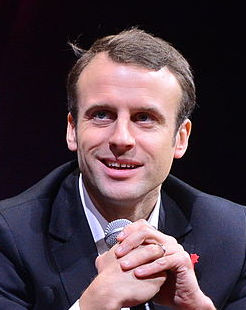
Emmanuel Macron - France's president
He achieved the "impossible" in traditional politics, reaching the runoff of a presidential election, and then winning it, without the help of any traditional or even new political party.
Though by 2022 much of the charisma had worn off, Macron has been presented as a French equivalent of Tony Blair or Barack Obama, a charismatic leader, a militant moderate at the centre ground of politics, an economic liberal with a social conscience, a great speaker, and someone with a massive ambition to succeed. But while Blair and Obama played by the old rules of politics, working their way up in a party and then moving the party in their direction, Macron played by new rules, building up his power base outside the traditional parties – a tactic of the "new politics" that has been up to now more frequently exploited by the far right - as with Nigel Farage in the UK - or the far left - as with Alexis Tsipras in Greece.
Macron's case stands out from the rest in so far as he is neither extreme left nor extreme right but – if the expression is not a contradiction in terms – extreme centre. His political enemies on the far left have taken to calling him, the former investment banker, the candidate of "extreme finance".
His case also stands out by the way that he rose to power so fast, and without the backing of any political party at all . Macron's machine, "En marche " ( In movement) was not a party, but a "movement", basically a grass-roots movement supported by hundreds of thousands of people across France who had become disillusioned by traditional politics and politicians. In this respect Macron is an anti-system politician, like Donald Trump or Nigel Farage ; but in other more significant ways Macron is a classic product of the French "system".
His parents were doctors; and he was educated at one of France's top lycées, the Lycée Henri IV in Paris. He later went on to the ENA (Ecole Normale d'Administration) - the graduate school attended by countless future French top civil servants, leaders of industry ministers and presidents. Following that he worked for Rothschilds, before being recruited as economic adviser by President Hollande . In this respect he is very much a product of the system – which is no doubt why he does not believe that the way to change the system is to defy it, but to change it from within.
Creating "En Marche" as a movement, not a party, was a masterstroke. It enabled men and women from other parties, from the Socialists, from the Modem, from the Greens, even from the Republicans, to give support to the Macron cross-party movement, while remaining members of their current party. Examples included former prime ministers Manuel Valls (Socialist) and Dominique de Villepin (Republicans), or Daniel Cohn Bendit (Greens) and François Bayrou (Modem) who all gave their backing to Macron even before the first round of the presidential election, while there were still official candidates from other parties in the running.
After his victory in the first round of the 2017 Presidential election, and facing a runoff against far-right candidate Marine Le Pen, Macron immediately received backing for the second round from both Republican candidate François Fillon, and Socialist candidate Benoît Hamon – and was endorsed too by outgoing president François Hollande.
Having won the presidential election, Macron then needed to ensure a majority in the French Parliament; to do this without a political party could have been a tall order, so out of the En Marche movement was born a new centrist political party, "LREM", or to give it its full name, La République en Marche. LREM went on to win an resounding absolute majority of seats in the 2017 general election. While many of its elected deputies were political novices, others were experienced parliamentarians from both left and right, who had already backed Macron in the presidential election, and joined the new party rather than go with the imploding Socialist party or with the Républicains who were moving further to the right.
► Renaissance
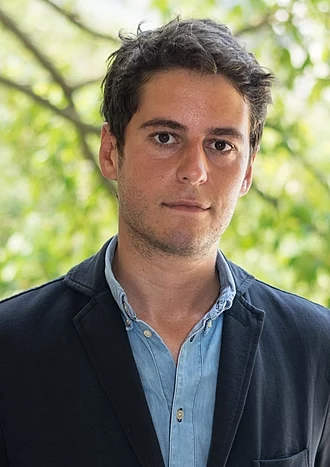
The name "LREM" was changed to Renaissance in 2022. Following a relative victory in 2022, when his party lost its absolute majority but remained the largest party in the National Assembly, Macron appointed Elizabeth Borne as Prime Minister. Borne saw through some very difficult and politically unpopular reforms, notably the new retirement laws, but to do so was obliged to use the notorious article 49.3 of the French constitution, which allows the government to create new law without parliamentary approval.In January 2024, Borne was replaced by Gabriel Attal, a rising star of French Politics and faithful Macronist - but also the figurehead of the centre-right Ensemble grouping (see above). Appointed at age 34, he became the world's youngest serving prime minister.
Following Macron's dissolving of the National Assembly in summer 2024, Attal was replaced by Michel Barnier who, later in the year was ousted in a no conficence vote, and replaced by the leader of the MoDem party François Bayrou. Bayrou lasted until September 2025, when he demanded a confidence vote in himself, and his plans to reform the French budget; and lost. He was replaced by a Macron loyalist Sébastien Lecornu.
In 2026 Gabriel Attal remains president of Renaissance
Other parties in the Ensemble grouping
► MoDem
Trying to weave a decidedly tricky course between the left and the right in French politics, former presidential candidate François Bayrou created the MoDem, or Mouvement Démocratique in an attempt to distance himself and his followers from the perceived "liberal" policies of President Sarkozy. This party really is in the political centre: but with just two deputies elected in the 2012 general elections, and Bayrou losing his seat, the Modem's future hung in the balance. Yet in 2017, Bayrou was an early backer of Emmanuel Macron in the presidential race. In December 2024, he was chosen by President Macron to lead a coalition government, but lost a vote of no confidence nine months later.► Horizons
Horizons is a centre-right very pro-European political party founded in October 2021 by Macron's first Prime Minister, Édouard Philippe. Within the framework of Ensemble, the party hopes to be a key player in the 2027 parliamentary and presidential elections.On the left
For
the 2024 general election, the Parti socialiste, the Greens, France
Insoumise, the Communists and the NPA fielded joint candidates in
most constituencies under the label Nouveau
Front Populaire - a name that evokes the 1936 Front Populaire
which, under Léon Blum, brought the Socialists and Radicals to power in
an unexpected election success.
The main party of the left is the Parti Socialiste, or Socialist Party (PS); formed in 1969 by the alliance of existing parties of the non-Communist left, the Socialist party had much in common with the old Labour Party in the UK, before it turned into "New Labour". As was Britain's Labour Party in the Wilson / Callaghan years, the Parti Socialiste was very much a socialist party, believing in nationalisations, a strong welfare state, and participative democracy. This was the ticket on which François Mitterrand was elected in 1981 as the first Socialist President of the Fifth Republic. The Socialist governments of the 1980s and 1990s moved slowly away from the "old Socialist" model, first nationalising sectors of the economy, then doing a U-turn and developing a policy of privatisations; but the party never really turned itself into a modern social democratic party in the way most other European socialist parties did. Its failure to modernise led it to a series of electoral mishaps and disasters from which it has not (so far?) recovered.
In 2009, the party took less than 15% of the national vote in the European elections; it was riven with strife between modernisers, reformers and traditionalists, and was looking not just for a leader to pull it out of the doldrums, but also a convincing political strategy that will appeal to voters.
In October 2011, after what can only be described as a successful process of American-style primary election, party members and sympathisers chose moderate former party-leader François Hollande to be their candidate in the 2012 presidential elections. Hollande beat runner-up Martine Aubry convincingly in the second round of the two-stage process. He then went on to win the 2012 Presidential elections, and spearhead a return of the Socialists to power following victory in the ensuing general election.
However, having failed singularly to turn round the French economy, and overseen a worsening of unemployment, Hollande saw his popularity ratings sink to a record low by the end of 2014.
In 2014 Hollande appointed a new modernising centre left prime minister, Manuel Valls, to put through some unpopular but much-needed economic and social reforms. However the appoitment of Valls led to an increase of tensions within the Socialist Party and open rebellion by the left wing of the party. Ensuing in-fighting between the hard left and the modernisers has left the party struggling to preserve a semblance of unity. In departmental elections in March 2015, the party lost control of almost half the departmental councils they previously controlled. In the presidential and general elections in 2017, led from the left by a new leader Benoît Hamon, they performed very poorly, losing most of their seats in the French parliament.
At the start of 2022, in the runup to the spring elections, the Parti Socialiste remained weak and divided, with the designated presidential candidate Anne Hidalgo struggling to get into double figures in the opinion polls. However, in 2024, the party was reinvigorated by an up-and-coming figure, the MEP Raphaël Glucksmann.
Historically, the other main party of the French left had been the Parti Communiste, or communist party (PCF). In the 2012 elections, the Communists - with their allies of the Front de Gauche - only managed to win 10 seats in the French parliament - down from 17 in 2007. Long considered as stalinist, the party did not abandon its attachment to the soviet social model until 1976, shortly before it entered government as a minor partner to the Socialists.
Unlike the Italian Communist Party, the French Communist Party did not reinvent itself after the fall of soviet communism in the 1990s; the result was a series of internal fractures, with the once monolithic party splitting into different factions, the refounders, the reformers and the orthodoxists. Once attracting over 20% of voters in French elections, the PC now attracts less than 5%.
The other main party of the centre left is EELV - Europe Ecologie Les Verts, or the Green Party. Thanks to an electoral pact with the Socialists, the Greens won 18 seats in the 2012 legislative elections, but were not part of the government. Their great strengths are as a party of local government, with key positions in many city councils, and as a party in the European parliament. The mainstream French Green party has traditionally been an ally of the Socialists, though other French greens, and indeed other environmentalist parties, are allied to the centre or the centre right. But with environmental issues fast becoming a major platform for all main political parties, the survival of the Greens as a political force in their own right is not guaranteed. The party virtually fell apart in 2016 on account of internal rivalries and splits between those wishing to hang on to some kind of power through an alliance with the Socialists, and those wanting the Green party to go it alone. In 2017 former EELV leader Daniel Cohn-Bendit supported Emmanuel Macron.
After doing very well in local elections in 2020, when they took the town halls of several major French cities, including Bordeaux, Grenoble and Strasbourg, the Greens have regrouped and were able to conduct an orderly selection process to choose their candidate for the 2022 presidential elections. In this, the MEP Yannick Jadot, reputed to be a pragmatic centrist Green, narrowly beat his more radical left-wing rival Sandrine Rousseau, giving rise to fears that some of the Greens' more militant supporters may go over to La France Insoumise (see Far Left, below).
The Far Left
Both the PS and the PCF have struggled to maintain credibility as left-wing parties, faced with the rise of social democracy in the political centre, and the emergence of new "extreme left wing" parties to their left. The Far Left (Extrême gauche) has long been a resilient and active force in French politics, and parties such as Lutte Ouvrière (Workers' Struggle) and LCR (the Revolutionary Communist League) have attracted support – and sympathy – in a way that similar parties in most other European countries could only dream of.More recently, with the ageing of their historic leaders, these parties have given way to newer structures. One, the "Parti de Gauche" (PG) founded in 2008 had two deputies, dissident members of the Socialist Party; another, the NPA (Nouveau Parti Anticapitaliste), was founded in 2009, to propose a complete economic alternative to current forms of western society. For the 2012 elections, the PG aligned itself with the Communists under the title "Front de Gauche" - picking up 10 seats, essentially in traditionally communist-voting parts of France.
For the 2017 and 2022 elections, the PG and the Communists fell in behind firebrand ex-Socialist Jean-Luc Mélenchon to campaign in the presidential election under the banner "La France Insoumise" (Unsubmissive France alternatively known as France Unbowed), an anti-capitalist anti-system anti-European movement of the far left. Mélenchon - who is an excellent orator and comes over well in TV debates - surprised the pundits by taking 19.5% of the vote; in 2022, he took 21.95% of votes..
In 2026, Mélenchon remains the most high-profile figure on the left in French politics, but just as controversial.
About-France.com
Home
page - Site search
- Regions
- Maps of France