The Tour de France - 2010 |
About-France.com
-
more than just a travel site. A
thematic guide to France - in English |
| About-France - home | Guide to Paris | French route maps | French travel and tourism |
2010
France's greatest sporting event
The
Tour de France is certainly the world's greatest cycling race; if you
are visiting France in July, it is a free spectacle that may well be
coming to a town or a road near you! Each year, hundreds of
thousands of locals and holidaymakers turn up in spots all round France
to watch not just the cyclists, but also the great "caravan" of floats,
cars, media and officals go by....In 2010, many people in France are
hoping that the glitz of the Tour will help help them get over the
fiasco of France's football team at the world cup in South Africa....
Le Tour 2010 the route
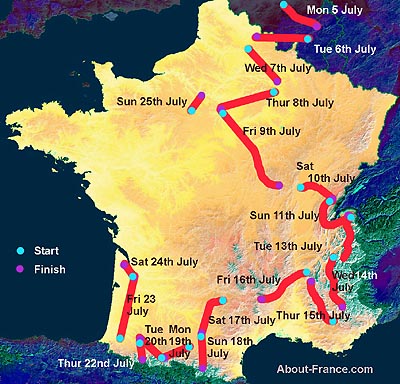 Map free to copy. Please credit About-france.com Map by About-France.com superimposed on enhanced NASA satellite photo of France. |
The 2010
Tour de France
set off from Rotterdam, in the Netherlands, on July 3rd 2010, and will
finish in Paris on July 25th. It was the first time that the tour has
visited the Netherlands. All the foreign stages of the race have now
taken place, and riders now stay in France until the end of the Tour de
France in Paris. The mountain stages will take place in the
Jura,
the Alps and the Pyrenees, plus a stage across the Cevennes. The race can be watched anywhere along the route: near the start of the day's leg, riders tend to be very bunched, and the actual race passes in about a minute. Towards the end of a leg, riders are more spaced out, so the thrill of the race lasts longer. However most of the spectacle comes not from the riders themselves, but from the "caravan", an hour-or-more long procession of cars, floats and motorcycles from the Tour's sponsors and the teams. It's all very commercial, with freebies being thrown out to the spectators; cheap baseball caps, little packs of sweets, mini-pretzels, keyrings and other gimmicks. It's interesting to watch, and the kids love it. But if its the actual race you want to see, then it's far better to watch it on TV where the cameras follow the riders from start to finish. If you go to watch the Tour, specially with kids, take care! Don't let children stand too close to the road, and never cross the road while the caravan is passing. |
The 2010 Route:
For the record: route of the The Tour de France 2008 : Tour de France 2009 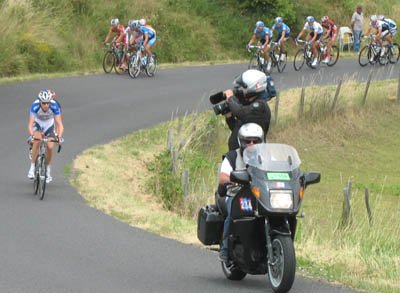 With
almost 200 cyclists, including many of the world's best, the Tour de
France - which first took place in 1903 - is certainly a great sporting
event; nonetheless, it is an event that has been marred - even heavily
marred - in recent years by doping scandals, with cyclists proving
positive in anti-doping tests. The 2008 race was no different from
others, and at a small number of competitors were withdrawn from the
race following a positive doping test. With
almost 200 cyclists, including many of the world's best, the Tour de
France - which first took place in 1903 - is certainly a great sporting
event; nonetheless, it is an event that has been marred - even heavily
marred - in recent years by doping scandals, with cyclists proving
positive in anti-doping tests. The 2008 race was no different from
others, and at a small number of competitors were withdrawn from the
race following a positive doping test.
Yet in spite of the doping scandals, and the withdrawal in
recent
years of certain major teams, the "Tour" goes on, and it is difficult
to imagine how it could not. This mega sporting event is worth millions
of Euros in advertising, sponsorship and worldwide television rights,
attracts millions of spectators, and is one of Europe's great media
circus acts.
For the hundreds of thousands who turn up to line the route, the cycling is actually only a tiny bit of the show: While the time-trial races may offer a more long-drawn-out cycling experience for spectators, with competitors taking part one by one, on normal race days the riders may go past in just a minute, especially in the earlier part of a day's leg, before the participants have become more spaced out. But then, the actual race is just a small part of the show. Starting some two hours before the race, the "Caravan" is a cavalcade of floats, decorated cars and other vehicles that moves along the route, throwing out goodies and free samples to the spectators; it is a massive advertising stunt. The advertising caravan, made up of the Tour's official sponsors, is followed by a long line of official cars, technical vehicles, media and motorbikes, lights flashing, horns sounding, all warming up the spectators for the actual event itself. Then, at last, the riders come by - and are gone again as quickly as they appeared, pounding uphill or downhill at speeds that can reach 50 mph or more. A bit of an anti-climax.... And with that, the day's excitement is over. Anyone wanting to watch the race in a serious manner would be well advised to do so on television; but for a day's outing, with all the fun of the crowds, the waiting, the caravan, and the atmosphere, watching the Tour go by is as good as many other events, and what's more it's free. The Tour can be watched all over France, and each year the route is different, taking in at least one leg in another country. The 2010 Tour covers a distance of 3596 km, in 21 stages, about 150 km longer than the 2009 route.. The most exciting legs of the itinerary are those that take place in mountainous regions of France. The principal mountain stages in 2010 are stages 8 and 9 in the Alps, and stages 14 and 15 in the Pyrenees. However stages 7 (finishing at le Rousses, a Jura ski resort), 10 in the Vercors, and stage 12, crossing the C�vennes, also include some good uphill climbs. Tourists wanting to book holiday accommodation along the route are advised to do so early. Click here for holiday cottages or for bed and breakfast accommodation in France. Visit the Official site of the tour de France Tourist attractions in France, by region : France in general: The main historic monuments and tourist attractions in France Follow these links for a more detailed list of major tourist attractions in the following regions: Paris tourist attractions Alsace tourist attractions Auvergne tourist attractions Brittany tourist attractions Burgundy tourist attractions Franche-Comté tourist attractions Tourist attractions in Languedoc-Roussillon Tourist attractions in Limousin Tourist attractions in the Midi-Pyrenees region Tourist attractions in Normandy Tourist attractions in the Pays de la Loire Tourist attractions in the Poitou-Charentes region Provence tourist attractions A brief introduction to the regions of France |
Advertisements ***
***
 |
Copyright About-France.com 2009 - 2010
| ►► Site guide |
| About-France.com home |
| Full site index |
| About-France.com site search |
| ► Cycling in France |
| ►► Principal chapters on About-France.com : |
| The
regions of France Beyond
Paris, a guide to the French regions and their tourist attractions.
|
| Guide
to Paris Make
the most of your trip to Paris; Information on attractions,
Paris hotels,
transport, and lots more.
|
| Tourism in France
The
main tourist
attractions and places to visit in France - historic
monuments, art galleries, seasides, and more
|
| Planning a trip to
France
Information
on things to do before starting your trip to France..
|
| Driving in France
Tips
and useful information on driving in and through France - motorways,
tolls, where to stay....
|
| Maps of France
Cities,
towns, departments, regions, climate, wine areas and other themes.
|
| The French way of
life
A
mine of information about life and living in France, including working
in France, living in France, food and eating, education, shopping.
|
| A-Z dictionary of France Encyclopedic
dictionary of modern France - key figures, institutions, acronyms,
culture, icons, etc.
|