
Paris on the cheap - 2024
Get
best value for money in Paris
How to
get by without spending too much
- Explore France ►
- Visiting Paris
- Stay and get round in Paris
- France beyond Paris
- More useful pages
About-France.com
- the connoisseur's guide to France
PARIS ON A LIMITED BUDGET - How to do more for less
Special Paris budget travel advice - 2024. Unless you have no option, avoid Paris during the Olympic period, 20 July 2024 to 8 September 2024.
► See also: Paris for Free
| Jump directly to .... | ||
| Budget accommodation | Budget travel | General tips |
| Paris on About-France.com |
| Essential tourist information |
| How to get round in Paris |
| Things to see in Paris |
| What's where in Paris?s |
| Where to stay in Paris |
| Paris airport connections |
| A week in Paris |
| Paris in the Spring |
| Paris for free Things
to see and do in Paris without spending a single euro
|
| The quarters of Paris |
| Disneyland Paris |
| A week in Paris |
| Paris with children |
| Paris car hire |
One thing is certain, and that is that it's worthwhile booking things up well in advance. Travel tickets, hotels, and even - if you plan to visit lots of things and don't want to waste hours queuing to get in to the main museums and monuments, a visitor pass.
Leaving everything until last minute, or even until you reach Paris, will be more expensive, may be very frustrating, and will cost more.
Before booking your trip to Paris, before booking a hotel, the first thing to do is to decide if you want to stay in the city (and as Paris is a living European city, there are plenty of residential quarters and plenty of hotels throughout Paris "intra-muros"), or in the suburbs. You may even decide that it is in your interest to stay well outside Paris, and come in on a fast train for the day.
Budget accommodation in Paris
Hotels for your budget and your lifestyle
- Check out our selection of good value Paris hotels. covering all categories of hotel
- Or prefer our choice of cheap Paris hotels. (Just inexpensive hotels, mostly 1 or 2-star)
- or discover small Paris hotels on the iHi independent hotel guide.
- or for a different style altogether check out our choice of Paris backpacker hostels (including youth hostels)
Staying in central Paris: Advantages: access, time. If you are young and energetic, or even not-so-young and energetic, you can walk to and between a lot of the Paris tourist attractions. You'll save the cost of public transport, and the time and cost of commuting into the city. You'll also see a lot more of the city, as long as your eyes aren't glued to the sidewalk or pavement.
Disadvantages: hotels near the tourist areas are generally quite expensive; cheaper hotels are often in less attractive areas of the city, far from the tourist sights and attractions, or else on the edge.
P If you come to Paris by car, parking will be a major extra cost. Few central Paris hotels have their own parking facilities, and those that do tend to be at the higher end of the price range.
Staying in the suburbs of Paris: Advantages: hotels and hostels will on the whole be cheaper, and hotel rooms may be bigger.
P Hotels in the suburbs tend to have parking space, often free.
If you choose a hotel or hostel that is near a train station, access to central Paris can be relatively easy and quick. Check out hotels in the south east and south west suburbs. There are many suburban hotels belonging to the cheap budget chains such as Première Classe or Formule 1. Check out Paris hostels too.
Or check out this interactive outer Paris hotel map that only lists independent hotels with parking, often free, and within easy walk of a train or RER rapid transit station for central Paris.
Disadvantages: check that the cheaper room cost is not offset by the extra travelling costs - though remember that it is advisable not to take your car into Paris. Also, if you stay outside Paris, you'll have less time to enjoy Paris by night.
Budget travel round Paris - 2024
- Buy a book of metro/bus tickets
for use in central Paris .Paper carnet tickets have been phased out,
but carnets and tickets can be downloaded to your phone. For
more on this see below under "Do".
Alternatively, walk or use the Velib bike hire system. - Buy a Paris Visite transport pass Zones 1-3 + a Paris Museum pass for two days, which will cost 24.30 € + 55 € - total 79.30 €uros (Jan 2024 price), which is less than the cost of the Paris City Pass... but with less scope..
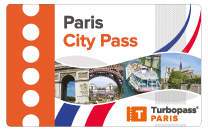
- However, the Paris City Pass (special 5% off with About-France.com - quote code aboutfrance) , which is the cheapest of the all-in Paris passses (starting at 109.90€ for two days - adult rate), does include some other attractions, such as a Seine cruise, and is a good buy if it is important to save time and get a lot in to a short stay in Paris.
- Hop-on hop-off sightseeing bus pass The Open-Tour /Cityrama service, has a choice of hop-on hop-off passes from 45 € for one day or 59€ for two days, and covers three different routes (plus optional Batobus service on the Seine).
- The "Batobus" and travel on the Seine. The Batobus are river buses that go up and down the Seine from the Eiffel tower to the quai de Montebello (near Notre Dame). There are 8 stops in all. A day pass at the start of 2024 costs 23€ (children 13€) , and a 2-day pass costs 27 € per adult. Tickets from Batobus or from Tiquets
► Don't buy
the Paris
Visite
bus and metro pass online
in advance, buy it when you arrive. Apart from the official
site, other sites selling this pass charge inflated prices and
high delivery costs.... up to 29.90 € for delivery to North
America,
and even more for "rest of the world". You can buy the pass at
airports, main train stations, and all Paris urban transport stations.
What to see and do in Paris:
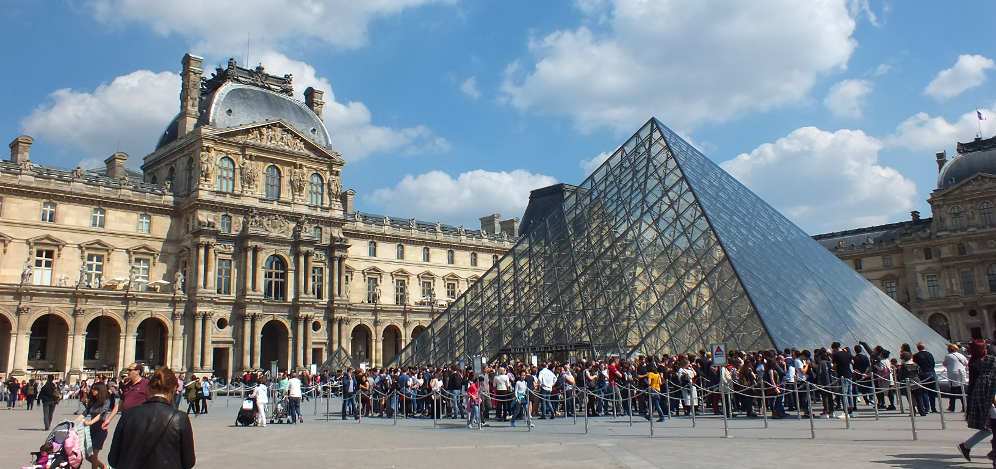
If your budget is limited, visit the Paris for Free page. Even the Louvre is free, if you know when to go or - in many cases - if you are under 26 !
General Budget Paris tips:
The dos and don'ts to make your dollars or euros or pounds go a bit further......Do.....
- Book your hotel in advance so you have time to get a good rate. It is possible to find a two-star hotel or a one-star hotel double room for under 80 €uros a night, and hostel accommodation even cheaper... though difficult at peak periods
- Use ordinary public transport - and buy yourself or yourselves a "carnet" of T- tickets usable in Zones 1-3 (Paris city) with no time limit. . IMPORTANT Paper tickets are being phased out and carnets are no longer on sale. For journeys within Paris tourists are advised to buy a rechargeable Navigo Easy pass (cost 2€) which can then be loaded with e-tickets (including an e-carnet) in ticket machines in most stations. But take care. Each traveller needs an individual Navigo Easy pass; you can't run the same pass twice through the ticket reader to let two people through.
- Visit the great free attractions of Paris - Notre Dame cathedral, Montmartre, the banks of the Seine, wander along the Champs Elysées and more. There are also free museums, including the Petit Palais just off the Champs elysées, with its Monets and impressionists and more. Many major museums are free on the first Sunday of each month.
- Eat your main meal at midday - when many restaurants offer a full meal for less than 15 €uros; Chinese and Vietnamese restaurants are particularly good value. Take something simpler in the evening.
- Pay by credit card or in cash that you get from an ATM (check your own bank's charges for foreign transactions)
- Check out the list of free concerts in parks and churches, specially in summer.
- View Paris from on high by touring round the "metro aérien", the elevated metro (particularly lines 2 and 6) which circles round inner Paris, above the boulevards, at second story level. A normal ticket is all that is needed.
- Drink at the bar. Many Parisian cafés charge less for customers who stand at the bar than for those who get served at a table.
- Use the Velib bike hire system - but take care. Use it correctly, and it will just cost 1 € a day.
- Don't take a coffee or a beer at a pavement café on the Champs Elysées, or any other tourist trap.
- Don't take breakfast in your hotel, unless they are charging less than 9 €uros. go to the nearest café; most cafés offer a light breakfast.
- Don't eat in glitzy boulevard restaurants in the evening;
- Don't use taxis for short trips
- Don't try to exchange foreign cash or travellers cheques - not even in banks. But if you have to, avoid changing small sums, as the commission is often a flat rate.
- Don't go to the top of the Eiffel tower: the views are already pretty spectacular from the second level (see Eiffel tower ticket prices)
- Don't try to find a hotel when you arrive. Book one in advance.
- Don't use the Velib bike hire system unless you realise how it works.
Click here for Paris tourist attractions info : Notre Dame, the Louvre, Montmartre, Moulin Rouge, and much more. Or see the Eiffel tower info page,
Copyright © About-France.com 2007-2024
About-France.com
Home
page - Site
search
- Regions
- Maps of France
- Contact
The About-France.com guide to
Paris:
getting round Paris, main tourist attractions and other things to see
and do .
In
an emergency
in Paris:
24
hr chemist / pharmacies:in Paris:
a) 84, av des Champs-Elysées 75008, tel
0145 62 02 41
b) 6, place Clichy 75009, tel
0148 74 65 18 .
English-speaking pharmacies:
British Pharmacy
62, Avenue des Champs-Elysées
75008 Paris
0143 59 22 52
British-American pharmacy,
1 rue Auber, 75009
0142 65 88 29
English-language crisis line;
SOS-Help
Daily 3 pm - 11pm
01 46 21 46 46
Ambulance:
Call/phone: 15
Hospitals:
Hertford British Hospital: 3, rue Barbès, 92300 Levallois-Perret
Tel 0146 39 22 22
American Hospital of Paris
63, Bd Victor Hugo
92200 Neuilly-sur-Seine
0146 41 25 25
About-France.com
is an independent user-supported website that does not track visitors
and does not
show any
personalised advertising, Pages may contain affiliate links to selected
partner websites from which commission may be earned, at no cost to the
user.
About-France.com is an affiliate partner of leading booking and ticketing portals, and may earn a small commission from bookings made through these third-party websites.
More useful pages
Paris travel maps
View or print out a plan of the metro system in the central area of Paris.
Interactive tourist map
Easily find what's where with this interactive map of Paris tourist sites
Train travel within France or to France
Information in English for train travel in or to France. Tickets can be bought online in advance, but how to buy them depends on where you are.
Paris travel maps
View or print out a plan of the metro system in the central area of Paris.
Interactive tourist map
Easily find what's where with this interactive map of Paris tourist sites
Train travel within France or to France
Information in English for train travel in or to France. Tickets can be bought online in advance, but how to buy them depends on where you are.
Disneyland
Paris... just click

The
Louvre museum, and its glass pyramid.