
For drivers in France - a checklist
Papers, equipment ... what you must have with you when driving in France
- Explore France ►
- KEY PAGES
- Where to go
- How to get there
- More about France
About-France.com - the connoisseur's guide to France
This
page provides an initial checklist: for a lot more tips and
useful information, visit the main Driving
in France page on About-France.com
Travelling by car through
France is perfectly easy, and does not need any specific
preparation. Nevertheless, there are a number of things that need to be
seen to before starting your journey - particularly if you are coming
from the United Kingdom or the Irish Republic, or another country where
cars drive on the left.Checklist :
Choose where to stay in
rural France
French gite and B&B locator maps
Here is a quick checklist of the points to see to before you leave. For
details see below.rural France
French gite and B&B locator maps
Book directly in
English with the owners
Gitelink.com
- Driving licence
- Proof of vehicle ownership or hire
- Vehicle insurance
- Headlamp beam deflector
- Spare set of bulbs
- Breathalyzer kit
- Hazard warning triangle (breakdown triangle)
- Spare set of car keys
- High-visibility waistcoats
- Vehicle condition
- Maps or Satnav with info on road restrictions for anything other than a car
- ►
Driving
licence.
When driving in France, you will
need a
recognised full and valid drivers
licence.
An international licence
(an IDP) is not required for short term visitors (up to 90 days) from
countries
of the EU, EEA, the UK (post Brexit) , USA, Canada; however it is
either recommended or else
required for visitors from other countries. For specific details, check
with the local French embassy in your country of origin.
NB: The minimum age for driving in France is 18, so drivers under the age of 18 cannot drive in France, even if they have a full driving licence issued in their own country. -
Find hotels in FrancePersonal ID. Anyone visiting France must have a valid personal ID card. For visitors from countries like the UK which do not issue ID cards, a valid passport is required. Travellers not holding a European Union or North American passport may need to obrain a tourist visa. For further details consult this official French foreign ministry website in English.
Calais
Click for best online rates for hotels near the following towns on main motorway routes.
Reims
Dijon
Beaune
Lyon
Rouen
Orleans
Tours
Limoges
Poitiers
Bordeaux Clermont-Fd.
About-France.com is partnered with Europe's leading hotel booking portal, Booking.com, to bring you the best online prices - For longer stays, standard EU driving licences remain valid, but holders of driver's licenses from non-EU countries will probably need to obtain a French licence. Again, check with the French embassy in your country before starting off on your trip.
- ► Proof of ownership, This is the car's registration certificate (for cars registered in the UK, the V5C certificate). If stopped by the police, you may well be asked for the "Carte grise" (grey card) : it is the vehicle's registration certificate that you are being asked to show.
- ► Proof of insurance. The standard international and European insurance document is the "Green Card", and drivers from Europe (including the UK) should make sure that they have a Green Card from their insurer before entering France. UK insurers may provide this free, or may charge extra. Within the EU, standard vehicle insurance is valid throughout the Union, but only provides basic insurance for your vehicle (third party cover) unless otherwise stated, whether or not a green card is provided. As regards the extent of you vehicle insurance cover, you should check with your insurance company before setting off for France or beyond. Many insurance policies that are comprehensive policies in the UK only provide third party cover when the vehicle is taken abroad.
- Many UK motorists like to take out extra holiday insurance, such as that available from the AA, to cover the costs of emergency repairs and/or repatriation of the vehicle and passengers in the event of a major mishap. Click to visit the AA website.
- ► Headlamp beam deflector. Depending on your car, visitors from the UK or Irteland will either need deflector patches or have to adjust the beam manually. In the UK, headlamps dip to the left, which is a big problem when driving at night on the continent, as that means they dip into the path of oncoming traffic. Beam deflectors (often just a bit of opaque tape to stick on a part of the headlamp) correct this.
- ► Spare set of bulbs. Though it is highly unlikely that you will be stopped and asked to show your spare set of bulbs, and though it is not practical to carry spare sealed-beam units that require a garage visit for fitting, French rules of the road require cars to carry a spare set of bulbs. Many French drivers do not carry them.....
- ► Breathalyzer kit. or alcohol level test. In theory, it is obligatory to carry one of these - but there is no penalty for not having one.
- ► Hazard warning triangle. All vehicles must carry a red reflective breakdown warning triangle that can be placed at a suitable distance behind a car if it is immobilised on the highway or hard shoulder
- ► Spare set of car keys. Not obligatory, but highly recommended. After all, it would be unimaginable hassle to lose your keys, then have no way of getting into your car... or once in it, of starting it.
- ► High viz waistcoats. All cars are required by law to carry a high-visibility waistcoat or jacket (fluorescent yellow or orange). Hi-viz jackets must be carried IN the car, not in the boot (not in the trunk), so that they can be slipped on immediately by any driver or passenger who needs to get out of an immobilised vehicle, notably on a motorway or main road.
- ► Vehicle condition . Don't set out on a long journey to France or beyond, to Italy or Spain or wherever, without having first had your car serviced or checked. In particular, check tyre pressure and condition.
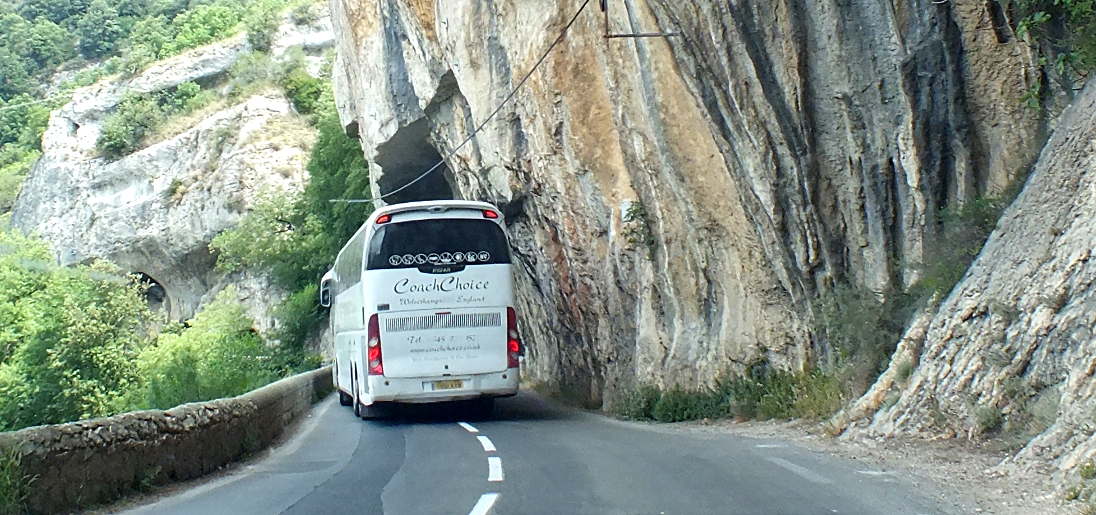
- ► Maps or Satnav . One or the other of these is always advisable, even if you are planning a simple journey on motorways or main roads. Detailed local maps can help you in the event of the unforeseen. They can also help drivers of larger vehicles - coaches, HGVs, caravans or motorhomes - avoid unsuitable roads before they actually reach them... unlike the driver in the photo at the top of this page! Satnavs are quite good at forgetting to mention bits of vital information, such as low bridges or narrow bridges on minor roads.
- ► Emissions quality sticker . These are required for vehicles driving into many French cities during weekdays, or in some other cities on poor air quality days (mostly in winter). Stickers can be ordered directly from the official French government agency for less than 5 € including postage within Europe..
► Much more key information on driving in France
Visit the main About-France.com Driving in France page, for much more useful information on taking a car to France, including information on:
French
motorway tolls
Road numbers, roadsigns and secondary routes
Avoiding Paris
Avoiding heavy traffic
Petrol prices in France
HGV restrictions
Speed limits & cameras
Routes south from Calais
Stopping for the night
Accidents - what to do in the event of an emergency
plusRoad numbers, roadsigns and secondary routes
Avoiding Paris
Avoiding heavy traffic
Petrol prices in France
HGV restrictions
Speed limits & cameras
Routes south from Calais
Stopping for the night
Accidents - what to do in the event of an emergency
Motorway
hotels and route guides:
►To south and southwest France: routes via Rouen
►To To southeast France: A26 - routes via Reims
►To south and southwest France: routes via Rouen
►To To southeast France: A26 - routes via Reims
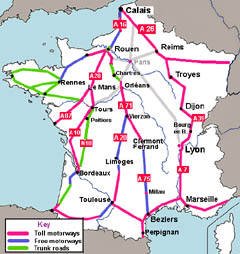
Driving from Calais: ► click map for enlargement and details.
About-France.com
is an independent user-supported website that does not track visitors
and carries very little advertising, Pages may contain affiliate links
to selected partner websites from which commission may be earned, at no
cost to the user.
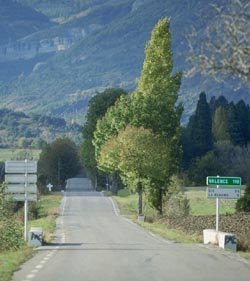
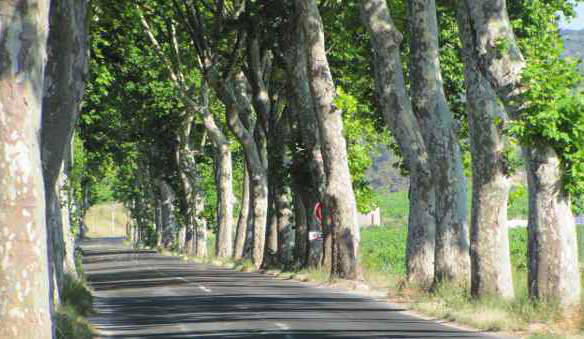
Quiet country roads....
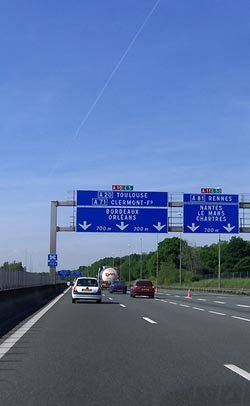
Motorway driving in France is normally quite relaxed... but not always...
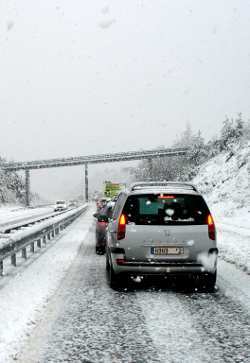
Winters can be hard, particularly in central and eastern France
Click here for
low-cost car hire in France
low-cost car hire in France
Related pages:
Other
"driving in" pages....
You may also like....
You may also like....
- Driving in Spain
- Driving in Britain for foreign visitors
- Driving in Quebec (and Canada)
- Driving in the USA
Website text and photos © copyright About-France.com 2003 - 2025 unless otherwise stated