
About-France.com
- the connoisseur's guide to France
- Explore France ►
- Essential pages
- Travel in France
- Where to go
- What to see and do
Education
in France, 2 : Higher education
Universities, "grandes écoles" and lycées
► Click here
for information on applying to French
universities.
► Click here
for List of French
universities and website links
Compared to other countries, France has an unusual and complex system of higher education. In virtually all countries in the world, the pinnacle of the education system, the institutions providing the finest centres of excellence, are universities. Not so in France. While France has close to a hundred universities, most of them able to hold their own as regards teaching and research with universities in other parts of Europe, the peak of the education pinnacle in France is represented by the country's "Grandes Ecoles", relatively small and highly selective "schools" (in the American sense of the word) which provide a cosseted higher education to the nation's future elites - tomorrow's "haut fonctionnaires" (senior civil servants), leaders of industry, top military brass, top politicians, engineers, physicists and others. In spite of the national preocupation with equality and equal opportunities, the top end of the French higher education systems is elitist.
Grandes Ecoles are very well funded, have small classes and top teaching staff; indeed they (and the lycée classes preparing students for their competitive entry exams) syphon off a disproportionate amount of the education budget - to the detriment of France's universities that are relatively underfunded, compared with international standards. Four of France's universities (including the "Grande Ecole" Polytechnique), are listed in the 2025 THES/QS world's top 100 universities listing; and French schools of management do well in the MBA listings, with 2 of the top 12 places.
Nonetheless, despite their limited funding, French universities generally do a remarkably good job; and in terms of productivity (the ratio between investment per student, quality, and the results obtained) they must rank among the most efficient institutions of higher education in any developed country!
Student fees in France
For students, the great advantage of higher education in France is the cost. Basic standard student fees in France in 2025 were just 175 €uros per year for undergraduates, and 250 € per year for post graduate Master's courses - plus a few extras that may add on about 100 €. Students are also eligible for subsidised student restaurants, basic but very cheap student residences (though demand well outstrips supply for rooms in residences) bus passes and discounts in many places. In addition, students from low-income backgrounds get grants; French student grants vary from just exemption from paying tuition fees, to exemption + 4370 € per year, and are means related. This means that very few graduates in France enter the jobs market burdened with the heavy levels of debt seen in the UK or the USA.
Entry into higher education:
French universities are open to all "bacheliers", that is students who have passed their baccalauréat. However, while some types of degree course are open to all comers (notably courses in arts faculties and social sciences), scientific and medical courses are usually only open to students who have passed a scientific "bac".
The baccalauréat is the gold standard, when it comes to getting into university; but getting into a "grande école" is a whole different ball game. Entry into many "grandes écoles" is at "bac+2" level, i.e. the level of the third year of university studies; and to get into a "grande école", many students actually stay on in Lycée for two whole years after the baccalauréat. In this respect, Lycées are also a part of the French higher education system, thanks to what is known as "les classes préparatoires".
Higher education is thus provided by three main types of institution: lycées, universities, and "grandes écoles".
Lycées: Les classes préparatoires. Lycées as institutes of higher education. Unlike high schools in most other countroes, French lycées have a role that extends beyond the traditional end of high school. Thus, the best and biggest lycées all have two more years of classes after sixth-form / twelfth grade level, corresponding to the first two years of higher education. The most prestigious of these are known as "les classes préparatoires" (or prépas), and are basically a selective alternative to the first two years of (generally unselective) university. Students in "prépa" are in small classes, and have an intense programme of studies, often over 30 hours of classes a week, plus plenty of homework; but the rewards are good, and students work hard to succeed. "Prépas" prepare their students for entry into the "grandes écoles" (see below), another aspect of the French education system that has no equivalent in other countries.
"Prépas" are the classic illustration of the traditional French approach to education, which involves a lot of book-learning, long hours in the classroom, amassing of facts and information, and less in the way of questioning, discovery and creativity than is customary in the English-speaking countries and many others. After all, the lycée system was invented by Napoléon, as a means to train the educated elites who would run the nation - a task in which it has been very successful until now. Some common prépa classes are Khâgne and Hypokhâgne (literary studies), Maths sup and Maths spé (mathematics), or Prépa HEC (business and commercial studies).
For more about French Lycées, see the Primary and secondary education page
BTS: Brevet de Technicien Supérieur. Lycées are also responsible for providing instruction for what is the equivalent of Higher National Diplomas (HNDs) in the UK, i.e. two-year higher education courses, generally technologically or vocationally oriented. BTS classes are selective entry, and as in "classes prépas", students have a heavy load of coursework to get through. The approach tends to be "scolaire", i.e. as in a school, rather than "universitaire", and classes are small (up to 30 or so). Popular BTS courses include "mechanics", "trilingual secretariat", "tourism", and so on.
Universities. France has about 80 state universities (the figure varies slightly as universities merge, or sometime split) , plus 5 Catholic universities (and a large number of private "institutes", some of which award degrees.)
State universities: The development of French state universities over the past half century was hampered by a combination of two factors: a) the very heavy role of the state in their administration and development, and b) relative underfunding (note), compared to universities in other countries. After considerable delay, and oppositiion to reform from within the universities themselves, things have changed, and a law on the Autonomy of Universities was passed in 2007, giving greater decisional power to the Presidents (vice chancellors) of public universities - among other things.
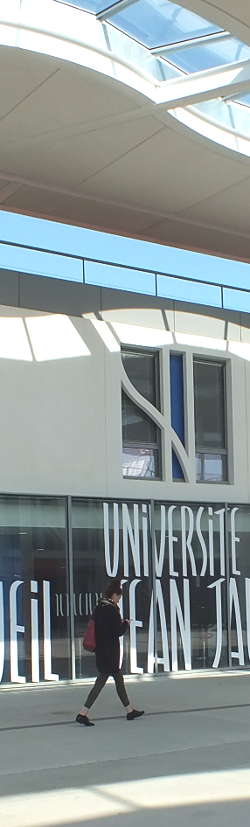
Universities are officially known by the name of the city in which they are located: there are thus 13 institutions called the University of Paris, numbered from 1 to XIII; most of these are actually in the suburbs. Many Universities have taken other names, which they use on all their official documents; for example the Université d'Auvergne in Clermont Ferrand, or Aix-Marseille Université in Aix, or Université Marie & Louis Pasteur, formerly known as the Université de Franche-Comté, and before that as the Université de Besançon|. Universities are divided into faculties that are officially called "UFRs" (Unités de Formation et de Recherche), though the word "Faculté" is still often used - as in Faculté des Sciences or Faculté des Lettres.
Universities also include other "components" (composantes), such as IUTs (Institut Universitaires de Technologie) which offer two-year diplomas (called DUT) and also degrees; or IAEs, (Instituts d'Administration des Entreprises) - business management institutes, with a special status, which have been set up in recent years in response to an awareness that universities had largely missed out on the massive expansion in demand for higher education business courses - demand that had been taken up (with varying degreees of academic quality) by private business schools, that have flourished throughout France.
Degrees: Universities award three types of degree, in line with the European "Bologna" system. The first degree (3 years) is the Licence, the first postgraduate degree (5 years' study) is the Masters (using the English term), and the final degree, obtained after at least eight years' study, is the Doctorat. Degree courses must all be approved by the ministry for higher education, and every five years all universities now go through a bureaucratic and time-consuming process known as "habilitation".
Grading: Degrees at Licence and Masters levels come with various grades: as throughout the French education system, marks are graded on a scale of 0 to 20, with 10 being the pass mark. A pass degree is one where the student has an average mark of between 10 and 11.99; at first degree level, the majority of students get a pass degree. From 12 upwards, students receive a "mention" : Assez Bien from 12 to 13.99, Bien from 14 to 15.99, and Très Bien from 16 upwards. Any general "mention" would tend to correspond at least to a 2:1 (upper second) degree from a UK university. In most university departments, a general 'Mention très bien" would not normally be awarded to a maximum of 5% of students, often far less - so it is really something quite exceptional on a graduate's CV.
Graduation ceremonies do not exist in French universities. However, some university departments have introduced unofficial ceremonies, notably for Masters graduates.
Administration: Universities, which are under the theoretical control of the local "Rectorat" (Education Authority), are run by a Board (Conseil d'Administration - CA), presided over by an elected Vice Chancellor, the "Président". Présidents d'université are elected by the CA for a period of 4 years, once renewable. The CA is made up of elected representatives of the teaching staff (about 50% of members), of administrative staff and students, plus external members representing local interests.
Structural reorganisation of higher education in France
French universities have recently been reorganized into large local federations of existing universities and institutes of higer education, known as PRES - or Pôle de recherche et d'enseignement supérieur – higher education and research poles. There is a twofold aim in this; firstly to save money, by merging some of the administrative structures currently duplicated in each university or institution. Secondly to make French universities more "visible" on the international stage, and hopefully, by bringing together under a single umbrella research laboratories currently belonging to different universities , boost the ranking of French universities in international league tables.
For example, while it is hard for the universities of Bordeaux 1, Bordeaux 2, Bordeaux 3 and Bordeaux 4 to feature individually in global university league tables, it is easier for the new "University of Bordeaux", with its 60,000 students, to do so. And where league table places are obtained purely thanks to the volume of research carried out by an institution, or the number of graduates, the desired result may be achieved. Whether that makes the university/ies of Bordeaux any better in real terms is debatable.
It has certainly rationalized the "university map" of France, insofar as having four universities all calling themselves the "University of Bordeaux" was confusing to outsiders; but universities had already tackled this problem by taking specific names - such as Université Michel Montaigne (Bordeaux 2). Furthermore, the new structure remains confusing in that the new "University of Bordeaux" is made up of four establishments that are each - very officially - universities in their own right. Whether that remains the case for long remains to be seen.
In Strasbourg, the three universities merged into one in 2009, to form the single "University of Strasbourg", with its 42,000 students. But more changes are afoot, some of them succeed, others get called off. In 2013 the University of Strasbourg planned to merge with the University of Haute Alsace, to form the University of Alsace, but this has not happened. While the UHA would have gained in visibility from joining the much bigger University of Strasbourg, it was not exactly clear what the advantages would have been for the new University of Strasbourg.... unless sheer size is deemed a vital criterion of success.
There are certainly some positive sides to the PRES restructuring of higher education in France; but this latest reform does not address the real difficulties faced by French universities, which are a consequence of their underfunding in comparison with universities in most other developed countries.
Private universities: According to an old French law, no private institution can call itself a "university"; but this does not stop the Catholic universities from doing so.
Catholic universities: As with state universities, there is often an official name (such as Institut Catholique de Lyon) and the common name that most people, and the institutions themselves, use (such as Université Catholique de Lyon). Catholic universities offer the same range of degree courses as state universities, and students can freely move between the two systems.
Other private institutions; these tend to call themselves "schools", and include some of the "grandes écoles" (see below), plus a whole range of private establishments offering business degrees, technical qualifications and other courses. To offer a "degree", a school must have its courses recognised by the Ministry, in the same way as public universities.
LesGrandes Ecoles.
These are the pinnacle of the French education system; students get in by competitive examination (concours), the institutions are relatively small, and classes in them small too. Many of the teaching staff in "grandes écoles" are professionals or else academics from neighbouring universities, who do extra teaching at rates well in excess of the hourly rate paid in universities.
The most famous Grande Ecole is "Polytechnique", also known as "X", which was founded in 1794 as a school of public engineering. It comes under the responsibility of the Ministry of Defence, and students wear ceremonial military uniform, with tricorn hats, for official occasions, such as graduation. Students follow 4 years of study, including a strong general science culture, and French students have the status of army officers. Polytechnique is reputed as one of the world's top "universities", and runs exchanges with other institutions in the same league: MIT, Harvard, Stanford, Oxford, ICL, and others.
Another very high ranking school was the Ecole Normale d'Administration, the ENA, France's top institution for the training of future senior civil servants (hauts fonctionnaires), top politicians and managers. In recent years, the elitism of the ENA, which provided a disproportionate number of France's senior civil servants and government ministers, came in for such criticism for training up top bureaucrats and politicians who are out of touch with the rest of society, that in 2019 President Macron, himself an alumnus of the school, announced that the school would be closed down. This happened in 2022, when the historic school was replaced by a more modern version, known as the National Public Service Institute (INSP).
Other famous Grandes Ecoles or Grands Etablissements include the Ecole des Mines, Ecole Normale Supérieure (the top institution for arts subjects, originally for training teachers for lycées), and world-class business and management schools such as HEC (Hautes Etudes Commerciales), INSEAD (European Institute of Administration) and Sciences Po, the Institut des Etudes Politiques de Paris, an autonomous state-funded school of higher education.
Academics and Research.
Most academics in French higher education have the status of "enseignant-chercheur" (teacher-researcher), and do both teaching and research. Research in French universities has become far more structured in recent years than in the past, and nowadays all enseignants-chercheurs must belong to a "laboratory"; laboratories come in all fields , from nuclear physics to medieval English literature. There are two grades of tenured enseignants-chercheurs in French universities, Maîtres de conférence (corresponding to lecturers, senior lecturers and ordinary professors) and professeurs (corresponding to senior professors).
To gain appointment at either level, a candidate must go through an arcanely French procedure known as "habilitation". Foreign nationals can go through the habilitation process, but it is something that must be initiated at least a year before the candidate hopes to take up a teaching position. To become a professor in a French university, academics must go through an even more complex habilitation, for which it is necessary to write what amounts to a second thesis. As a consequence of this system, foreign academics – and even French academics hoping to return from abroad, notably the USA – cannot enter the French university system with anything like the ease of international mobility that exists in most other countries, another factor that has been detrimental to the development of French universities. There have been many cases of French universities finding it impossible to recruit highly qualified academics - French or foreign - to professorships, due simply to their not having the required "habilitation", or not getting it in time.
Other teaching staff: There are two other common categories of teaching staff in French universities; those known as PRAGs (qualified secondary teachers), who have no research requirement, and ATER - the equivalent of graduate teaching assistants - who are usually completing their doctoral thesis, and often hoping to get recruited later on as a tenured lecturer
Funding of French universities.
According to OECD figures (2022), higher education funding per student in France is about average for OECD countries, but lower than average for western Europe.
About-France.com
Home
page - Site search
- Regions
- Maps of France