- Explore France ►
- Essential pages
- Travel in France
- Where to go
- What to see and do
About-France.com
- the connoisseur's guide to France
The different Quarters, or districts, of Paris
| About-Paris guide | Discover Paris | Getting round Paris |
| Main Paris attractions | The quarters of Paris | Paris transport tips |
| Paris hotel information | Budget Paris | Paris airport guide |
| Paris with children | Paris for free | Velib bike hire system |
| Paris in the Spring | A week in Paris | Paris car hire |
► Jump to: Area profiles - a short guide
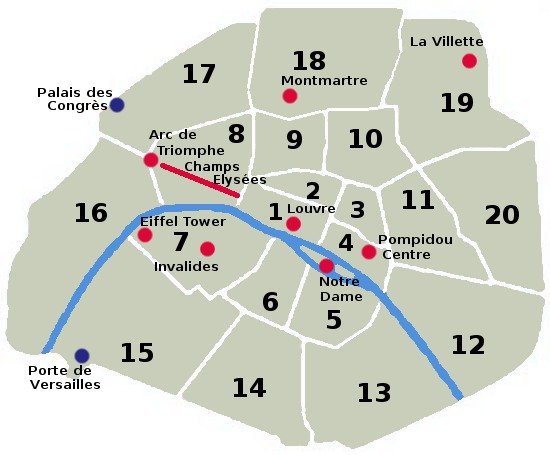
The districts of Paris
Like any big city, Paris is not a homogenous block of urban development. As an ancient city dating back to before Roman times, it is a city that has grown organically over the centuries, to the point that it has reached today, a city with an intra-muros population of 2 million inhabitants, an urban/suburban area of 6 million, and a metropolitan area of close to 10 million inhabitants. Knowing where the "arrondissements" or districts are is useful for knowing where to go or stay; knowing what the areas of Paris are like is useful for knowing what to expect when you get there.....Paris Trade fairs and conventions.
Paris has three main exhibition centres for trade fairs: at the Porte de Versailles, at la Villette in the 19th district, and at Villepinte, close to Charles de Gaulle airport. The Paris Convention Center is the Palais des Congrès, at the Porte Maillot, in the 17th.Paris intra-muros
"Paris", in the strict sense of the term, is an area covering 10,539 hectares or 105.39 sq. km, corresponding to the "departement" of the Seine (75), the smallest in France in terms of size. This area is almost exactly delimited by the route of the Paris inner ring road, or "Boulevard Périphérique", which circles the city.Within this area, Paris is divided administratively into 20 urban boroughs, called arrondissements, conveniently known by their numbers, rather than historic names. Parisians know the numbers, and often use them to refer to parts of the city; yet the historic areas of Paris also have names, some of them well-known, other less. Here therefore is a short guide to the main "Quarters" of Paris.
► Paris by area .... the different parts of Paris
La Cité
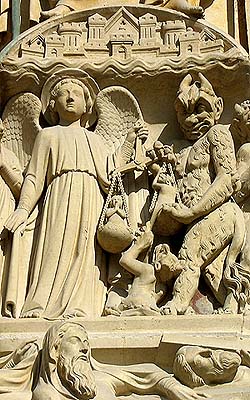
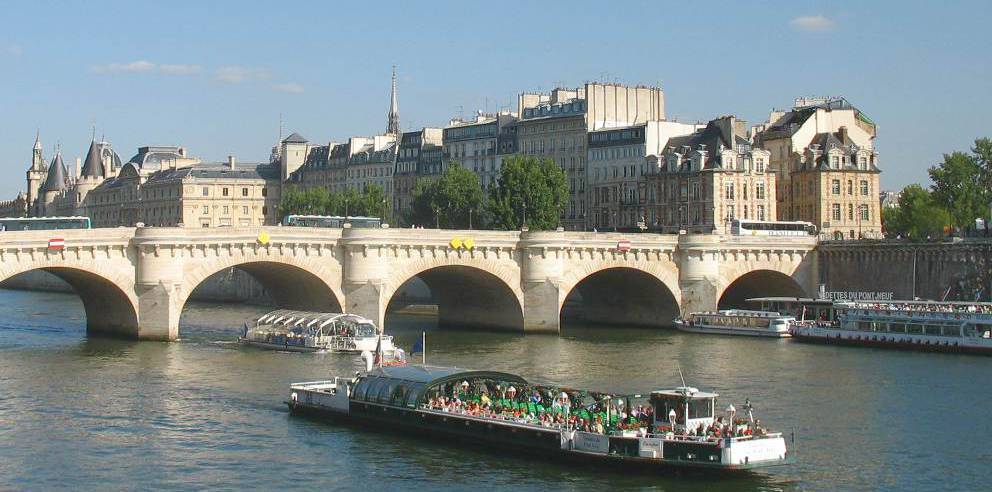
- The city: Part of the 1st District (premier arrondissement); La Cité is one of the the islands in the middle of the Seine, and is the historic heart of Paris. L'Ile de la Cité is today home to a number of historic monuments and administrative buildings, including Notre Dame Cathedral, and the Sainte Chapelle. Next to l'Ile de la Cité is the Ile Saint Louis, another very old quarter, which is more residential, with shops, restaurants and small hotels. The best
value Paris visitor pass
The best
value Paris visitor pass Louvre / Champs Elysées
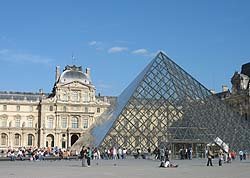
1st 2nd and 8th arrondissements. The Champs Elysées bisect this quarter from south-east to north-west. This quarter includes the Louvre and the Tuileries, the Place de la Concorde, the Champs Elysées, the Place de l'Etoile and the Arc de Triomphe, as well as several other museums including the Orangerie, the Grand Palais and Petit PalaisLes Grands Boulevards
The district of the Grand Boulevards (2nd and 3rd Arrondissements, and 8th to the 11th). Running more or less from the Place de la Madeleine (8th arrondissement) to the Place de la Bastille (11th arrondissement), this is the main shopping area of central Paris. The heart of the shopping area is the Boulevard Haussmann, near the Opéra (RER Auber, Metro Opéra), with some of the biggest department stores.Le Quartier Latin
The Latin Quarter - Covering part of the 6th arrondissement, and also part of the 5th, this is the traditional student quarter of Paris, centered on the Sorbonne and the Panthéon. The narrow pedestrian streets are full of cafés and restaurants, and the busy boulevards, particularly the Boulevard Saint Michel, known as the Boul'Mich, have bookshops, cinemas and other shops.Le Marais
The 4th Arondissement. This district, lying on the north bank of the Seine, has become a chic residential area; it is a district of narrow streets, with a lot of attractive historic buildings, and has become particularly popular since the opening of the modern art museum and library at the Pompidou Centre (closed for renovatioçns until 2030).Le
Septième - Quartier des Invalides.
This
district on the south bank of the Seine is largely administrative and
residential. It contains, among other things, the Eiffel
Tower,
the Hotel
des Invalides, the French National Assembly (parliament
building), the residence of the Prime Minister (Hôtel
Matignon), and the Musée
d'Orsay.Pigalle
/ Montmartre
The 9th and 18th arrondissements. Pigalle is the night-life
district of Paris, famous for its clubs, cabarets and bars. It is also
known as the red light district of Paris. Among the world famous
cabaret bars are the Folies
Bergère and the Moulin
Rouge, popular tourist attractions. It borders on
Montmartre, the
hill on which sits the famous Sacré
Coeur church, and the so-called artists quarter of Paris,
today rather commercial.18th to
20th arrondissements:
Essentially ordinary residential areas, among the less
expensive parts
of the city. The Cité des
Sciences de la Villette,
the Paris
science museum, is located in the 19th on the site of former industrial
premises.Le Seizième
The sixteenth arrondissement: over in the west of Paris, this is the chic residential area of the Paris west end, where housing and office space is most expensive. A large number of foreign embassies are situated here. Beyond the ring road (boulevard péphérique) lies Paris's biggest and most famous park, the Bois de Boulogne.Chinatown, le Treizième
Paris has a large Chinese and south-east Asian population, which is concentrated in the 13th district, around the Place d'Italie. This area has lot of oriental restaurants - Chinese, Vietnamese, Cambodgian, and more, plus exotic shops and commerces.Quartier de la Bastille.
The area round the Place de la Bastille (4e, 11e, 12e) is a popular bustling area of Paris; it is an area with lots of shops, including all kinds of specialist shops which have set up in this part of town which is cheaper than the other end of the Grands Boulevards. This is also a chic cultural area, with the Paris Opera, and chic boutiques.La Défense
Strictly lying outside Paris, la Défense, in the north west of the city, is the modern business district. La Défense lies at the edge of the city, following the line of the Champs Elysées, beyond the 16e / 17e arrondissements.Hiring a Velib bicycle.
The cheap way to get round Paris.... if you take care!
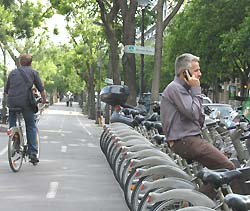 In
all quarters of Paris, approximately every 300 yards in all directions,
visitors to the city cannot help noticing bicycle racks, full of
identical bicycles. This is Paris's successful "Velib"
bike-hire scheme, which - if used correctly - can prove an excellent
and cheap way to get around the capital.
In
all quarters of Paris, approximately every 300 yards in all directions,
visitors to the city cannot help noticing bicycle racks, full of
identical bicycles. This is Paris's successful "Velib"
bike-hire scheme, which - if used correctly - can prove an excellent
and cheap way to get around the capital.You can hire a Velib bike for just one Euro a day, if you use the system properly: on the other hand, if you do not use the system as it is intended (for short hires only), it can work out very expensive.
To hire a Velib, you need a chip-and-pin credit card. On hire, you will be charged a 150 € deposit, which may well not be recredited to your card for another two weeks. A day's use of the system costs just 1 €, which includes as many half-hour hire periods as you want, during the day. These first half hour periods are always free, and you can have as many free "first" half hours as you want in a single day. After that, rates rise steeply to reach 4 € per extra half hour. So while you could use a Velib for all your needs for just a single Euro per day, you could find yourself billed over 80 €, which is far more than a hire car!
If this is not clear, read the two following examples.
Examples How to use the velib system for 1€ a day:
John and Mary both hire Velib bikes at 8.30 a.m from near their hotel, and set off independently for a day's visiting Paris.
John does not find out how the system works, so takes his bike and spends the whole day cycling round the city. Each time he stops, he locks the bike, but never returns it to a Velib rack, not even when he goes for lunch in a restaurant. He brings the bike back to where he first hired it at 9.30 p.m. He has thus had a single hire of 13 hours Cost, a whopping 96 Euros !! (Some might call this a scam!).
Mary, on the other hand, uses the system as it is designed to be used; for short trips only. She picks up her Velib bike at 8.30, rides to the Eiffel Tower (20 mins) and immediately returns the bike to a Velib rack by the tower. At 11.05 she takes another bike, crosses the Seine to the Arc de Triomphe, and returns the bike to another rack at 11.31, after 26 minutes. During the day, she takes a bike seven times, but always returns it in less than 30 minutes to a different rack. She never keeps a bike when not on the saddle. She returns to the hotel at 9.30 p.m. Total day's hire: 7 hires of less than 30 minutes each: Cost, just 1 €uro. Excellent value for money!
Links to main Paris tourist attractions:
The
Eiffel Tower,
Notre Dame Cathedral,
Sainte Chapelle,
The Champs
Elysées,
Arc de Triomphe,
The Louvre,
the Orsay museum,
Seine river boats,
the Latin Quarter,
Montmartre,
Moulin Rouge,
Pompidou Centre,
About-France.com
Home
page - Site search
- Regions
- Maps of France