
- Explore France ►
- Key pages
- Where to go
- How to get there
- More about France
About-France.com
- the connoisseur's guide to France
An introduction to Burgundy
| ► Go to... | About Burgundy | Main tourist attractions | Selected hotels |
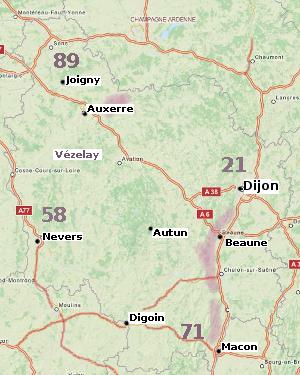
Map of Burgundy - vineyard areas shaded in pink
Burgundy is made up of four departments. Northern Burgundy comprises the department of the Yonne (89), capital Auxerre, a rolling agricultural area bordering on the outer fringes of the Paris region. In the west, the Nièvre (58), capital Nevers, is a hilly department that includes the
Hotels
in Burgundy
► Hotels
in the Nièvre
(58)
► Hotels
in Southern
Burgundy (71)
Choose
from hundreds of Burgundy hotels available at best ratesThe historic and modern capital of the Burgundy region is Dijon (population 150,000), a thriving administrative and cultural centre, which is also a major communications and freight-distribution hub. The city is just 1hr. 40 mins. from Paris by direct TGV high-speed train service. Dijon has a historic city centre, with old narrow streets, and houses built in the local pale honey-coloured stone; of particular interest to visitors are the Palace of the Dukes of Burgundy, and the gothic Cathedral of Saint Bénigne. The centre of old Dijon is classed as a UNESCO World Heritage site.
The world-famous Burgundy vineyards produce some of the most prestigious and expensive wines in the world. The top wines are mostly produced on a narrow strip of land running south from Dijon, on the western fringe of the Saône plain, in the Côtes de Nuits and the Côtes de Beaune vineyard areas. These include names such as Gevrey-Chambertin, Vosne-Romanée, Pommard, Volnay and Clos Vougeot. Many of the top vineyards, which are quite small and called "Clos" (closed areas) are protected behind stone walls and iron gates, so valuable are the grapes that they produce. They are probably the most valuable agricultural real estate in the world.
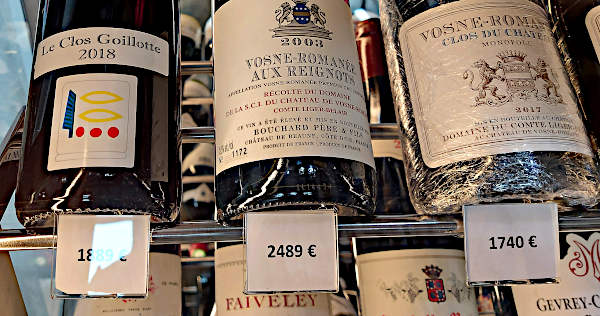
Fortunately most top Burgundy wines do not come in at silly prices like this. Some red Grands Crus can still be bought for under 100 Euros... and Premiers Crus for a third of this. Generic "Bourgogne" reds and "Bourgogne Aligoté" whites are comparable in price to wines from other areas .
How to reach the Burgundy area :
By TGV train from Paris Gare de Lyon, or from Lille; train from many cities, motorway from Paris, Lille, Strasbourg, Nancy, Lyon, Geneva.By air: There is currently no commercial airport in the Burgundy area operating regular international flights. The north of the region is accessible from the Paris airports, the south of the region is closer to Lyon St Euxpéry airport
Selected BURGUNDY HOTELS:
Good value and convenient hotels in Burgundy - The About-France.com selection.- Dijon
(21 Côte d'or) Gare
The Hotel Kyriad Dijon Gare is located opposite the railway station, and a good choice for visitors arriving by train. This air-conditioned upper ** hotel, with pool, is well located for exploring Dijon and the area, and is well reviewed by travellers. Plenty of restaurants close by. - Beaune
(21 Côte d'Or)
Hostellerie le Cèdre ***** Warm hospitality, reasonably priced for the quality. This hotel occupies a historic villa close to the old town. The famous Hospices are in walking distance . A comfortable base for exploring Burgundy. - Beaune
(21 Côte d'Or)
Hotel de la Cloche ** For those on a tighter budget, this is reputedly the best address in the centre of Beaune. Some parts could do with a new coat of paint, but this is a friendly hotel and good value for money. - Vezelay (89 Yonne) Hotel de la Poste et du Lion d'Or Classic French hospitality in the old centre of Vézelay, below the hill on which stands the great basilica. The hotel is in a calm location, and has large clean rooms
- Hotel le Mas des Lilas ** Close to the river Yonne, this is a modern ** hotel just south of Auxerre; it has large mature gardens, and is close to the RN6 highway, a few kilometres from Exit 20 on the A6 Paris-Lyon motorway.
- Near
Autun - Morvan (71 Saone et Loire)
Auberge de la Chaloire ** Not far from Autun, with its magnificent cathedral, this hotel is located in the heart of the Morvan regional park. quiet rural location, friendly welcome, and very good service. - Off
A6 motorway Chalon sur
Saône (71 Saone et Loire)
Hotel Ibis *** A short distance and easy to find from the A6 motorway, exit 25, this standard Ibis hotel has an outdoor pool. - Tournus
- (71 Saone et Loire)
Le Rempart *** is a hotel with 34 rooms and lots of character, which was once a guard house. It has two restaurants, and stands in the centre of old Tournus, near the river Saone and St. Philibert church. Easy access from A6 motorway , exit 27. - Nevers
(58 Nièvre)
The Hotel Astrea is a modern ** hotel in a quiet location just a short distance from the the old town.Good value, and facilities for the disabled.
Main tourist attractions in Burgundy
Routes and areas:
- The Burgundy canal (Canal de Bourgogne) and rivers Saône and Yonne waterways.
- The Morvan mountains - forested uplands
Côte d'Or department (21)
- Alésia - near Montbard. Muséoparc Living history museum on the site of the Battle of Alesia, where Julius Caesar defeated the Gauls, led by Vercingetorix in 52 BC. Interpretive center and archaeological museum. Part reconstitution of the Roman defences. Historic reenactments.
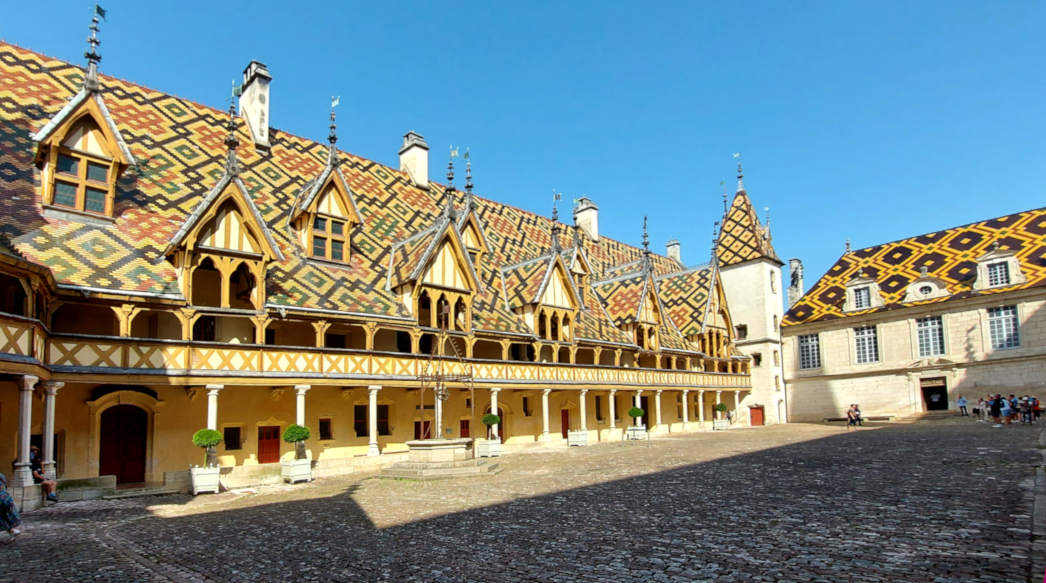
- Les Hospices de Beaune - the medieval hospice at Beaune is one of the most unusual ancient monuments in France, a medieval hospital that opened in 1483 and remained in use for five centuries – until the late 20th century. Today the hospice is a museum and art gallery, and contains one of the most famous works of medieval Flemish art, the Beaune altarpiece by Rogier van der Weyden, painted for the hospice, and still in situ. The hospices, with their sixty hectares of prime Burgundy vineyards, are still owned by the Beaune Hospital; the annual Beaune wine auction - now run by Christie's – is the world's most prestigious wine auction, with profits going to the hospital and to medical research.
- Beaune area: the vineyards of Burgundy, cellars and estate visits. Visit the Chateau du Clos Vougeot or the château de Pommard, near Beaune, or the Burgundy wine museum in Beaune. Route des vins des Grands Crus - the Grand vintage wine trail. See Burgundy wines
- Dijon: the capital city of Burgundy; historic city, palace of the dukes of Burgundy, gothic Cathedral, Museum, shops
- Fontenay
great Cistercian
abbey
(UNESCO World
Heritage Site), near Montbard.
Saone & Loire department 71
- Autun - the small town on the edge of the Morvan hills boasts one of the finest romanesque cathedrals in France, with remarkable sculptures, as well as a number of Roman remains, including city walls, and two city gates.
- Digoin, in the extreme west of Burgundy, is a popular pleasure boating centre, at the junction of the Loire valley canal and the Canal du Centre, and has a fine canal aqueduct over the Loire
- The site of Cluny, the old town and the remains of the Benedictine abbey, once the largest chuch in Chrisendom.
- Cormatin, between Chalon s/ Saône and Cluny. Fine 17th century château surrounded by a moat, and recently renovated gardens. Richly decorated interiors, including the golden rooms. Open daily April to mid-November.
- Le Creusot - former mining and steel town, le Creusot has one of the world's largest preserved steam hammers, built in 1876. For those with an interest in industrial archaeology...
- Le Maconnais - the southern part of the Burgundy vineyards, around the city of Macon.
- Tournus; The church of St Philibert is one of the oldest churches in France (early 11th century).
- Semur
en Brionnais. Listed among the "plus beaux villages de
France" Semur is a bit off the beaten trail so is rarely
swamped by tourists. Fine medieval chateau and Burgundian romanesque
church
Yonne department (89)
- The romanesque churches of Burgundy, including the remarkable Abbaye de Vézelay (UNESCO World Heritage Site), starting point of one of the main pilgrimage routes to Santiago de Compostella. There are many delightful historic churches in the Saone et Loire area
- Auxerre and Chablis - the northern part of the Burgundy vineyards, old towns, wine museums and cellar visits. Auxerre is a popular centre for boating on the Yonne and Burgundy canal.
- Avallon - attractive old walled town
- Guédelon - the castle featured on BBC television's "Secrets of the Castle" series. Treigny. amazing living history attraction; since 1997, a team of craftsmen have been building a medieval castle from scratch, using historic methods and tools.
- Montreal
- famous fortified hilltop village
Nièvre department (58)
- La Charité sur Loire Historic small town with several monuments. The large Romanesque Notre Dame basilica, with fine sculpted tympana, is a UNESCO heritage site on the Pilgrimage route to Santiago de Compostella. Sixteenth centry stone bridge over the Loire. Sections of medieval ramparts.
- The Morvan regional natural park. Area of outstanding natural beauty (mostly in the Nièvre), popular with hikers and nature-lovers. Though peaking at only just over 900m, this is seen as the closest area of mountain to Paris.
- Nevers; historic town on the banks of the river Loire, at the confluence of the Allier. The Palace of the Dukes of Nevers is a fine Renaissance château. St Cyr & Ste. Juliette's Cathedral is a fine small gothic cathedral in the Burgundian style.
- The vineyards of Pouilly sur Loire
Further tourist information
Official Burgundy tourism site
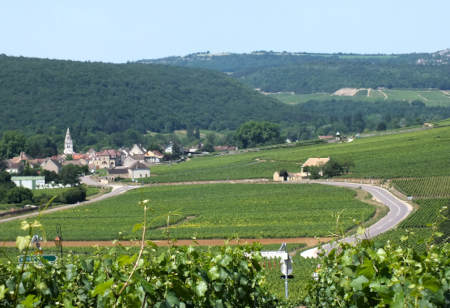
On the Burgundy wine trail, through the vineyards
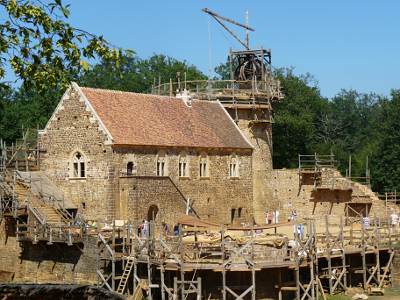
Living history : at Guédelon, in the Yonne, discover a new castle, being built as in the Middle Ages.
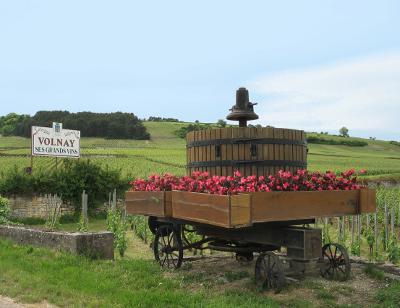
Burgundy "Grand cru" vineyards, at Volnay, near Beaune
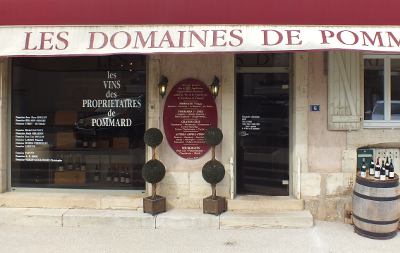
A wine-producers' outlet in Pommard.
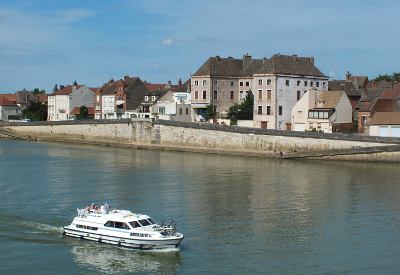
Boating on the River Saone
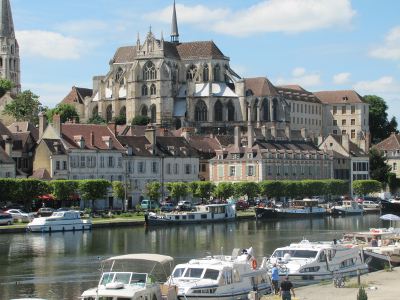
Auxerre, on the river Yonne
About-France.com
Home
page - Site
search
- Regions
- Maps of France
- Contact
Photo top of page:
The Hôtel Dieu in Beaune. Also known as the Hospices de Beaune, this is a unique Medieval hospital opened in 1443, and in operation as a hospital until the 1980s. The remarkably preserved building still contains the historic beds and hospital equipment from the past, as well as the invaluable Beaune altarpiece, painted for the hospital by Flemish artist Rogier van der Weyden.
Famed
the world over for its wines, Burgundy is one of the great
historic regions of France; indeed, in the Middle Ages, Burgundy was
the great dukedom which rivalled in power and prestige with the kingdom
of France itself. In those days it covered a large part of central
eastern France, including half of modern-day Switzerland.
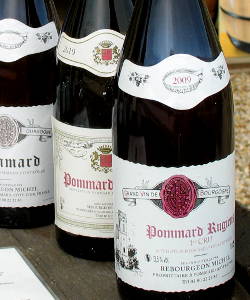
Burgundy grands crus.... for special occasions
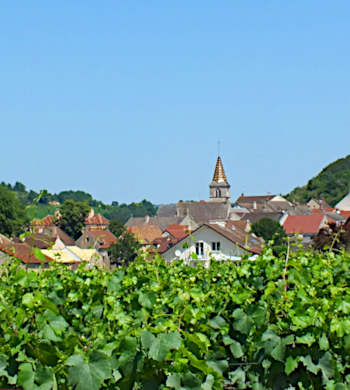
Burgundy village
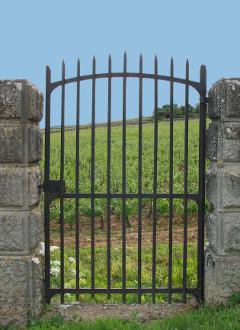
A Burgundy "Grand cru" vineyard, protected by stone walls and iron gates
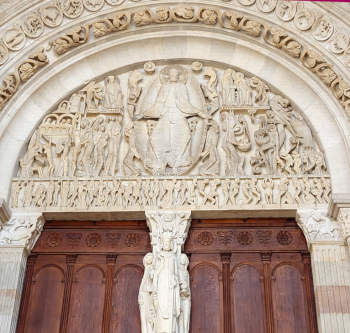
Romanesque typanum of Autun cathedral
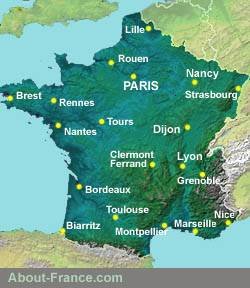
Click here for
low-cost car hire in France
low-cost car hire in France
Text and photos Copyright © About-France.com
except where otherwise indicated.
Photo of Guédelon © Guédelon