

Limousin - an area guide
An inside guide to the north of New Aquitaine
About-France.com
- the connoisseur's guide to France
| Page Index: | The region | Main tourist attractions | Places to stay |
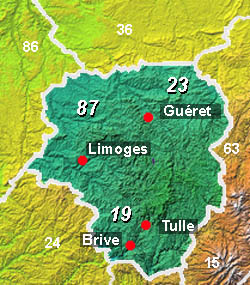 The Limousin area and former region is made up of just three
departments, the Haute
Vienne (87),
capital Limoges, the Creuse
(23), capital Guéret, and the Corrèze
(19),
capital Tulle. Lying between altitudes of 200 metres and 1000
metres, the Limousin is mostly a region of hills and valleys and low
mountains. The highest point in Limousin is the Mont Bessou, 977
metres, near Ussel, in the Corrèze department; it is the
highest point
of a large upland area, a part of the Massif central
known as the Plateau de Millevaches, which
borders on the higher areas of the neighbouring Auvergne
region.
The Limousin area and former region is made up of just three
departments, the Haute
Vienne (87),
capital Limoges, the Creuse
(23), capital Guéret, and the Corrèze
(19),
capital Tulle. Lying between altitudes of 200 metres and 1000
metres, the Limousin is mostly a region of hills and valleys and low
mountains. The highest point in Limousin is the Mont Bessou, 977
metres, near Ussel, in the Corrèze department; it is the
highest point
of a large upland area, a part of the Massif central
known as the Plateau de Millevaches, which
borders on the higher areas of the neighbouring Auvergne
region.The only town of any size in the Limousin region is the city of Limoges; with about 140,000 inhabitants, and an urban area of almost 300,000 inhabitants, greater Limoges provides about half of all the jobs in the region - which gives a good idea of how depopulated the rest of the region is. Until the turn of the millennium, the Limousin, part of the "empty France" area, was a region that had been losing population for a century or so; that decline has now been halted, thanks largely to an influx of people from outside the region, in from Britain and Holland, seeking a quiet location in which to settle. The region's second city, Brive la Gaillarde, has just under fifty thousand inhabitants; it is the biggest town, though not the departmental capital, of the Corrèze department, the southernmost of the region's three departments. Apart from Limoges and Brive, no town in the Limousin has more than 20,000 inhabitants; towns such as Tulle, Aubusson and Guéret are small market towns that have grown little in the last century.
Once a Roman city, Limoges, lying on the river Vienne and on a main route between Paris and Toulouse, has always been a major centre, in this relatively sparsely populated region. In the Middle Ages, it was renowned as a centre of arts and culture. In the nineteenth century, it became famed throughout Europe, and beyond, for its porcelaine; indeed the city became rich with its porcelaine industry, and much of the city centre dates from this period. Limoges has a large historic quarter, with narrow streets and many fine half-timbered houses.
Brive-la-Gaillarde, on the river Corrèze is an attractive small city, with a historic centre built in the pale honey coloured local stone. Brive is also the most important centre in southern Limousin on account of its position as a communications hub, being the point where the east west route between Lyon and Bordeaux (A 89 motorway) crosses the north-south route between Paris and Toulouse (A20 motorway) . Tulle, a few miles up the Corrèze, is a small manufacturing town that has given its name to a type of fine loose meshed lacy fabric, used in the clothing industry. The town rises up the steep sides of the narrow river valley. Aubusson, in the Creuse department, is another textile town, famed worldwide for its tapestries; Aubusson tapestries were famous from the15th century onwards, but the industry declined in the early twentieth century, until it was relaunched in the late 1930's by Jean Lurçat, reputedly the greatest tapestry designer of the 20th century.
Rural Limousin
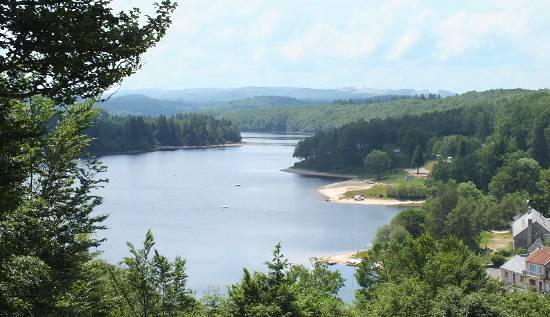
The
Plateau de Millevaches, in the Corrèze - fields, forests and
lakes
Rural Limousin is a land of deciduous woods and fields in the west and northwest, of sheep grazing land in the north, and an upland area of spruce forests and grazing land on the Plateau de Millevaches (the plateau of the thousand springs, not the thousand cows - there are many more than that!) in the east. In the south west, the region borders the Dordogne; the river Dordogne itself cuts through the south west of the region, after several kilometres where it, in its steep wooded valley, it forms the border with the neighbouring region of Auvergne.
Forming the north-western edge of the Massif Central, Limousin is a region that is relatively well watered, particularly in the east. The south-western part of the region, including the area round Brive, can be hot in summer.
Limousin travel information:
- Access by rail from Paris Gare d'Austerlitz; there are regular Intercités trains from Paris to Limoges and Brive la Gaillarde, with connecting services to other towns. There are also a few cross-country services from Clermont-Ferrand via Ussel and Brive to Bordeaux.
- Road access to Limousin: the region is crossed north-south by the A20 motorway (Paris - Orleans - Vierzon - Toulouse), and northeast-southwest by the A89 motorway (Lyon - Clermont-Ferrand - Brive - Bordeaux)
- . Regional airport: Limoges airmort is served by several low cost airlines from the UK and Belgium. There are also some services to the new Brive airport
Stay in the Limousin : some ideas
Main tourist attractions in Limousin
- Limoges (87) Regional capital of Limousin, city of art and history; old city centre, with parts dating from medieval times, cathedral, old bridges on the Vienne. Porcelaine museum.
- Oradour sur Glane (87); the martyred village. In June 1944, the Waffen SS torched the village and massacred over 600 villagers in a mistaken act of reprisal. The village has been left as it was, fixed in time, as a memory to the brutality and horror of war.
- Rochechouart: (87) the impressive castle, dating partly from the 13th century, houses administrative offices and an contemporary art gallery, as well as historic rooms and artefacts.
- St
Junien (87): famous and large romanesque basilica.
- Ahun: (23) old village with remains of a medieval monastery.
- Aubusson
(23) : capital of the tapestry
industry, tapestry museums, tapestry workshops, old town.
- Bourganeuf
(23) Attractive old town, founded in medieval times by the Knights
Hospitaller (Order of St John of Jerusalem).
- Argentat: (19) Delightful small town on the Dordogne. Water sports.
- Beaulieu sur Dordogne:(19) Fine romanesque church, with remarkable carved tympanum
- Brive la Gaillarde.(19) Attractive old city centre.
- Collonges la Rouge, Curemonte and Turenne (19); reputedly three of the prettiest villages in France. Collonges la Rouge is so known on account of the red sandstone used in the buildings.
- The Dordogne valley;(19) the upper Dordogne valley is a place for water sports (sailing on the artificial lakes, kayaking where the river flows freely).
- Parc Naturel Régional de Millevaches: (19, 23) the Limousin highlands - outdoor activities, hiking, riding, nature.
- Treignac-sur-Vézère: (19) attactive village in the upper valley of the Vézère, north of Tulle. Granite built houses with slate roofs. The Vézère offers good opportunities for kayaking.
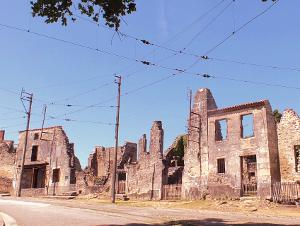
Oradour-sur-Glane - frozen in time since 1944
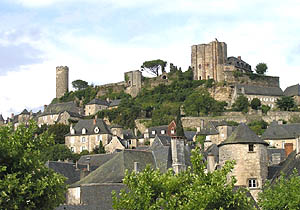
The village of Turenne
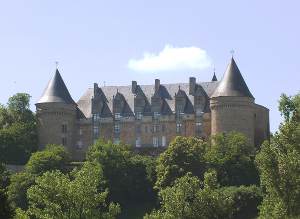
The chateau at Rochechouart
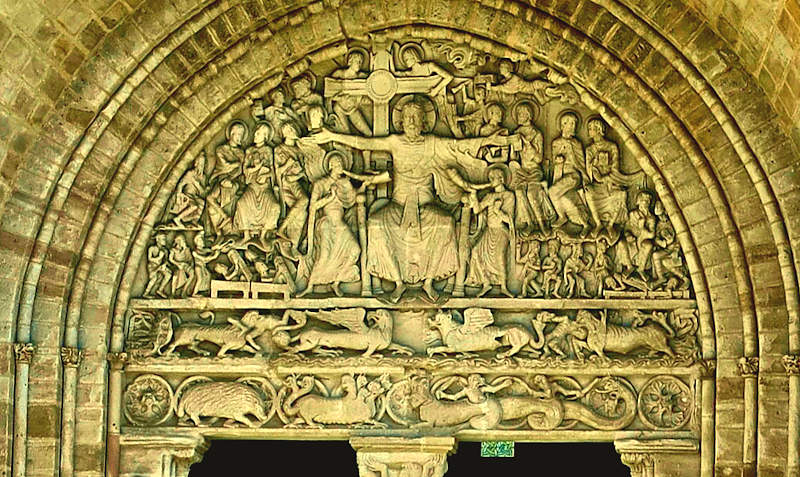
Stunning 13th century
doorway of the Saint Pierre abbey, Beaulieu sur Dordogne
About-France.com
Home
page - Regions
- Maps of France
- Contact
Photo
top of page: the village of Ahun, on the river Creuse
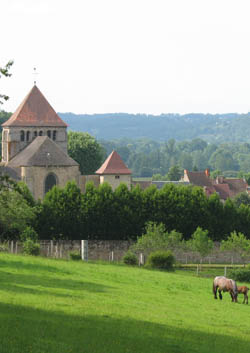
Rural calm; Ahun, in the Creuse.
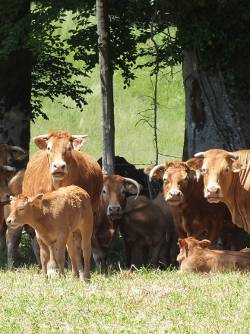
Limousine cattle - one of the finest breeds
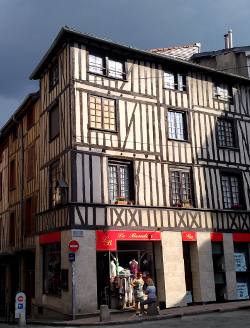
The old quarter of Limoges
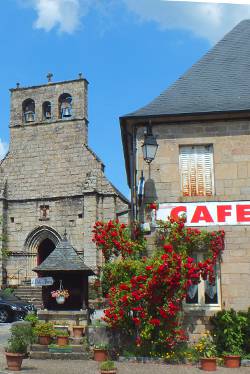
Small town in Haute Corrèze
Text Copyright © About-France.com 2007 - 2025
Photos licenced cc Creative Commons when indicated
Beaulieu abbey - Creative Commons 4.0 photo by JGS25
Site
search
About-France.com
What are you looking for ? Where do you want to go?
About-France.com
What are you looking for ? Where do you want to go?
Until
2016 Limousin
– occupying the north western part of the Massif
Central
– was one of the smallest regions in France, and the one with
the
smallest population. Now it forms the northern tip of the New Aquitaine
region. The name derives from the regional capital,
Limoges, and in one form or another has been taken worldwide to
describe a type of motor car, and a famous breed of beef cattle. The
cattle originate from this region, the cars do not.
Rural calm; Ahun, in the Creuse.
Limousine cattle - one of the finest breeds
The old quarter of Limoges
Small town in Haute Corrèze
| ►► Site guide |
| About-France.com home |
| Full site index |
| About-France.com site search |
| ►► Principal chapters on About-France.com : |
| Guide
to the
regions of France Beyond
Paris, a guide to the French regions and their tourist attractions.
|
| Guide
to Paris Make
the most of your trip to Paris; Information on attractions, Paris
hotels, transport, and lots more.
|
| Accommodation
in France
The different options, including hotels,
holiday gites, b&b, hostels and more
|
| Tourism in France
The
main tourist attractions and places to visit in France - historic
monuments, art galleries, seasides, and more
|
| Planning
a trip to France
Information
on things to do before starting your trip to France.
|
| Driving
in France
Tips
and useful information on driving in and through France - motorways,
tolls, where to stay....
|
| The
French way of
life
A mine of information about
life and living in France, including
working in France, living in France, food and eating, education,
shopping.
|
Click here for
low-cost car hire in France
low-cost car hire in France
Text Copyright © About-France.com 2007 - 2025
Photos licenced cc Creative Commons when indicated
Beaulieu abbey - Creative Commons 4.0 photo by JGS25