
Pays de la Loire - a regional guide
An inside guide to the lower Loire valley
- Explore France ►
- Essential pages
- Travel in France
- Where to go
- What to see and do
About-France.com
- the connoisseur's guide to France
An introduction to the Pays de la Loire
| Go to ► | Regional guide | Main tourist attractions | Puy du Fou | Access |
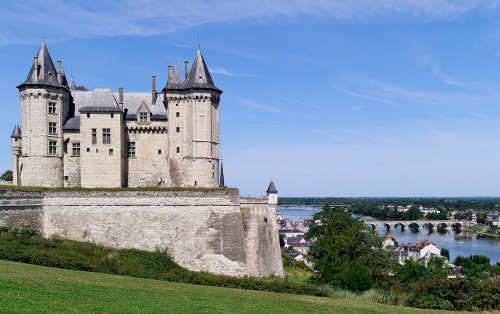 Saumur
- château, vineyards and the Loire.
Saumur
- château, vineyards and the Loire.The Pays de la Loire covers the area to the south of Brittany and Normandy, along the lower stretches of the river Loire, the longest river in France.
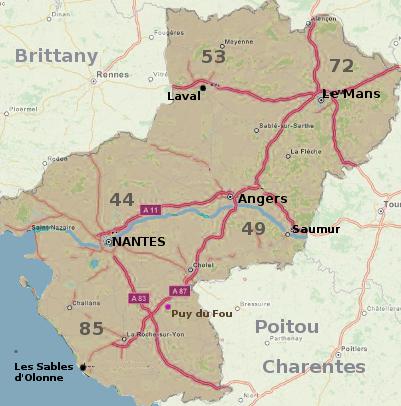
The region is composed of five departments, two of them coastal – the Loire Atlantique (44) and the Vendée (85) – and three of them inland, the Mayenne (53), the Sarthe (72) and the Maine et Loire (49).
 Loire Atlantique
Loire Atlantique
Nantes (44), the regional capital is the sixth largest city in France, with 270,000 inhabitants in the urban borough of Nantes, and an estimated 800,000 inhabitants in the urban area as of 2008. It is located on the Loire, 50 km inland, and is the largest economic hub in the north west of France. In the eighteenth century, Nantes (like Bristol) was a flourishing seaport, indeed the most important seaport in France; the city acquired great wealth at that time, wealth which is reflected to this day in its urban heritage. Today, most of the shipping activity has moved to the mouth of the Loire, to the port of Saint Nazaire, which is also one of the major ship-building cities in Europe. It was in the Saint Nazaire dockyards that the new flagship of the Cunard line, the world's largest passenger ship, the Queen Mary 2, was built. A clear birds-eye view of the shipyards can be had from the Pont de Saint Nazaire, the high road bridge that spans the Loire estuary. (Originally a toll bridge, this bridge is now free to cross).On the coast of the Loire Atlantique department lie two of France's historic seaside resorts, La Baule and Le Croisic. The area round Le Croisic is also famous for its salt pans, and "sel de Guérande" is one of the best-known types of salt in France. The town of Guérande is a delightful small ancient walled city, just inland from the salt marshes.
Vendée
 South of the Loire Atlantique department
lies an area known as Vendée.
The modern department (85) is much smaller than the historic
area
that once carried this name. Vendée is famous in the history
of France
as one of the old bastions of Protestantism; after the revocation of
the Edict of Nantes in 1685, and the end of religious tolerance, tens
of thousands of Vendéen protestants fled from this part of
France, and
went to live in England, or America. Thus many people in
England can
trace some of their ancestry back to this part of France.
South of the Loire Atlantique department
lies an area known as Vendée.
The modern department (85) is much smaller than the historic
area
that once carried this name. Vendée is famous in the history
of France
as one of the old bastions of Protestantism; after the revocation of
the Edict of Nantes in 1685, and the end of religious tolerance, tens
of thousands of Vendéen protestants fled from this part of
France, and
went to live in England, or America. Thus many people in
England can
trace some of their ancestry back to this part of France. After the French Revolution, Vendée was a centre for the royalist counter-revolution.
The department is largely flat in the northern coastal area, low-lying and gently undulating inland. The capital, the city of La Roche sur Yon, is a small rural city in the middle of the department. The coast is built up round the seaside resorts, notably the fine beaches at les Sables d'Olonne, Saint Gilles Croix-de-Vie and St. Jean de Monts, but elsewhere there are stretches of empty coastline. In parts, a band of pine forests, planted on land that was once sand dunes, protects the flat farmland behind from the Atlantic winds and the sand - and protects it against flooding when Atlantic storms batter the coastline.
Maine et Loire
Further inland, the department of Maine et Loire (49) covers a territory to the north and south of the Loire.This is the heart of the region known as Anjou, and its capital Angers is one of the great historic cities in the Loire valley. Anjou was the fief of the Angevins, better known as the Plantagenets, who, starting with Henry II, ruled England for three centuries. The great castle of the counts of Anjou, in Angers, is one of the biggest medieval fortresses in Europe. Henry II, his wife Eleanor of Aquitaine, and their son Richard the Lionheart are buried at the Abbey of Fontevraud, between Saumur and Chinon.Sarthe & Mayenne
The two remaining departments of this region, Sarthe (72) and Mayenne (53) form the rest of the old provinces of Anjou and Maine, and border on Normandy. Rural departments, and strongly agricultural, they both have more in common with Normandy than they do with Vendée. Half the population of the department of the Sarthe lives in the urban area round the capital, Le Mans, famous for its Roman walls and its annual motor race. Apart from that, the Sarthe is deeply rural. La Flèche, an attractive small town on the river Loir (without an -e !) boasts one of the best and oldest zoos in France, coverning some 30 acres. Laval, capital of the Mayenne, is a small city with a historic centre. The city is located on the banks of the river Mayenne, which crosses the department from north to south, a navigable waterway with opportunities for boat hire, and 85 km of towpath idel for cyclists and hikers. The department of the Mayenne also boasts the highest point in the northwest quarter of France, the summit of the Mont des Avaloirs, at 417 metres, about 1350 ft.Access: how to reach Pays de la
Loire:
By train (TGV) from Paris Gare Montparnasse, or from Nantes, Angers, Le Mans, Les Sables d'Olonne
Access by car from the UK, via any of the Channel ports, from Roscoff (Brittany) to Calais.
Local airports for Pays de la Loire: Nantes, Poitiers and La Rochelle
By train (TGV) from Paris Gare Montparnasse, or from Nantes, Angers, Le Mans, Les Sables d'Olonne
Access by car from the UK, via any of the Channel ports, from Roscoff (Brittany) to Calais.
Local airports for Pays de la Loire: Nantes, Poitiers and La Rochelle
Main tourist attractions in Pays de la Loire
- The river Loire (44 / 49) The wide slow-moving Loire is one of Europe's great rivers. The river, excellent for fishing, is bordered by many attractive small towns, and the flat land is good for cycling.
- Rivers
Maine, Mayenne and Sarthe: (49, 53, 72) riverboat cruising
(cabin cruisers), from several boat hire bases.
- Nantes (44), Regional capital; Nantes is a big city, with a historic centre; it offers plenty of opportunities for shopping and urban tourism. The biggest attraction is the castle of the Dukes of Brittany, which houses the city museums. Nearby the Musée des Arts is one of the best art galleries in western France, with a good collection of European art, including works by Bernardo Daddi, Perugino, Georges de Latour, Ingres, Delacroix, Courbet, Monet, Marquet, Signac and many more. Other attractions in Nantes include more museums, the late medieval cathedral, in in western French gothic style, and river boats on the Erdre, a tributary of the Loire.
- Guérande (44), just inland from the coast, to the north of the Loire, Guérande is a small walled city, with a historic centre.
- La Baule (44) - One of the more famous French seaside resorts - famous since the nineteenth century .
- Planete Sauvage, (44) south west of Nantes. A large wildlife park (over 250 acres) , with safari tours. Over 2,000 animals in semi liberty.
- Angers (49) Historic city, with one of the biggest and finest medieval castles in France.
- Ecuillé (49) 15th century Chateau du Plessis-Bourre. A fairytale white stone château standing surrounded by water, this privately owned château has been little altered since it was first built. It has a working drawbridge. Closed Nov-Feb. Rest of year open daily except Mondays.
- Saumur (49) National Tank museum - tanks from World War 1 to today. See industrial museums. Historic château
- Near Segré (49) La Mine Bleue. Take the train 126 metres underground for an authentic slate mine visit. See industrial museums.
- Fontevraud (49) Part of the Loire valley UNESCO world heritage site. Large 12th century former Benedictine Abbey, with the tombs of the English kings Richard I (Lionheart), Henry II, and queen Eleanor of Aquitaine.
- Laval (53). Old city with some interesting and unusual monuments, and the unique Lactopole, a museum of the milk, cheese and dairy industry
- Mayenne (53) Attractive small town on the banks of the river Mayenne - historic medieval castle, gothic church
- Le Mans (72) - Famous for its annual 24 hour motor endurance race. The historic city has some of the best surviving Roman city walls in France - among the best in Europe - as well as a fine cathedral (11th - 16th centuries) and attractive historic centre, known as the Cité Plantagenet..
- La Flèche (72) : Zoo de la Flèche, one of the five major zoos in France.
- La Barre des Monts (85) Ecomuseum of the Vendée fens. Open air museum covering 100 acres of preserved fenland, a salt marsh, traditional farms and local breeds
- Le
Puy du Fou
theme park (85) Arguably the best historic theme park in the world, famous for its historic reenactments (daily in summer).
- Les Sables d'Olonne: (85) One of the most famous seaside resorts on the west coast. the Vendée Globe round-the-world yacht race starts here. Beaches, harbour, Modern and contemporary art museum.
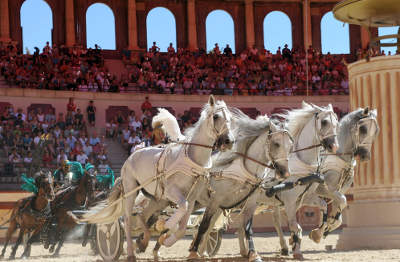
Roman chariot racing at the Puy du Fou historic theme park
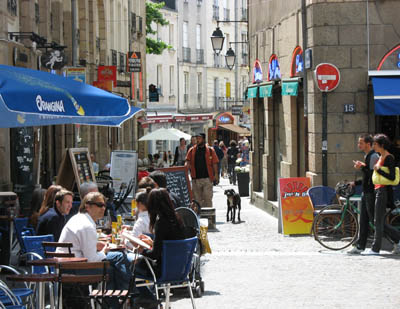
The old quarter in Nantes, the regional capital: almost Parisian.
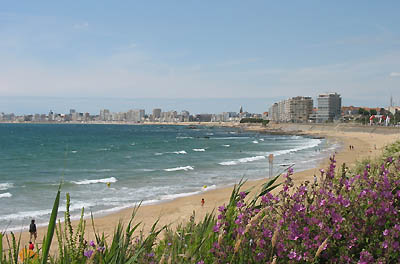
Les Sables d'Olonne - seaside resort in Vendée.
Going further: Official Pays de la Loire tourism site
About-France.com
Home
page - Regions
- Maps of France
- Contact
Photo
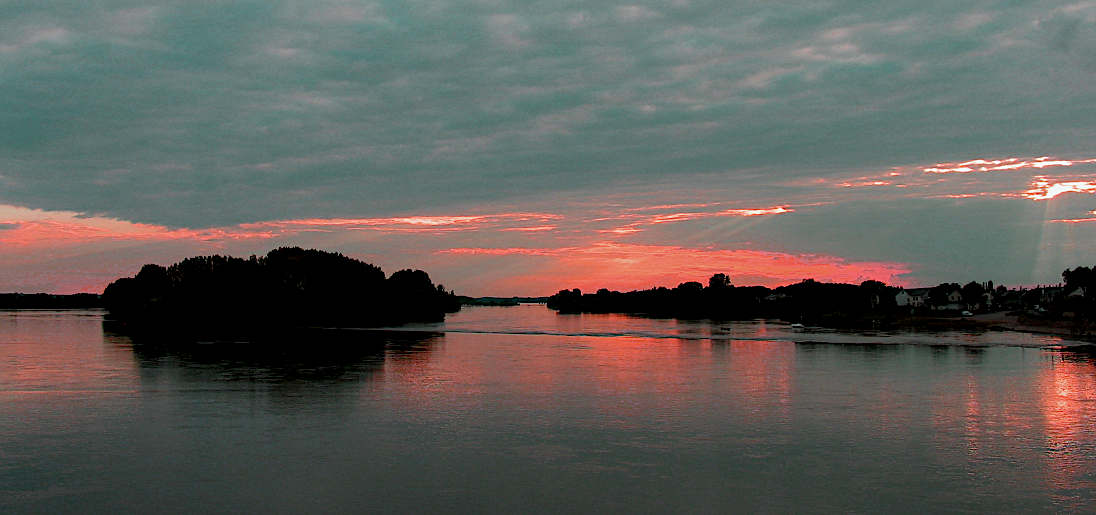
top of page: sunset over the Loire, near Saumur
The Pays de la Loire region covers the area round the lower Loire, from the Sarthe through Anjou to the Vendée. It is not the main area for visiting the famous "Chateaux de la Loire". They are further upstream. For these see the Centre–Val-de-Loire region .
Pays de la Loire accommodation
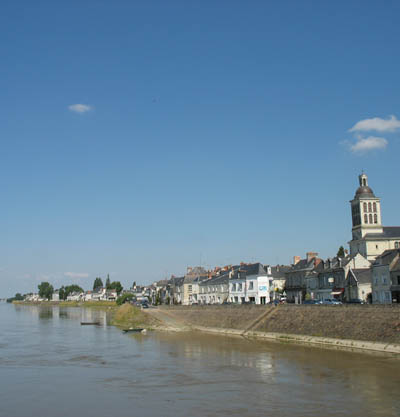
On the banks of the Loire
Text Copyright © About-France.com 2007 - 2025
Photos licenced cc Creative Commons when indicated
Site
search
About-France.com
What are you looking for ? Where do you want to go?
About-France.com
What are you looking for ? Where do you want to go?
The Pays de la Loire region covers the area round the lower Loire, from the Sarthe through Anjou to the Vendée. It is not the main area for visiting the famous "Chateaux de la Loire". They are further upstream. For these see the Centre–Val-de-Loire region .
Pays de la Loire accommodation
Hotels
in Pays de la Loire
►Hotels
in Nantes
►Hotels
in Angers
(49)
► Hotels
in Le
Mans (72)
About-France.com
is an independent and free travel information guide, funded
solely
through affiliate commission that may be earned on bookings made
through selected partner websites.
On the banks of the Loire
| ►► Site guide |
| About-France.com home |
| Full site index |
| About-France.com site search |
| ►► Principal chapters on About-France.com : |
| Guide
to the
regions of France Beyond
Paris, a guide to the French regions and their tourist attractions.
|
| Guide
to Paris Make
the most of your trip to Paris; Information on attractions, Paris
hotels, transport, and lots more.
|
| Accommodation
in France
The different options, including hotels,
holiday gites, b&b, hostels and more
|
| Tourism in France
The
main tourist attractions and places to visit in France - historic
monuments, art galleries, seasides, and more
|
| Planning
a trip to France
Information
on things to do before starting your trip to France.
|
| Driving
in France
Tips
and useful information on driving in and through France - motorways,
tolls, where to stay....
|
| Maps
of France
Cities,
towns, departments, regions, climate, wine areas and other themes.
|
| The
French way of
life
A mine of information about
life and living in France, including
working in France, living in France, food and eating, education,
shopping.
|
| A-Z
dictionary of France Encyclopedic
dictionary of modern France - key figures, institutions, acronyms,
culture, icons, etc.
|
Click here for
low-cost car hire in France
low-cost car hire in France
Text Copyright © About-France.com 2007 - 2025
Photos licenced cc Creative Commons when indicated