
Picardy: from the Somme to the Marne
A guide to Picardy and its tourist attractions
- Explore France ►
- Essential pages
- Travel in France
- Where to go
- What to see and do
About-France.com
- the connoisseur's guide to France
| ► Go to... | About Picardy | Main tourist attractions | Gites in Picardy |
From
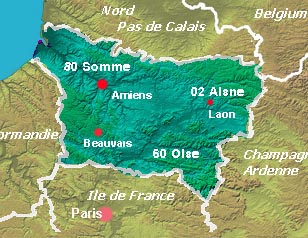
its short coastline on the Channel, at the mouth of the river Somme, to
a brief border with southern Belgium,
Picardy is a region that has been at the heart of European history for
well over a thousand years. Its importance is reflected in its historic
heritage - including some of the finest medieval cathedrals in France,
some impressive chateaux, and many sites and memories of the
Great War
Picardy
Accommodation
Since 2016, Picardy has been combined with the larger area to the north, Nord– Pas-de-Calais, to make up a larger region which has curiously been given the name Hauts de France, though it is probably the most low-lying of all the regions in France.
Stay in Picardy
*** ► Selected Picardy hotels
Online booking at guaranteed rates from Hotels.com, Accor and other reputable hotels sites. About-France.com only lists hotels with good visitor reviews.
St. Quentin (Aisne)
Campanile hotel ** A convenient stop-off for travellers heading south (or back north) on the A26 motorway between Calais and Reims.
 Laon
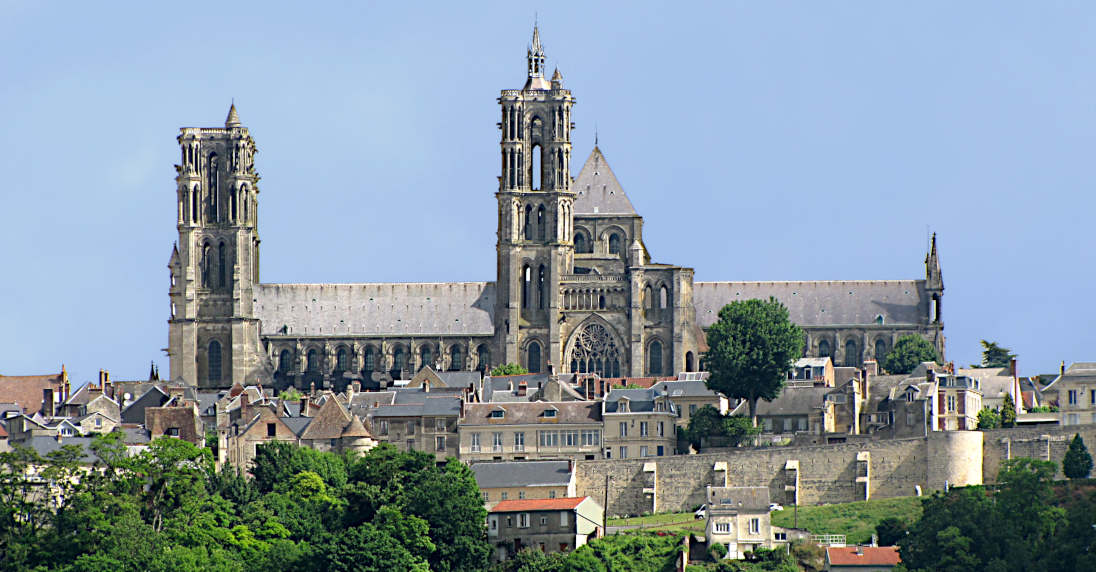
cathedral (12th century) , and city ramparts
Laon
cathedral (12th century) , and city ramparts
Laon (Aisne)
Hotel Campanile ** Modern two-star hotel located on the road betwen the A26 motorway exit and the historic walled city of Laon
Albert (Somme)
Hotel de la Basilique, ** Comfortable small hotel with well recommended restaurant, opposite the basilica. A handy base for exploring the battlefields of the Great War
Amiens (Somme)
Hotel Mercure Amiens Cathédrale
Quality *** hotel in the centre of Amiens, opposite the cathedral. Ten minutes' walk from the station. Air-con, bar, restaurant

► B and B in Picardy
Hotels in Picardy
► Hotels in Amiens
► Hotels in Laon
► Hotels in Beauvais and the Oise
Lying in the historic centre of action of western Europe, in the triangle between Paris, Amsterdam and London, Picardy is an area with a very rich history. It was in this part of France that were fought some of the most famous battles of French and European history, notably the battle of Crécy, and the battle of the Somme. And in the course of the last thousand years, areas that are now part of modern region of Picardy have been ruled over at different times by the English, the Habsburgs, the Spanish and the French.
In past centuries, the region was relatively prosperous; its productive farmlands, including a large expanse of flat or relatively flat land, created wealth in local towns and cities, a wealth now reflected in the many fine gothic churches and cathedrals of the region.
In modern economic terms, Picardy is a region that is divided quite distinctly into two areas. The department of the Oise and the southern tip of the Aisne, in the south of the region, are economically attached to the Paris region; towns like Beauvais, Chantilly and Compiègne, though towns in their own right, form part of the outer circle of suburban Paris, with many people commuting from here into Paris. Even Amiens, the regional capital, is sufficiently close by commuter train to be home to many people working in Paris; though in the case of Amiens, which is an industrial and commercial city, people commute both ways.
As for the northern part of the region, including the departments of the Somme and most of the Aisne, these areas are largely agricultural. Agriculture in the region is particularly centered on cereals and crops. And while cereal production is the the principal agricultural activity of the region, Picardy is also the leading French region for the production of sugar beet (37% of total national production), France being the world's largest producer of sugar beet.
Main tourist attractions and sites in Picardy
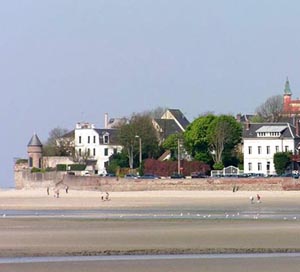
Le Crotoy, at the mouth of the Somme
Photo Mikeones -
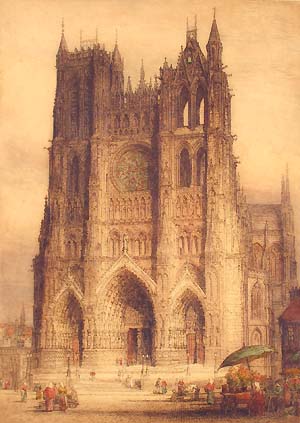 Amiens cathedral.
Nineteenth century etching by Alphege Brewer -
Private collection.
Amiens cathedral.
Nineteenth century etching by Alphege Brewer -
Private collection.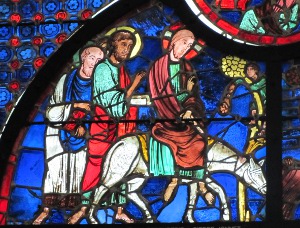
Detail from the 14th century stained-glass windows of Laon cathedral
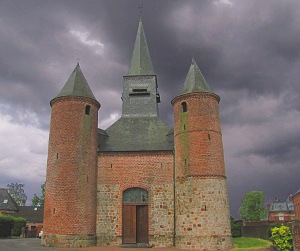 Fortified
church at La Bouteille, Thierache, Aisne.
Fortified
church at La Bouteille, Thierache, Aisne. Going further: Official Picardy tourism site
Somme area
- Albert, Thiepval (80): Sites and monuments to the victims of the Great War, notably the Battle of the Somme. (see WW1 sites and map). There are many more First World War sites and monuments in Picardy
- Amiens (80): One of the finest of the main medieval gothic cathedrals of France.
- Baie de Somme (80): important wetland area at the mouth of the river somme, famous for its wildlife (bird sanctuary). there is also a small steam railway popular with tourists.
- Péronne (80) : Historial de la Grande Guerre - Museum of the Great War. Trilingual displays,
- Samara (80) Between Abbeville and Amiens. Prehistoric living history museum on the site of a prehistoric settlement and Roman oppidum. Reconstructed prehistoric dwellings, animations
Aisne area
- Corbeny, near Laon (02): Caverne du Dragon - system of underground caves and workings used by troops on both sides in the First World War
- Guise (02): Le Familistère Godin. Like Titus Salt's Saltaire or Owen's New Lanark, Godin's cooperative Familistère is a major example of a social housing project set up by an enlightened manufacturer for his workers, during the Industrial Revolution.
- Laon (02): Attractive old walled city perched on a hilltop overlooking the surrounding plains. Fine early gothic cathedral (1150-1180) with remarkable stained-glass windows; there was until recently a funicular railway from the train station up to the town hall - now closed.
- Soissons (02) Small town with gothic cathedral containing fine medieval stained-glass windows. Remains of the St Jean des vignes Abbey.
- St. Quentin (02): small town famous for its gothic basilica, largely rebuilt after the first world war. Also famed for its ensemble of art-nouveau buildings, also put up during the post WW1 rebuilding. The Musée Lécuyer has a major collection of works by the 18th century portraitist Quentin Latour.
- Thiérache (02): A large number of 16th century fortified churches grace small towns and villages in this rural area. Several signposted tourist trails.
Oise area
- Beauvais (60): the tallest of the great gothic cathedrals that were built in medieval France. Planned to be the greatest cathedral in France, Beauvais cathedral was never completed; but the part that was built (the choir and the transept) is extremely impressive.
- Chantilly (60): Magnificent chateau, rebuilt in the 19th century; the chateau houses a museum (the Musée Condé), and is set in fine gardens and parkland that includes a famous racecourse. The Musée Condé includes one of the most important collections of Renaissance art in France, with works by Raphaël and Fra Angelico among the highlights.
- Compiègne (60). The Clairière de l'Armistice; the site of the signing of the 1918 Armistice, that put an end to the first world war. Reproduction of the railway carriage in which the Armistice was signed.
- Compiègne (60). Chateau de Compiègne, fine 18th century royal residence.
- Ermenonville (60): Mer de Sable. Wild-west theme park, with plenty of rides and attractions.
- Plailly (60): Parc Astérix. One of France's most visited theme parks, bringing to life the world of Asterix the Gaul and his friends.
| Page index ► | Regional overview | Main tourist sites |
The
Nord and Pas de Calais area
Photo
top of page: Laon
The historic province of Picardy is nowadays the part of the larger "Hauts de France" region, the part of France most easily accessible for short visits from Britain and Benelux.
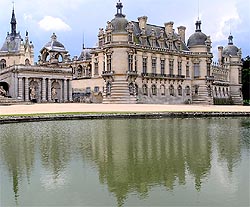
Chateau de Chantilly
photo Arnaud 25
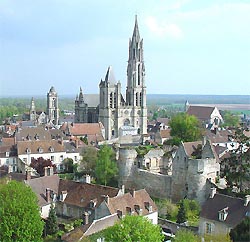
The small town of Senlis:
photo copyright Neuf & 9.
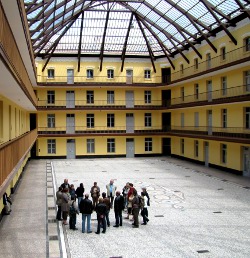
Guise, Aisne. Covered courtyard of Godin's 19th century workers' utopia.
All photos © About-France.com except when otherwise indicated .
Other photos licenced under Creative commons
Text Copyright © About-France.com 2003 - 2025
The historic province of Picardy is nowadays the part of the larger "Hauts de France" region, the part of France most easily accessible for short visits from Britain and Benelux.
Site
search
About-France.com
What are you looking for ? Where do you want to go?
About-France.com
What are you looking for ? Where do you want to go?
About-France.com
- France as it really is
Picardy
,
lying between Paris and the Pas de Calais area, is a relatively unknown
part of France, even for the French. While millions of tourists drive
through Picardy each year, few stop to visit.
Though it is a historic province of northern France, and though it has attractive countryside as well as historic towns and cities and is not far from Paris, from Belgium and from the UK, it is not one of the great tourist areas of France.
Even so, there are plenty of places to visit in Picardy- from major historic sites including some of France's finest medieval cathedrals and the battlefields of the First World War, to fine châteaux and old towns ..... not forgetting the famous Asterix theme park near Chantilly.
Though it is a historic province of northern France, and though it has attractive countryside as well as historic towns and cities and is not far from Paris, from Belgium and from the UK, it is not one of the great tourist areas of France.
Even so, there are plenty of places to visit in Picardy- from major historic sites including some of France's finest medieval cathedrals and the battlefields of the First World War, to fine châteaux and old towns ..... not forgetting the famous Asterix theme park near Chantilly.
Chateau de Chantilly
photo Arnaud 25
| ►► Site guide |
| About-France.com home |
| Full site index |
| About-France.com site search |
| ►► Principal chapters on About-France.com : |
| Guide
to the
regions of France Beyond
Paris, a guide to the French regions and their tourist attractions.
|
| Guide
to Paris Make
the most of your trip to Paris; Information on attractions, Paris
hotels, transport, and lots more.
|
| Accommodation
in France
The different options, including hotels,
holiday gites, b&b, hostels and more
|
| Tourism in France
The
main tourist attractions and places to visit in France - historic
monuments, art galleries, seasides, and more
|
| Planning
a trip to France
Information
on things to do before starting your trip to France.
|
| Driving
in France
Tips
and useful information on driving in and through France - motorways,
tolls, where to stay....
|
| Maps
of France
Cities,
towns, departments, regions, climate, wine areas and other themes.
|
| The
French way of
life
A mine of information about
life and living in France, including
working in France, living in France, food and eating, education,
shopping.
|
| A-Z
dictionary of France Encyclopedic
dictionary of modern France - key figures, institutions, acronyms,
culture, icons, etc.
|
The small town of Senlis:
photo copyright Neuf & 9.
Guise, Aisne. Covered courtyard of Godin's 19th century workers' utopia.
All photos © About-France.com except when otherwise indicated .
Other photos licenced under Creative commons
Text Copyright © About-France.com 2003 - 2025