- Explore France ►
- Essential pages
- Travel in France
- Where to go
- What to see and do
About-France.com
- the connoisseur's guide to France
Where
to
shop, when to shop and other useful tips
Page index: Click a link
| Where to shop | Shopping in Paris | Shopping in other French cities | Factory outlet malls | Shopping
vocabulary |
| Opening times | Pharmacies | Supermarkets & superstores | French Fashion | Paying
with cash or cards |
 Click
for
Click
forCheck out some French
stores that deliver to your country
► See also: Christmas shopping in
France
A cross-Europe
study recently showed prices in French shops to
be among
the lowest in Europe; and perhaps, if you are buying a cross-section of
everyday goods, they are. But tourists do not shop like locals, so the
price advantage of France may not be so obvious to visitors. Besides,
shops selling to tourists are notorious worldwide for high prices, and
France is no exception. With the exchange rate standing at around 1.19 USD to a Euro in Spring 2021, prices in France are attractive for many international visitors. Prices are also attractive for visitors from the UK, as Sterling has gained back about 5% since its lows before Brexit.
Shopping is a major part of the tourist experience in France, specially in Paris, and each year millions of tourists visit France and make a point of heading for the shops at some time during their stay. This page offers general and useful information for tourists intending to do some shopping while on holiday in France.
Prices and sales tax (TVA) :
As is the custom throughout Europe, prices displayed in shops in France always include sales tax ("la TVA" - value added tax). The price you see on the label is the price you will be charged - which can be a pleasant surprise for American or Canadian visitors.Normal shop opening times in France:
However things are changing, and in urban shopping areas, most large shops such as department stores now operate what is called "la journée continue", and do not close at midday. Out-of-town supermarkets in France also tend to stay open at lunchtime, and depending on the town or district, other shops in large urban or suburban shopping centres also stay open. Many smaller shops have reduced their midday closing period, and now shut from, for example, 12.30 to 1.45 - in order to catch office workers who have free time during their midday break.
Out of town supermarkets and superstores - for instance Carrefour, Leclerc, Auchan, Casino, SuperU - (called "centre commerciaux") do not usually close for lunch. They generally open from 8.30 a.m. (or earlier) until 8 p.m. (or later); other large stores in out-of-town shopping centres often close a bit earlier in the evening, often at 7 p.m.
For Sunday opening and other exceptions, see below.
Sunday opening
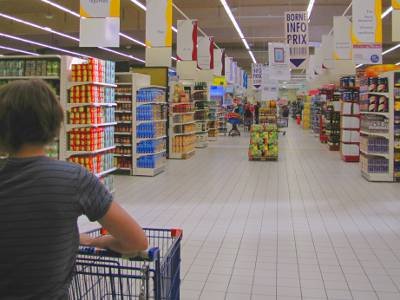
Traditionally speaking, shops do not open in France on Sundays; however the rules have changed in recent years, and now across France you will find supermarkets, DIY and gardening shops open on Sunday morning. In tourist areas the rules are more flexible, and all sorts of shops can now stay open all day. In Paris for instance, the big department stores and shops in the main shopping areas and malls now stay open all day on Sunday, though sometimes with shorter opening hours.
Even more shops are open on Sundays during the Christmas shopping weekends, and Sunday has become one of the busy shopping days
Monday shopping in France:
In small towns, and even in cities, many shops may be closed on Monday morning; some small shops may be closed all day Monday. However it is unusual for out-of-town shopping malls and supermarkets to be closed on Mondays24-hour opening in France:
Don't expect to find this. The idea runs contrary to the French tradition, and there are very few shops indeed that remain open round the clock, except some pharmacies (see below).Bakeries
Bakeries often stay open at the start of the midday break, and close typically from 1 p.m. to 3 p.m., though there is no rule, and each bakery is free to decided its own opening times. similarly, many bakeries stay open later in the evening, specially in towns, and if they have bread left to sell. See the guide to French bread.Pharmacies (chemists)
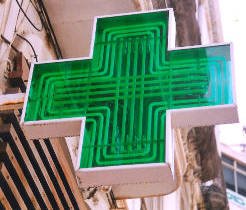
Luminous green sign outside a pharmacy
Chain stores: supermarkets (supermarchés) and superstores (hypermarchés)
The main national chains:
- The giants: Carrefour, Auchan, E.Leclerc, Géant Casino. These stores sell virtually everything useful for everyday living.
- Supermarkets or neighbourhood "hypers": Super-U, Carrefour Market , Simply , Cora, Casino, Intermarché, Ecomarché
- City-centre supermarkets / department stores: Monoprix , Galeries Lafayette
- Hard Discount: Leader Price, Ed, Aldi, Lidl, Netto
Specialist stores
Main national chains other than food, found in out-of-town shopping malls (this is by no means a complete list):Sportswear: Decathlon, Sport 2000, Intersport
Computer equipment: Boulanger
Furniture, white goods: Darty, But, Conforama, Maisons du Monde
Clothing: Kiabi, la Halle aux Vêtements, Orchestra
DIY : Castorama, Leroy Merlin, Brico Dépot, Monsieur Bricolage, Weldom.
French fashion
 The
top French fashion houses such as Yves St. Laurent, Chanel or Dior
have their own boutiques in Paris (see Champs
Elysées)
: they also retail through major department stores in Paris and through
their boutiques in other main cities and up market resorts like
Courchevel or Saint Tropez.
The
top French fashion houses such as Yves St. Laurent, Chanel or Dior
have their own boutiques in Paris (see Champs
Elysées)
: they also retail through major department stores in Paris and through
their boutiques in other main cities and up market resorts like
Courchevel or Saint Tropez. For those looking for affordable French fashion stores, for young or old, France has plenty of choice through a range of brands available in main department stores, or through fashion boutique chains present in most city centres and many out-or-town shopping malls; these include Alain Manoukian, Jules, Mexx, Naf-naf, Kookaï, Pimkie, Brice, Petit Bateau, and plenty more.
Factory outlet malls in France
France has a couple of dozen factory outlet malls, mostly in northern France. Of particular interest to holidaymakers from the UK or Benelux are the Usine Côte d'Opale factory outlet centre at Coquelles next to the Channel tunnel exit, two factory outlet centres at Troyes, near the A26 motorway from Calais to the south of France (fashion, household appliances), or the La Seguiniere Factory Outlet at Cholet, in the Loire Valley close to Vendée. For more details and addresses, visit MarquesAvenue.comWhere to shop in Paris:
Central Paris:Rue de Rivoli (running from the Place de la Concorde, past the Louvre, to central Paris) and the central end of Rue du Faubourg Saint Honoré, one block to the north. This the area with the most chic shops in Paris.
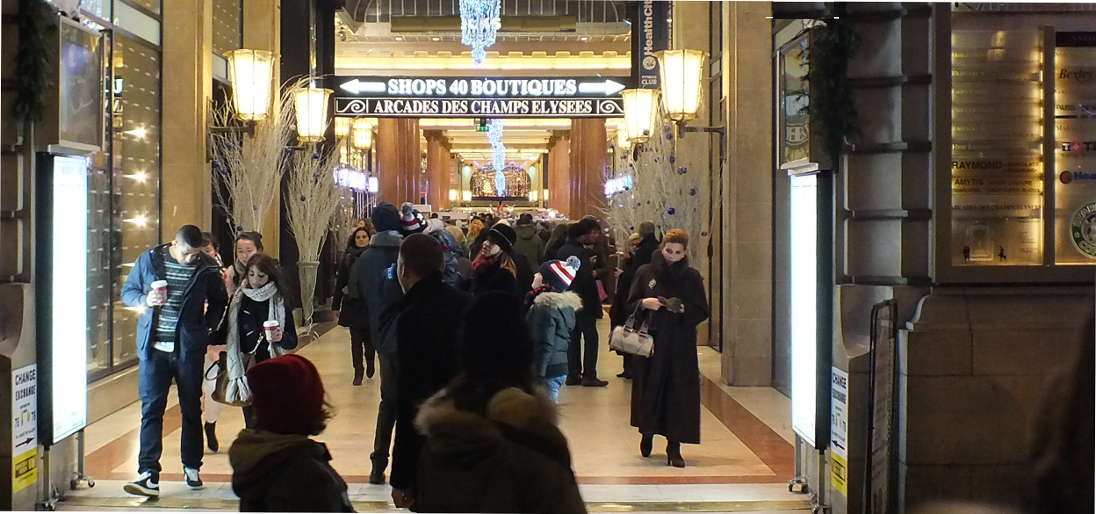
The Champs Elysées: These days most of the shops on the Champs Elysées are flagship outlets for large international chains, from Hugo Boss to Disney to Zara, and the inevitable McDonalds - plus a few very chic shops, but beware of the prices. With the a few exceptions such as Lacoste, Sephora, Cartier and Louis Vuitton, French stores have been pushed out; the major French fashion stores and perfume houses however are not far away, many of them on Avenue Montaigne (Dior, Chanel etc.). Avenue Montaigne meets the Champs Elysées at the level of Franklin D Roosevelt metro station.
On or near the Boulevard Haussmann, near the Opéra. This is the main boulevard for the big department stores, including Galeries Lafayette, Printemps, la Samaritaine, C & A.
Left Bank (Boulevard St. Michel): book stores, including Gilbert, the biggest in Paris.
Les Halles / le Marais and the lower end of the Rue de Rivoli; fashionable French and international chainstores, and trendy outlets. The "Forum des Halles", a large urban shopping mall, has outlets for virtually all the off-the-peg fashion retailers present in France, both French such as Kookaï, Camaïeu, Comtoir des Cotonniers, Naf-Naf, Esprit or Jules, and international including Benetton, Gap and Quiksilver.
Shopping in other French towns and cities.
Provincial towns and cities: town centres remain among the principal shopping areas, with the more select boutiques and shops, including up-market and mid-market national chains and franchises. Out-of-town shopping malls offer the big hypers, as well as a range of small shops, mostly mid-market popular chains, in all fields from clothing, footwear and music, to opticians and accessories. Many out of town hypermarkets are open until 9 p.m.Calais, Cité Europe shopping centre: the Carrefour and Tesco outlets in this large shopping centre next to the Channel tunnel terminal have long opening hours, 8.30 a.m to 9 p.m. or 10 p.m.
Grasse, Alpes Maritimes, Provence. Capital of the French perfume industry. Buy top quality perfumes direct from the producers.
Shopping in rural France.
Paying for things in France :
Paying with plastic: virtually all but the very smallest shops, such as neighbourhood convenience stores, accept credit cards and debit cards, notably Visa and Mastercard. In virtually all cases, foreign cards, including UK cards, are accepted in France as long as they are of the more modern chip and pin variety; old-fashioned swipe cards may not be accepted. Contactless cards can be used for small purchases, generally limited to 20€ or 30€.Other means of payment
Large department stores in cities may take travellers' cheques, otherwise most shops accept French cheques as long as the customer has ID. All shops accept cash (euros) - which can be obtained from any French ATM as long as you have a valid card from one of the main international operators (Visa, Mastercard, Cirrus, etc.)
Markets: See the markets of France page.
Essential shopping vocabulary:
Here are the French words for common types of shop:Supermarket:
supermarché (soup-air-marsh-eh)
Grocery store: épicerie (eh-pee-siree)
Bakers: boulangerie (boo-lonje-euree)
Cake shop: patisserie (pat-ee-seurie)
Butchers: boucherie (boo-sheuree)
Chemists: pharmacie (farm-assee)
Cobblers, shoe repairer: cordonnerie (cordonn-eurie)
Tobacconists: un tabac (ta-back)
Bookshop : librairie (lee-brair-ree)
DIY store: magasin de bricolage (mag-a-zann de bree-co-large)
Clothes shop: magasin de vêtements (mag-a-zann de vet-mon)
Wine merchants: marchand de vins (mar-shone de van)
Estate agents: agence immobilière (a-zhonse ee-mo-bee-leeair)
Newsagents: maison de la presse (may-zon de la press)
Grocery store: épicerie (eh-pee-siree)
Bakers: boulangerie (boo-lonje-euree)
Cake shop: patisserie (pat-ee-seurie)
Butchers: boucherie (boo-sheuree)
Chemists: pharmacie (farm-assee)
Cobblers, shoe repairer: cordonnerie (cordonn-eurie)
Tobacconists: un tabac (ta-back)
Bookshop : librairie (lee-brair-ree)
DIY store: magasin de bricolage (mag-a-zann de bree-co-large)
Clothes shop: magasin de vêtements (mag-a-zann de vet-mon)
Wine merchants: marchand de vins (mar-shone de van)
Estate agents: agence immobilière (a-zhonse ee-mo-bee-leeair)
Newsagents: maison de la presse (may-zon de la press)
And some useful shopping phrases .....
I'd like to... Je voudrais (Zhe voodray ... )
Pay by card : payer par carte (peh-yeh par cart)
Pay in cash: payer en liquide (peh-yeh on lee-keed)
Can I try this on please... Est-ce que je peux l'essayer, s'il vous plait. (Esker zhe per l'ess-say-yeh see voo play)
It's too big / small : C'est trop grand / petit (Say tro gron / petee)
It's for a gift : C'est à offrir (Say tar off rir)
Please can you wrap it up : pouvez vous l'emballer s'il vous plaît (poovay voo l'om-balay see voo play)
Please can you gift wrap this: pouvez vous faire un emballage cadeau, s'il vous plaît (poo-vay voo fair ern om-balarge cado see voo play)