

Traditional markets in France
Part of the French way of life
- Explore France ►
- Essential pages
- Travel in France
- Where to go
- What to see and do
About-France.com
- a connoisseur's guide to France
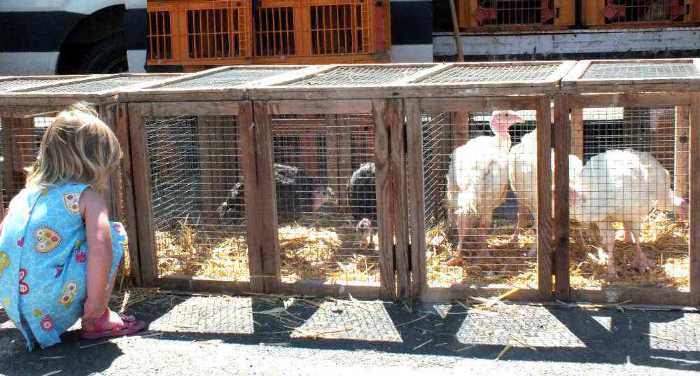
 In
countries like the UK and the USA, the market
is largely a tradition that has been revived,
in the form of "farmers' markets"; in France, the tradition did not
need to be revived, as traditional fruit and vegetable markets, as well
as markets offering a much wider array of stalls, have always remained
a part of life in France. The market, as a source of fresh fruit and
vegetables, is an integral part of France's famed tradition of good
eating, and is one of those French traditions that never
died.
And for that reason it is as authentic an experience as one can wish to
find.
In
countries like the UK and the USA, the market
is largely a tradition that has been revived,
in the form of "farmers' markets"; in France, the tradition did not
need to be revived, as traditional fruit and vegetable markets, as well
as markets offering a much wider array of stalls, have always remained
a part of life in France. The market, as a source of fresh fruit and
vegetables, is an integral part of France's famed tradition of good
eating, and is one of those French traditions that never
died.
And for that reason it is as authentic an experience as one can wish to
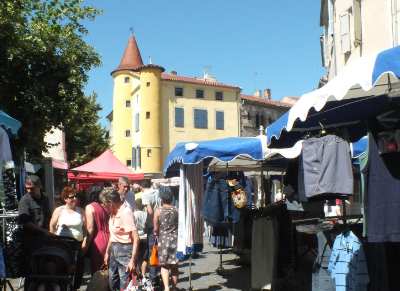
find.Most towns and large villages have a large market once a week; but in larger towns, markets may take place twice a week, or even every day. Typical French markets are a mix between the farmers' market and a traders' market, with stalls offering local produce straight from the farm standing alongside fruit and vegetable stalls, cheese stalls and other stalls offering a full range of produce. Even in Paris, fruit and vegetable markets can be found in every district of the city.
The largest markets in provincial France are often known as fairs (foires) : as in the olden days, French fairs are traditional extended markets that take place perhaps once or twice a year, on the local saint's day for instance. In a few places, they take place once a month. Most of them used to be livestock markets, but that aspect of them has largely disappeared; today they are expanded versions of large weekly markets that attract more traders from a wider area; there will usually be an eclectic and colourful array of ironmongers, clothes stalls, large organic produce stalls, craft stalls, plus the normal range of fruit and vegetable sellers and much more. In rural areas, there is often a small funfair too.
Foires are big events in a local calendar, and it is always a good idea to check with the local tourist office to find out when they take place.
Virtually every French town has its covered market (marché couvert), which is a permanent structure, occupied by an array of market stalls; in a classic "marché couvert", sometimes called "les Halles", most of the stalls will sell fresh fruit and vegetables, and some of the stall-holders will also be local market-gardeners, selling their own produce among other products imported from further afield. More recently, "halles" been attracting a growing number of expensive delicatessen stalls, and upmarket local product stalls, at the expense of traditional fruit and vegetable sellers, for whom the rents are too high. There is often a cluster of good restaurants to be found close to the covered market in a French town, and chefs will each morning pay a visit and bring back boxes of the freshest fruit and vegetables.
Other stalls are likely to include butchers, bakers, and delicatessens offering specialities from other countries such as Vietnam, Spain, or Italy. In Paris, fruit and vegetable markets spring up on the pavements under the trees beside wide boulevards on different days of the week, often on Saturday or Sunday morning.
 Large weekly markets are attended both
by local
stall-holders, and by a range of specialised traders who will set up
their stall on a different market each day of the week. Very often, the
larger town in an area will have its weekly market on Saturdays, and
smaller towns will have theirs on other days; in these smaller markets,
the number of itinerant stall-holders will depend on the number of
other markets on the same day within their area, and the relative
interest of each of these markets. Thanks to these itinerant
stallholders, larger weekly markets have a rich range of specialised
stalls, offering organic vegetables, food specialities from the region
or from other countries, olives and Mediterranean specialities, tools,
clothes, second-hand books, garden plants, wine straight from the
producer, honey and a lot more.
Large weekly markets are attended both
by local
stall-holders, and by a range of specialised traders who will set up
their stall on a different market each day of the week. Very often, the
larger town in an area will have its weekly market on Saturdays, and
smaller towns will have theirs on other days; in these smaller markets,
the number of itinerant stall-holders will depend on the number of
other markets on the same day within their area, and the relative
interest of each of these markets. Thanks to these itinerant
stallholders, larger weekly markets have a rich range of specialised
stalls, offering organic vegetables, food specialities from the region
or from other countries, olives and Mediterranean specialities, tools,
clothes, second-hand books, garden plants, wine straight from the
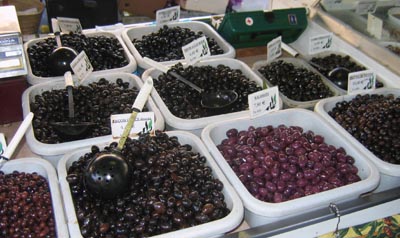
producer, honey and a lot more.A few markets, notably specialised markets, have acquired a national reputation; there is the famous flea market at the Porte de Clignancourt in Paris, the flower market in Nice, the Christmas markets in Strasbourg, the olive markets in Provence (photo), or the fish market round the old port in Marseilles. There are wine markets in Bordeaux, and famous gastronomic markets in Perigueux, the heart of French truffle and foie-gras country. But generally speaking, markets are a local or regional event, attended by local producers, craftsmen or traders, and as such they are not the type of event that has any reason to acquire a national reputation; markets are just a part of the French way of living.
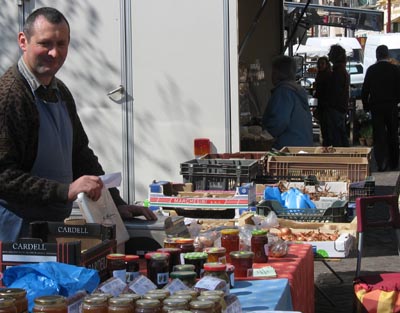 Obviously, it is fruit , vegetables and local produce in general that
are the mainspring of most markets, and the smaller the market, the
more it will tend to be an outlet for local producers. In rural areas,
it is still possible to find markets where small farmers sell just
their own produce - potatoes, vegetables and fruit in season, flowers,
perhaps farm-produced cheese, home-made bread, eggs, and even a living
rabbit or two, or week-old chicks. Although the number of small farms
in France has fallen dramatically in recent decades, there is still an
elderly generation of smallholders ("paysans") who attend weekly
markets in the way they have been doing for the past thirty or forty
years. Yet in spite of France's attachment to its rural heritages, the
smallholders selling their produce at a weekly market are survivors
from the old rural way of life which is fast vanishing. It is unusual
to see young smallholders on a market in rural France,
and while
the market itself, as a tradition, is not under threat, the nature of
small rural markets is changing, as is rural France in general. In
twenty years' time, there will still be plenty of markets in France;
but will there be as many, and will they still be rich in tradition as
they are today? That is less sure.
Obviously, it is fruit , vegetables and local produce in general that
are the mainspring of most markets, and the smaller the market, the
more it will tend to be an outlet for local producers. In rural areas,
it is still possible to find markets where small farmers sell just
their own produce - potatoes, vegetables and fruit in season, flowers,
perhaps farm-produced cheese, home-made bread, eggs, and even a living
rabbit or two, or week-old chicks. Although the number of small farms
in France has fallen dramatically in recent decades, there is still an
elderly generation of smallholders ("paysans") who attend weekly
markets in the way they have been doing for the past thirty or forty
years. Yet in spite of France's attachment to its rural heritages, the
smallholders selling their produce at a weekly market are survivors
from the old rural way of life which is fast vanishing. It is unusual
to see young smallholders on a market in rural France,
and while
the market itself, as a tradition, is not under threat, the nature of
small rural markets is changing, as is rural France in general. In
twenty years' time, there will still be plenty of markets in France;
but will there be as many, and will they still be rich in tradition as
they are today? That is less sure. Website
Copyright
© About-France.com except where otherwise stated.
About-France.com
Home
page - Site
search
- Regions
- Maps of France
- Contact
Photo top of page: market in Beaune
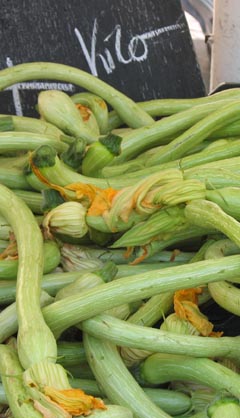
Unusual vegetables on a Provençal market

Red mullet - Mediterranean speciality

Copyright text and photos © About-France.com 2003 - 2026
Unusual vegetables on a Provençal market
Red mullet - Mediterranean speciality
Copyright text and photos © About-France.com 2003 - 2026
Click here for
low-cost car hire in France
low-cost car hire in France