

The French Riviera
The Côte d'Azur - France's Mediterranean playground
About-France.com
- the connoisseur's guide to France
- Explore France►
- Essential pages
- Travel in France
- Where to go
- What to see and do
Holiday time on the French Riviera
| On this page: ► | Riviera hotels | How to get there | Menton to Nice |
| South of Fréjus | Esterel: Cannes to Fréjus | Nice to Cannes |
A stretch
in the sun...
 It's
no surprise that the French Riviera is a major tourist
attraction. Situated at and to the east of the point where the Alps
meet the Mediteranean, it is an area that enjoys a
wonderfully
mild to warm climate all year round, despite being one of the
more
northerly coasts
on the whole Mediterranean. Through Autumn and Winter,
the Riviera is protected from cold north winds by the Alps in its
hinterland; since frosts and snow are rare, Spring comes early,
bringing the first mimosas into bloom by February; by April the days
are normally sunny and warm, and gardens already filled with flowers.
F
It's
no surprise that the French Riviera is a major tourist
attraction. Situated at and to the east of the point where the Alps
meet the Mediteranean, it is an area that enjoys a
wonderfully
mild to warm climate all year round, despite being one of the
more
northerly coasts
on the whole Mediterranean. Through Autumn and Winter,
the Riviera is protected from cold north winds by the Alps in its
hinterland; since frosts and snow are rare, Spring comes early,
bringing the first mimosas into bloom by February; by April the days
are normally sunny and warm, and gardens already filled with flowers.
F
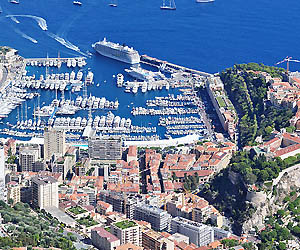 Looking
down on Monte Carlo
Looking
down on Monte Carlo
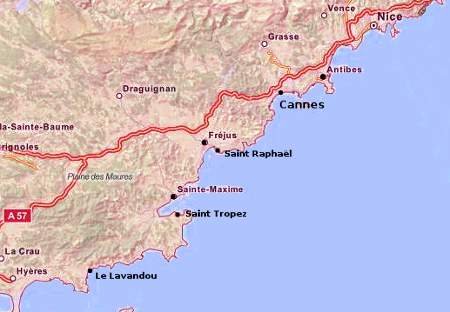
Main areas and resorts of the French Riviera
East of Nice
(From the Italian border to Nice) This is the most spectacular part of the French Riviera, and also the most up market in terms of tourism. This is where the Alps meet the Mediterranean, and mountains come almost down to the waters' edge. Old towns such as Menton or Villefranche sur Mer are crowded in between the water's edge and the mountains behind. The most famous of these towns is Monte-Carlo,Monte Carlo
In the tiny Principality of Monaco, an independent state surrounded on three sides by France, and on the fourth by the Mediterranean, and ruled by the Grimaldi family since the 13th century.Monte-Carlo, most famed for its casino, is an opulent micro-state, with the world's highest per-capita GDP: hemmed in between the mountains and the sea, it is also one of the most densely populated states in the world. It is a tax-haven in so far as residents do not pay any income tax, but it is not a tax-free country, and VAT is the same as in France. This does not prevent Monaco from abounding in prestigious luxury shops, and for visitors searching for the most famous brands in designer clothing, jewellery and other luxury goods, Monaco offers great shopping opportunities (as does Nice).
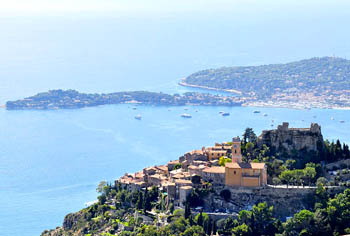
The village of Eze, overlooking Cap Ferrat
Inland, a few twisting mountain roads take visitors past breathtaking views, and up to old villages such as Eze, huddled into narrow valleys or clinging resolutely to the sides of steep slopes. But this part of the Riviera is resolutely turned to the sea.
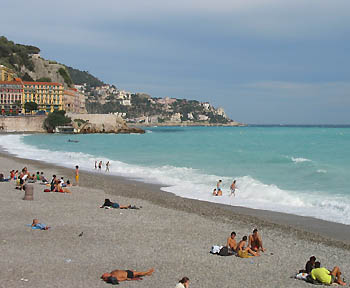
Nice - beach in frront of the Promenade des Anglais
From Nice to Cannes
Nice
the French Riviera is largely built up. Nice is France's sixth city, as well as being the biggest resort on the French Riviera. Nice is a city that has masses to offer, including historic quarters, a beautiful long seafront (from the Promenade des Anglais and westwards), a famous flower market, some interesting sites and sights, including the Matisse museum, the Chagall museum, and the famous Russian Orthodox basilica . It is also very well endowed in hotels, from five-star palaces such as the Negresco, to backpacker hotels away from the tourist quarter. And of course it is a city with plenty of nightlife and plenty of opportunities for shopping, in all seasons. ► More on Nice.Cagnes sur Mer
This town has a historic old quarter, as well as a famous racecourse (for horse racing), and a Renoir museum. Inland from Cagnes lies the old village of Saint Paul de Vence, known as the artist's village, and famous for its art galleries, most importantly the Fondation Maeght, with a remarkable collection of 20th century art and sculpture.A few miles south of Cagnes, Antibes is one of the classic resorts of the French Riviera. With its old town, its marina, its 48 beaches and its rocky headland, Antibes has long been a popular resort. It too has a number of museums, including the Picasso museum, with one of the best collections of Picassos in France.
Just west of Antibes lies Juan les Pins, another very smart but small Mediterranean resort, popular with film stars and actors. of course, both Antibes and Juan les Pins offer plenty of night life, specially in season.
Cannes,
Lying to the west of Antibes, Cannes is the other main city of the French Riviera: Cannes is of course most famous for its annual Film Festival, which after the Hollywood Oscars ceremony is the biggest annual event in the world of film. Cannes is also a popular venue for trade fairs, including the annual music industry fair, the Midem, that takes place in late January. During these events, the town attracts visitors hoping to get a glimpse of their favourite film-star or musician; and of course, it is a town with plenty of tourist accommodation and beaches. Anyone thinking of visiting Cannes at the time of a major event should book their accommodation months in advance.A few miles inland from Cannes lies the small town of Grasse, capital of the French perfume industry. The famous Fragonard perfumery offers free guided factory visits and perfume museum visits.
The Esterel coast - la Napoule - Fréjus
This part of the coast is less developed, mainly on account of the hills and forests that come almost to the water's edge. Apart from Fréjus and Saint Raphaël, the resorts are small, offering a quieter holiday style. The dry and rocky Esterel hills, with their Mediterranean pine forests, are popular with hikers and walkers. The coastline between Miramar and Saint Raphaël is full of little coves, many of them only accessible by foot from the coastal road, the "Corniche de l'Esterel", a scenic route offering magnificent views of the coastline and out to sea.San Raphaël is a small resort, with hotels, sandy beaches and a casino; its neighbour, Fréjus, slightly larger, is a historic city dating back to before Roman times, most popular these days on account of its large marina.
South of Fréjus - the western Riviera
 Saint
Tropez
Saint
Tropez
The other popular resorts in this part of the Riviera are the small towns of Sainte Maxime and Le Lavandou, old towns with harbours, shops, and markets as well as hotels and campsites.
On the capes to the east and the west of le Lavandou, and on the offshore islands, the Port Cros national park is France's only maritime national park, covering both terrestrial and marine environments. There are boats from le Lavandou out to the island of Port Cros.
Click for French Riviera hotels pre-selected by area and category - from budget to luxury hotels
Copyright ©
About-France.com except where otherwise stated.
About-France.com
Home
page - Site
search
- Regions
- Maps of France
- Contact
Until
a few eccentric Englishmen arrived in the late 18th century, France's
famous Riviera - known to the French as the Côte d'Azur - was
an area of sleepy fishing villages, with little
contact with the outside world. Then tourism was invented, and
foreigners, at first mostly from Britain, began arriving in increasing
numbers. The seafront at the little town of Nice became known as "La
Promenade des Anglais" - and so it is still called to this day. Today
the French Riviera
is one of the world's most famous coastlines; and in
spite of heavy development, it still boasts many fine beaches and
plenty of beautiful shorelines
HOTEL
FINDER
for the French Riviera
For the independent traveller: a large choice of Riviera hotels and apartments, from sea-front palaces in Nice or Cannes, to smaller and more affordable hotels away from the centres, or slightly inland.
for the French Riviera
For the independent traveller: a large choice of Riviera hotels and apartments, from sea-front palaces in Nice or Cannes, to smaller and more affordable hotels away from the centres, or slightly inland.
►
Select an
area & category
for
a full broad choice of hotels and the best discounted online booking
rates
available
| Resorts
(east to west) |
Two- star |
Three- star |
Luxury hotels |
| Menton / Roquebrune | Select | Select | Select |
| Monaco / Monte Carlo | Select | Select | Select |
| Villefranche
Beaulieu / St Jean |
Select | Select | Select |
| Nice | Select | Select | Select |
| Cagnes |
Select | Select | Select |
| Antibes Juan les Pins |
Select | Select | Select |
| Cannes, | Select | Select | Select |
| Fréjus / San Raphael | Select | Select | Select |
| Saint Tropez | Select | Select | Select |
| Hyères / le Lavandou | Select | Select | Select |
These
links will take you to Booking.com,
Europe's leading hotel booking portal. Booking.com
offers lowest online
rates, no booking charge, no administration charge and generally no
cancellation charge. In most cases, payment will not be
charged in
advance, but only once you reach your hotel or have completed your stay.
As an affiliate About-France.com may receive a small commission on sales made through our partners, at no extra cost to the buyer.
As an affiliate About-France.com may receive a small commission on sales made through our partners, at no extra cost to the buyer.
Access:
Getting to the French RivieraThe Riviera is well served by flights to Nice airport, one of the busiest in France. Nice airport lies between Nice and Cagnes sur Mer, and is well linked to Riviera resorts by bus and coach services. It is also linked to Monaco by helicopter services. There are also a few low-cost flights serving the airport at Toulon.
The whole of the Riviera coast is well served by train, the main Marseilles- Ventimiglia railway running close to the shore for much of the way between Toulon and the Italian border. There are direct TGV services from Paris, Brussels, LIlle, Strasbourg and other cities. Click here for train times and tickets.
Related
pages:
Click here for
low-cost car hire in France
low-cost car hire in France
Photo top of page: Eze, by G Koszegi
Saint Tropez by La Coccinelle