

The coasts of France
An inside guide to the coastlines and beaches of France
- Explore France ►
- Essential pages
- Travel in France
- Where to go
- What to see and do
Site
search
About-France.com
About-France.com
- the connoisseur's guide to France
Seaside areas around France - from the best beaches to the most secluded coves
 What
is the French seaside like? What are the seashores and beaches like?
Where are the best beaches in France? These are questions that tourists
often ask; but with over 2000 miles of coastline, continental
France (i.e., excluding Corsica) has plenty of coastline and beaches of
different sorts to satisfy the millions of tourists and holidaymakers
who flock to them each summer. From popular crowded resort beaches to
vast empty expanses of golden sand, France has beaches for all tastes.
This also means that for the foreign visitor, a holiday
on the French coast can sometimes be a disappointment if the resort or
region chosen has the wrong kind of seaside or seashore.
What
is the French seaside like? What are the seashores and beaches like?
Where are the best beaches in France? These are questions that tourists
often ask; but with over 2000 miles of coastline, continental
France (i.e., excluding Corsica) has plenty of coastline and beaches of
different sorts to satisfy the millions of tourists and holidaymakers
who flock to them each summer. From popular crowded resort beaches to
vast empty expanses of golden sand, France has beaches for all tastes.
This also means that for the foreign visitor, a holiday
on the French coast can sometimes be a disappointment if the resort or
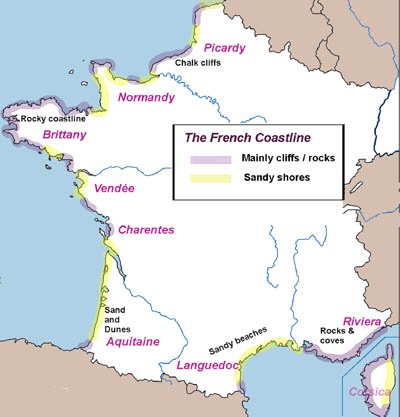
region chosen has the wrong kind of seaside or seashore.The map above divides the French coast very schematically into two types: in pink, coasts that are predominantly rocky, often with cliffs; in yellow, the flatter areas of coastline, where there are plenty of long sandy beaches.
Here, in greater detail, is a description of the French coastline, taken in an anti-clockwise direction, and starting at the top, on the Belgian border.
The North coast
The extreme north coast of France, from Belgium to Calais, borders on the North Sea, and is characterised by broad sandy beaches and sand dunes.
The Channel coast near Cap Gris Nez
In the north of Normandy, the chalk cliffs return, culminating in the famous cliffs of Etretat, the highest in France. The small seaside resorts, tucked into creeks, were once very popular with Parisians.
Beyond the mouth of the Seine, and the pretty historic port of Honfleur, the Normandy coast is generally a mix of broad sandy beaches with, here and there, low cliffs and pebbly beaches. This mixed shoreline, the site of the Second World War Normandy landings, carries round and up the Cotentin peninsula.
The northern end of Cotentin is marked by another rocky area, with granite cliffs and sandy beaches, rather like the Channel Islands which are close by.
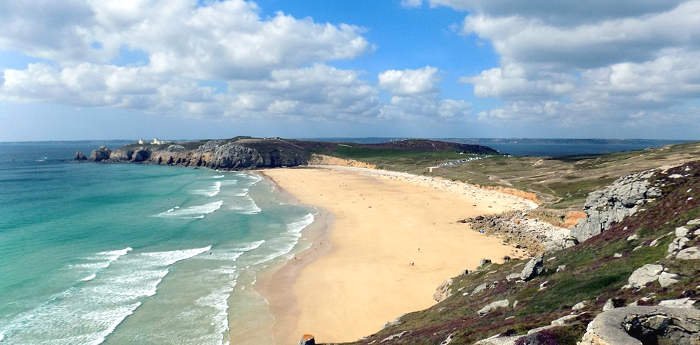
Coast in the west of Brittany
At the western base of the
Cotentin peninsula, Normandy becomes Brittany,
and after the flat shores surrounding the Bay of Mont Saint Michel,
the
coastline is then very rugged and rocky right round the Breton coast,
as far as the department of Morbihan, in the south. The
variety of
the rocky north Breton coast is reflected in the names of sections of
this coast;
the Jade Coast, the Emerald Coast near Saint Malo, the
Pink Granite coast (sounds
better in French!), and the Wild Coast. But along with the rocks and
cliffs, this coastline, like that of North Cornwall, offers a wealth of
sandy coves and beaches. Click here a carefully selected choice of hotels on the
coast of Brittany.
The south
Breton
coast is warmer and less rugged than the north, and in the department
of Morbihan, the coast is characterised by fine sandy beaches. (photo
above)The Atlantic coast
Southwards from the mouth of the Loire, from Vendée, through Charentes and as far as the Gironde, the Atlantic coast is largely made up of long sandy beaches; coastal towns and villages, such as La Rochelle, Les Sables d'Olonne and Rochefort, have tended to spread along behind the shoreline, but in many parts, the beaches are backed by a band of pine forests, and can be remarkably uncrowded even in summer.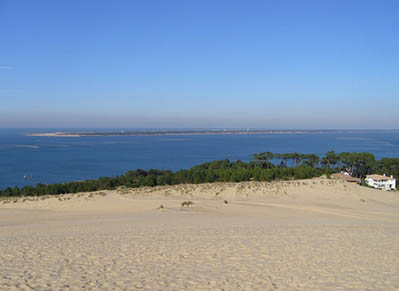 South
of the Gironde, the Aquitaine
coast is famous for its long sandy beaches, but also for its forests
that come right up to the coastline, or at least up to the band of sand
dunes behind the beaches. At the entrance to the Bay of Arcachon, the
Dune du Pilat (photo left) is the highest sand dune in Europe - over
300 ft high, and almost two miles long.
South
of the Gironde, the Aquitaine
coast is famous for its long sandy beaches, but also for its forests
that come right up to the coastline, or at least up to the band of sand
dunes behind the beaches. At the entrance to the Bay of Arcachon, the
Dune du Pilat (photo left) is the highest sand dune in Europe - over
300 ft high, and almost two miles long. Known as the "Côte d'Argent" or Silver Coast, the shoreline between the estuary of the Gironde and Capbreton, the coast offers mile upon mile of unbroken sandy beaches, often accessible only on small tracks through the forest.. This all changes as one reaches the Basque country, where the seaside is quite built up from Capbreton via Bayonne and Biarritz to the Spanish border.
The Mediterranean coast
 The
south coast of France is conveniently divided into two sections, west
of the Rhone (Languedoc), and east of the Rhone (Provence - Riviera). Languedoc
offers mile upon mile of sandy seashores - though the Mediterranean
being non-tidal, these sandy beaches are not generally as broad as
those of the Atlantic coast. On the other hand, the water is
usually
warmer.
The
south coast of France is conveniently divided into two sections, west
of the Rhone (Languedoc), and east of the Rhone (Provence - Riviera). Languedoc
offers mile upon mile of sandy seashores - though the Mediterranean
being non-tidal, these sandy beaches are not generally as broad as
those of the Atlantic coast. On the other hand, the water is
usually
warmer. The Languedoc coast is a popular tourist destination.Around the Rhone delta, between the Camargue and Marseilles, the coast is not particularly touristy; with the proximity of shipping ports - Fos and Marseilles, and the water coming from the River Rhone, this is not the best part of the French coast, though there are some attractive small beaches. The Camargue itself has long beaches, not always very accessible as this is a protected wetland area. The main tourist beaches, with their long expanses of sand, lie between the western end of the Rhone delta and Argelès sur Mer, south of Perpignan. There is then a short section of rocky coastline from Collioure to Cerbère and the Spanish border. At actual resorts, beaches can be busy in summer time; but between the resorts, there is plenty of room for everyone, even at the peak of the holiday season.

Riviera
hotels from
East
of Marseilles,
it is a different story. This is the start
of the Provence
and the French
Riviera,
a rocky jagged coast
characterised by
its small inlets, shingly or
sandy beaches, and beautiful landscapes. It should be noted that a lot
of the beaches here are of shingle or fine pebbles, including the
famous beach beside the seafront at Nice. This is the region with the
most famous of French seaside resorts - Saint Tropez, Juan les Pins,
Saint Raphael, Cannes, Nice
and many others. It is an
area that is extremely popular in summer, and holidaymakers thinking of
going here in July or August should make sure that they have booked up
their hotel - or campsite - well in advance.Hotels
.com
.com
As for the "best beaches in France", that's really a matter for individual choice; but for good measure, here is a selection of ten of the many great beaches to be found in France.
The Mediterranean by train
Many Mediterranean resorts and smaller towns can be reached directly by train. These include Marseilles, Nice and Cannes - but also smaller resorts like Cerbère, Collioure, Anthéor, le Trayas, where the train stations are just a few hundred meters from the beach.Ten of the best beaches in France
 This
list is in anti-clockwise order, going round the coast of France from
Calais in the North, via the Atlantic coast, then across the
Mediterranean coast to finish at Nice. These are all large spacious
beaches; The beaches at Le Touquet, La Baule, Chatelaillon, Biarritz
and Nice are in popular seaside resorts, and may become relatively
crowded in peak season; the others are in small resorts or between
resorts, and are liable to have plenty of space for all even during the
busiest time of the holiday season.
This
list is in anti-clockwise order, going round the coast of France from
Calais in the North, via the Atlantic coast, then across the
Mediterranean coast to finish at Nice. These are all large spacious
beaches; The beaches at Le Touquet, La Baule, Chatelaillon, Biarritz
and Nice are in popular seaside resorts, and may become relatively
crowded in peak season; the others are in small resorts or between
resorts, and are liable to have plenty of space for all even during the
busiest time of the holiday season.- Plage du Touquet. Hauts de France - South of Boulogne
- Plage de Surtainville, Normandy - on the west coast of the Cotentin Peninsula
- Plage des Grands Sables, Brittany - on the Morbihan coast in southern Brittany
- Plages de la Baule, Pays de la Loire. On the Atlantic coast, just north of the mouth of the Loire
- Plage de Chatelaillon, Charentes. Just to the south of La Rochelle
- Plage du Pin Sec, Gironde. Naujac sur Mer, on the coast north of Arcachon
- Plage de la Côte des Basques, Biarritz. Pyrenees Atlantiques, near the Spanish border
- Plage du Racou, Argelès sur Mer. In the Eastern Pyrenees south of Perpignan.
- Plage des Orpeillères, Valras Plage. Hérault. to the east of Valras, bordered by a nature reserve.
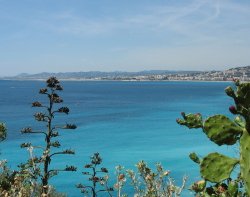
- Plage Beau Rivage, Baie des Anges, Nice, French Riviera. One of the most famous beaches in France
Click here for a detailed map of France, which you can scroll and zoom on any area.
Copyright
© About-France.com 2007 - 2025 except where otherwise stated.
About-France.com
Home
page - Regions
- Maps of France
- Contact

Stunning cliffs at Etretat, Normandy -
Discover
France by train with
►Trainline.com - French train tickets - Best rates, no extra fee, no surcharge, seating choice. Available worldwide for print-your-own tickets or e-tickets.

►Trainline.com - French train tickets - Best rates, no extra fee, no surcharge, seating choice. Available worldwide for print-your-own tickets or e-tickets.

The Mediterranean coast in the Calanaques area, near Cassis.

La Trinité sur Mer, Brittany
Related
pages:
Click here for
low-cost car hire in France
low-cost car hire in France
East coast of France?
In spite of a surprisingly high number of searches on Google for "East coast of France", France does not have an east coast ! The only stretches of water on the eastern borders of France are the river Rhine and some waterfront on the shores of Lake Geneva.The Riviera from Saint Tropez to the Italian border is sometimes known as the southeast coast of France - but not the east coast. The only length of east-facing coast in Metropolitan France is the east side of the Cotentin peninsula, in Normandy, and the eastern shores of some islands, including the east coast of Corsica.
About-France.com
is an independent and free travel information guide, funded
solely
through affiliate commission that may be earned on bookings made
through accommodation
and ticketing
portals.
Text copyright © About-France.com
Photos :
Dune du Pilat by Ronnie Garcia. Licence creative commons.
Etretat by Phenix 928
Brittany coast by Eaozone
All other photos copyright About-France.com