
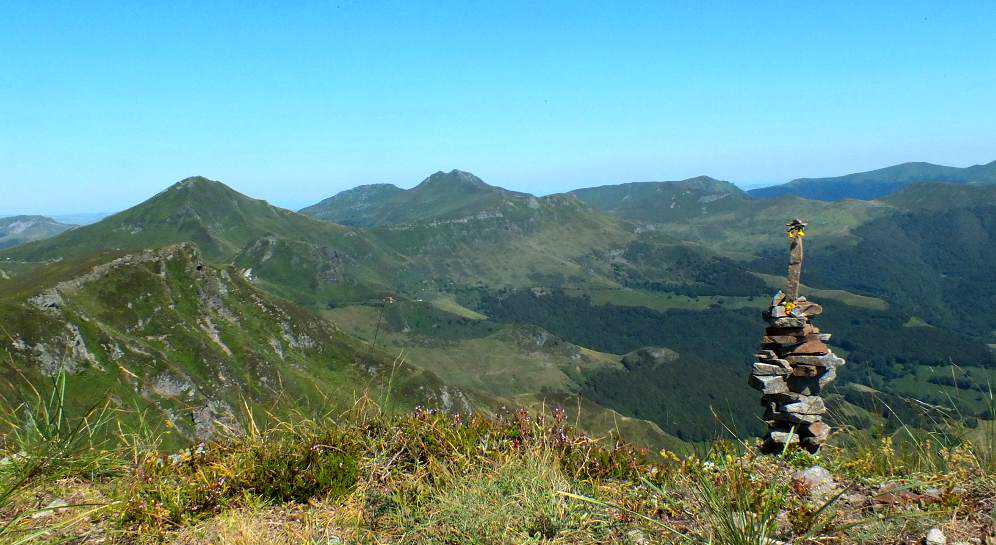
Outdoor France - the wild parts
Unspoilt
natural environments in France
- Explore France ►
- Essential pages
- Travel in France
- Where to go
- What to see and do


About-France.com
- the thematic guide to France
| ► Thematic index: Outdoor France | Hiking in France | Wild France |
| Wildlife in France | River cruises in France | Camping in France |
France's great outdoors
| Page index | Alps and Jura | North east |
| South of Toulouse | Central southern France | National and regional parks |
France is a big country; and it is a country where the countryside is big. On the other hand, as an old country, where humans have worked the land for over two thousand years, it is a country where much of the "natural" environment has been shaped - for better or worse - by the hand of man. There is little in the way of genuine "wilderness area" in France, such as one can find in the USA or Canada; but that is not to say that there is no such thing as "wild France". There are plenty of parts of this large country which remain, to this day, relatively wild and untamed, and a destination worth seeking out by nature lovers, ramblers and adepts of the "great outdoors".
For anyone wishing to escape from city life and find rural peace and quite, almost any part of rural France will fit the bill; but there are areas of France that are more deeply rural, and less populated than others. In particular, there is a large swathe of France, running from the Belgian border in the north east, to the Pyrenees in the south west, that is unofficially known as la diagonale du vide (the diagonal of emptiness), which contains many of the least populated areas of France (other than high mountain areas), plenty of wide open spaces, and ample opportunity for hiking, rambling , cycling and outdoor activities. This diagonal can be seen on the map opposite (or below on small screens)..
Eastern France
In the northeast, the area includes the Ardennes hills, with their forests, and the open spaces of the Champagne and Lorraine regions, rolling farming country that has seen considerable rural depopulation over the last hundred years. In the northern part of Burgundy, between Paris and Dijon, lie the Morvan hills, quite forested in parts, and peaking at over 700m (2,000 ft.) The Morvan is a popular area with weekend hikers, on account of its easy access from Paris.Central southern France
 The
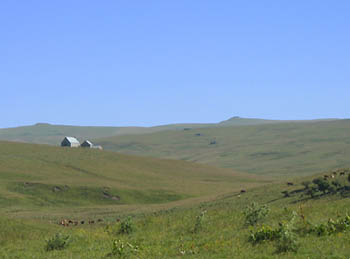
southern-central bulge in the "diagonal" is the area of the Massif
Central
mountains, which include some of the emptiest parts of France. The
Massif Central includes most of the regions of Auvergne
(chosen by Lonely
Planet as one of the top ten regions of the world to
visit) and Limousin,
as well
as the north of the Midi-Pyrénées
region, and the north of the Languedoc
region, and the west of the Rhone-Alpes
region. Many long-distance hiking paths cross these hills, passing
through some pretty wild and desolate areas, such as the barren
limestone Causses
in the south (in the departments of Lozère
and Aveyron),
traversed by the chasm of the Tarn
gorge,
the granite Aubrac
in the middle (Aveyron and Cantal
departments), and the Chaîne des Puys ( volcanic uplands
running through the Puy-de-Dome,
Cantal, Haute-Loire
and Ardèche
departments: see photo). This is the part of France for
lovers of wild
wide open spaces. A very sparsely populated area is crossed by the A 75
Clermont-Ferrand to Montpellier motorway, which runs for over 100 miles
at an average altitude of over 800 metres, with three peaks at over
1100m (about 3,500 ft).
The
southern-central bulge in the "diagonal" is the area of the Massif
Central
mountains, which include some of the emptiest parts of France. The
Massif Central includes most of the regions of Auvergne
(chosen by Lonely
Planet as one of the top ten regions of the world to
visit) and Limousin,
as well
as the north of the Midi-Pyrénées
region, and the north of the Languedoc
region, and the west of the Rhone-Alpes
region. Many long-distance hiking paths cross these hills, passing
through some pretty wild and desolate areas, such as the barren
limestone Causses
in the south (in the departments of Lozère
and Aveyron),
traversed by the chasm of the Tarn
gorge,
the granite Aubrac
in the middle (Aveyron and Cantal
departments), and the Chaîne des Puys ( volcanic uplands
running through the Puy-de-Dome,
Cantal, Haute-Loire
and Ardèche
departments: see photo). This is the part of France for
lovers of wild
wide open spaces. A very sparsely populated area is crossed by the A 75
Clermont-Ferrand to Montpellier motorway, which runs for over 100 miles
at an average altitude of over 800 metres, with three peaks at over
1100m (about 3,500 ft).South of Toulouse
 The
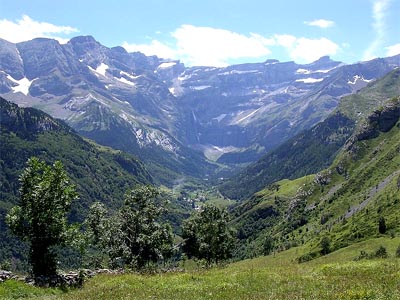
Cirque de Gavarnie in the High Pyrenees National Park
The
Cirque de Gavarnie in the High Pyrenees National Park Alps Jura and Vosges
 The
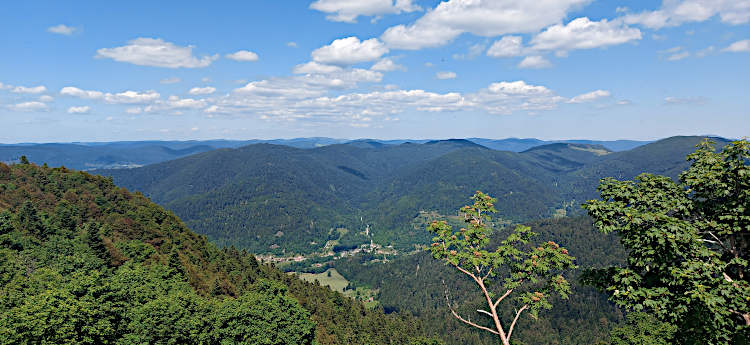
Vosges mountains in eastern France - dividing Alsace from Lorraine
The
Vosges mountains in eastern France - dividing Alsace from Lorraine To the east of the Rhone valley (a line running from Lyon to Marseilles), lies the other great natural area of France, the French Alps and their foothills (the Vercors, the Bugey). This zone offers plenty of very attractive mountain scenery, ranging from the dry terrain of the Verdon area of Provence, to the eternal snows of Mont Blanc. Many areas of the Alps have been heavily developed for winter sports, but away from the ski resorts,there are many hundreds of square kilometres of untamed hill and mountain, well equipped with marked hiking trails, linking valley to valley, or village to village. The high Alps are home to two of France's best-known national parks, le Mercantour and les Ecrins.
North of the Alps, running up the northern side of the border with Switzerland, the Jura mountains in the Franche Comté region offer another large mountainous area. The high Jura is characterised by spruce forests and meadows, as well as lakes and streams and plenty of hiking facilities.Finally, stretching northwards on the frontier between Alsace and Lorraine, the Vosges Mountains are a largely forested area of uplands with peaks over 1000 metres, and hundreds of kilometres of hiking and cycling trails.
Wildlife:
See About-France.com Wildlife in France and Birds in France pagesProtected Areas, national parks, regional natural parks
 The areas described above include most
of France's
(few) national parks (in the high Alps, the Cévennes and the
Pyrenees),
plus a large number of "Parcs naturels régionaux" (a phrase
which is
often mistranslated into English as "national parks"). There is no
fundamental reason why some areas should be designated national parks,
and others regional natural parks; the distinction is largely an
administrative technicality, akin to the difference between "state
parks" and "national parks" in the USA.
The areas described above include most
of France's
(few) national parks (in the high Alps, the Cévennes and the
Pyrenees),
plus a large number of "Parcs naturels régionaux" (a phrase
which is
often mistranslated into English as "national parks"). There is no
fundamental reason why some areas should be designated national parks,
and others regional natural parks; the distinction is largely an
administrative technicality, akin to the difference between "state
parks" and "national parks" in the USA.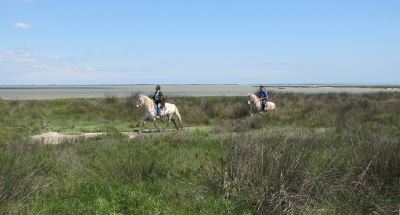 Riding
across the Camargue wetlands
Riding
across the Camargue wetlands Going further:
Click here for a detailed map of France, which you can scroll and zoom on any area.
About-France.com
Home
page - Site
search
- Regions
- Maps of France
- Contact
With
twice the surface area of Great Britain, and about the same
population, France is a country with plenty of countryside.
Away from the big urban areas round Paris, Lyon and the north
of France, France is essentially a rural country, with plenty of wide
open spaces. This is particularly the case in the hill country of
central southern and central eastern France. The great uplands of the
Massif Central, the Jura and the foothills of the Alps offer a wealth
of opportunities for visitors wanting to
"get away from it all".
"get away from it all".
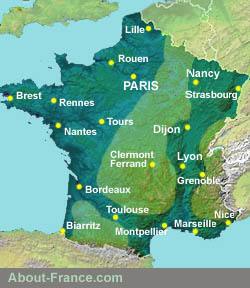
Empty France - the diagonal of sparsely populated areas
| >►► Site guide |
| About-France.com home |
| Full site index |
| About-France.com site search |
| ►► Principal chapters on About-France.com |
| The
regions of France Beyond
Paris, a guide to the French regions and their tourist attractions.
|
| Accommodation
in France |
| Guide
to Paris Make
the most of your trip to Paris; attractions,
Paris hotels,
transport, and lots more.
|
| Tourism
in France
The
main tourist attractions and places to visit in France - historic
monuments, art galleries, and more
|
| Planning
a trip to
France
Information
on things to do before starting your trip to France.
|
| Driving
in France
Tips
and useful information on driving in and through France - motorways,
tolls, where to stay....
|
| Maps
of France
Cities,
towns, departments, regions, climate, wine areas and other themes.
|
| The French way of
life
A
mine of information about life and living in France,
|
| A-Z
dictionary
of France Encyclopedic
dictionary of modern France
|
Click here for
low-cost car hire in France
low-cost car hire in France
A fully independent travel
information site, About-France.com is an affiliate partner of certain
travel service providers,
and may receive a small commission on sales generated after visitors
follow
links to our partners' websites.