
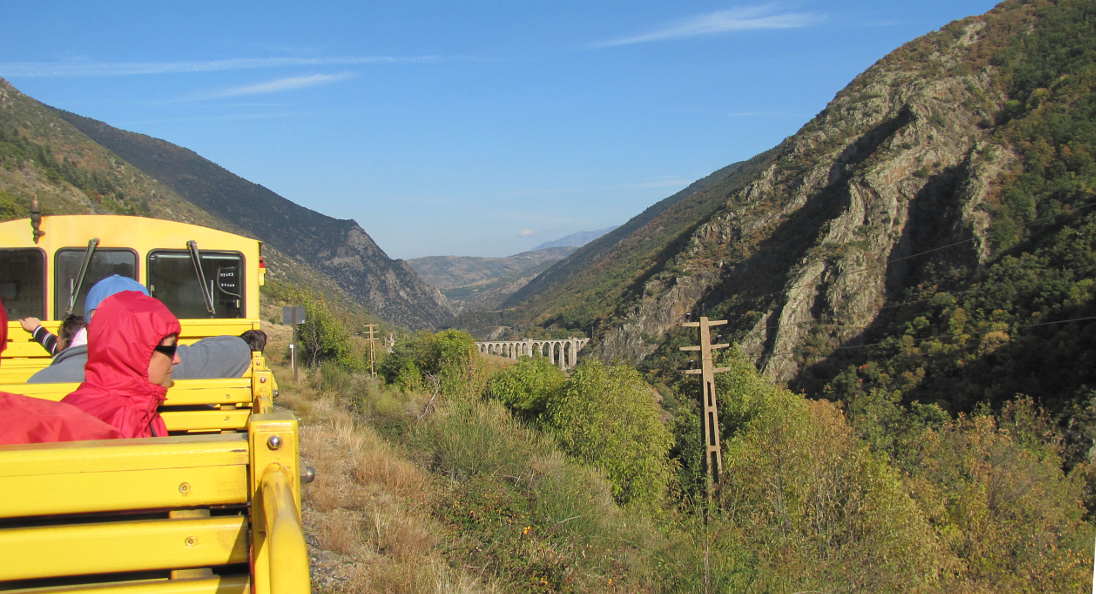
The Yellow Train of the Pyrenees
A Pyrenean adventure ride
- Explore France ►
- Essential pages
- Travel in France
- Where to go
- What to see and do
About-France.com
- the connoisseur's guide to France
Pyrenean
adventure
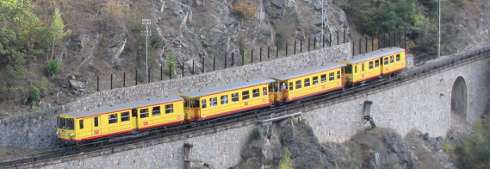
the Little Yellow Train
Location:
Starting point at Villefranche de Conflent, in the eastern
Pyrenees,
50 km inland from Perpignan.
Region: Occitanie. In the Roussillon part of the Languedoc Roussillon region
Distance from Paris: 900 km by road .
Nearest cities: Perpignan, 50 km
Nearest railway station: Villefranche-de-Conflent (Vernet les bains). (Mainline connection).
Other access from Paris: TGV train to Perpignan, then connecting local train service.
Region: Occitanie. In the Roussillon part of the Languedoc Roussillon region
Distance from Paris: 900 km by road .
Nearest cities: Perpignan, 50 km
Nearest railway station: Villefranche-de-Conflent (Vernet les bains). (Mainline connection).
Other access from Paris: TGV train to Perpignan, then connecting local train service.
Practical information
► Tickets and booking:
Though a historic scenic railway, The Little Yellow Train,is part of the French state rail network, run by the French train operator SNCF. Consequently, tickets come at standard French train rates, and can be booked online through the normal websites.
IMPORTANT:
key in Villefranche
Vern as your
departure point if you wish to leave from the main departure station,
officially known
as Villefranche-de-Conflent – Vernet les Bains.
Book Yellow Train tickets
About-France.com recommends Trainline.com ... but read this first.The options:
The most popular trips are to start from Villefranche-Vernet les Bains, and travel to one of the highest stations at Mont Louis or Odeillo-Font Romeu, a bit further to Bourg Madame, or through to the end of the line at Latour de Carol.
PRICES 2025
28.80 € return from Villefranche-Vernet les Bains to Font Romeu.
Price 48.60 € return for the full route.
For full route use Villefranche - Vernet-les-bains as departure station, and Latour de Carol as destination.
►Now go
to Trainline.com
to
book your journey online.
Note that there are no reserved seats on the Yellow Train. Your ticket is valid on the date for which you purchased it. You are advised to get to the departure station half an hour before the train leaves, to ensure a good seat.
About-France.com is an affiliate partner of Trainline and may receive a small commission on ticket sales. This does not affect ticket prices which are fixed by the train operator.
Train tickets for France
►Trainline.com French train tickets Best rates, no extra fee, no surcharge Available worldwide for print-your-own tickets or e-tickets.
Access by train:
Both ends of the line can be reached by standard-gauge train, the lower end by electric train from Perpignan, the higher end both by Spanish Railways (RENFE) line from Barcelona and Ripoll, and by SNCF trains from Toulouse and Foix.
For rail enthusiasts
A great do-it-yourself rail tour.... Villefranche-Vernet to
Latour de Carol: then to Barcelona (with possible extension to the
Spanish railway museum at Vilanova i la Geltrú), back to Perpignan by
the coastal line or by TGV, and on back to Villefranche-Vernet.
Two countries, three gauges, and spectacular
scenery all the way. Note: Latour to Barcelona: Catalonia rail service R3. Five trains a day... buy at the station, as for many local services in Spain and France. Barcelona to Port Bou (connect to French trains): Rail service R11 (hourly) Tickets not available online.
Need to book ?
In the summer and at weekends, it is strongly advisable to book in advance, as the trains can easily be full. At other times, booking may not be essential, but remains advisable since all it needs is a couple of tour buses, and all the available places in any given train can easily sell out. The best time to go is in Sping or in September or October, when many trains travel half empty, specially on weekdays.
The route
The Little Yellow Train runs from Villefranche de Conflent, 50 km from Perpignan, to Latour de Carol, well up in the Pyrenees near the Spanish town of Puigcerda.
The most spectacular part of the route is the section from the start at Villefranche, up as far as the small town and ski-resort area of Odeillo – Font-Romeu. Hugging the sides of the deep valley of the Tet, the line winds up between forests, chasms and gushing streams. From the start up as far Mont Louis, near the summit, passengers are treated to spectacular views of the rocky mountainous scenery, including villages, two historic fortresses, and a precariously perched old hermitage.
The line, which was begun in 1903, is a spectacular feat of civil engineering, and apart from the dozens of mostly short tunnels, it
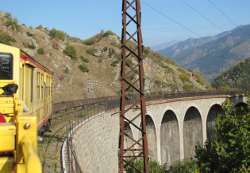 includes
many bridges and small viaducts, plus two remarkable viaducts spanning
wider valleys. These include the remarkable Pont Gisclard, or Pont de
Cassagne, which is the only railway suspension bridge in France.
includes
many bridges and small viaducts, plus two remarkable viaducts spanning
wider valleys. These include the remarkable Pont Gisclard, or Pont de
Cassagne, which is the only railway suspension bridge in France.After Mont Louis, the line continues to rise for a kilometre or so, before reaching a broad high valley, which it skirts along for seven kilometres as far as the station at Font-Romeu– Odeillo.
From here, it then descends some 300 metres down to a high valley on the Spanish border, and the frontier town of Bourg Madame. The station at Bourg Madame is just a few hundred metres from the Spanish border, and it is easy to walk to the old Spanish town of Puigcerda.
The line terminates a few kilometres further on, at the small town of Latour de Carol, where it connects with the French railway line from Toulouse, and the RENFE Spanish line from Barcelona.
Sights and excursions.
► Villefranche-de-Conflent:
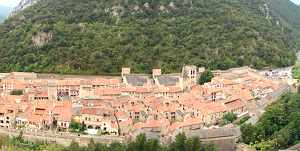 Historic
walled city; a UNESCO world heritage site. The entire old city, crammed
into the narrow valley floor, is circled by walls which were
strengthened and fortified by the great military architect Vauban in
the 17th century, after the area passed from Spanish to French
sovereignty.
Historic
walled city; a UNESCO world heritage site. The entire old city, crammed
into the narrow valley floor, is circled by walls which were
strengthened and fortified by the great military architect Vauban in
the 17th century, after the area passed from Spanish to French
sovereignty.Nearby: Fort Liberia, another Vauban fortification, perched on the mountainside above the town.
Nearby: 6 km. Vernet les Bains, an attractive small old town, up a side valley; starting point for routes and trails to le Canigou, the emblematic mountain of the Eastern Pyrenees.
► Mont Louis
Another Vauban fortified town and UNESCO world heritage site. Smaller and less impressive than Villefranche de Conflent
► Odeillo – Font-Romeu
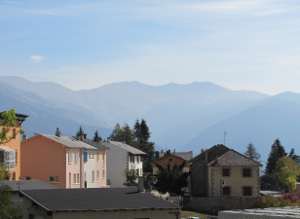 Odeillo
is a small Pyrenean mountain village, best known nowadays as the home
of one of the world's very first solar power stations.
Odeillo
is a small Pyrenean mountain village, best known nowadays as the home
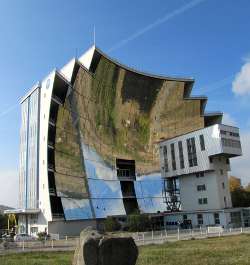
of one of the world's very first solar power stations.Opened in 1970, the solar power station was one of the first serious renewable energy plants. Run by the French National Research Centre CNRS, the “Four Solaire" is within easy walking distance of the station. Guided visits daily.
The villages of Odeillo and Via can be reached on foot from the station.
 Font Romeu
is one of the more popular ski resorts in the Pyrenees.
Font Romeu
is one of the more popular ski resorts in the Pyrenees.Hiking trail: a hiking trail (sentier de randonnée) leaves from the village of Via, just below the Odeillo train station; it is an easy 9km hike back to the station at Cabanasse – Mont Louis.
► Bourg Madame
Small and not particularly interesting town; but it is only a kilometre or so on foot from the station at Bourg Madame to the historic centre of the Spanish town of Puigcerda. Travellers coming up on a morning train and back on an afternoon train have time for a quick trip into Spain.
► Latour de Carol.
Of interest to rail buffs; the station at Latour de Carol is the only station in Europe, possibly in the world, to serve three different "normal" railway lines operating with three different gauges*. The metre-gauge Train Jaune, the European standard gauge SNCF line to Toulouse, and the Spanish broad-gauge line to Barcelona.
(* The station at Montreux in Switzerland also has three gauges, but these include special rack-and-pinion tracks).
Copyright
© About-France.com 2007 - 2025 except where otherwise stated.
About-France.com
Home
page - Site
search
- Regions
- Maps of France
- Contact
The
Little Yellow Train
of the Pyrenees is one of the great railway journeys of the world
– a
historic
metre-gauge electric railway in the French Pyrenees, opened in 1909,
and still going strong. The line rises through dramatic scenery from an
altitude of 427 metres
at its lower terminus at Villefranche de Conflent, to a summit at
Bolquère Eyne, France’s highest railway station,
lying at an altitude
of 1592 metres (5226 ft) above sea level. It then drops down to a high
Pyrenean valley, to its terminus at Latour de Carol.
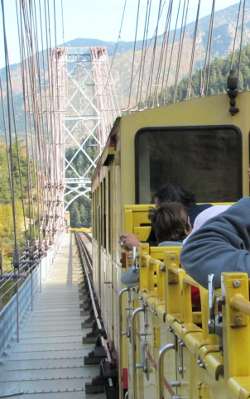
Pont Gisclard - rail
suspension bridge.
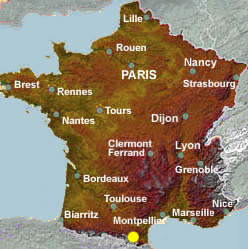
Locating map:
The Yellow Train is located at the yellow circle at the foot of the map.
Locating map:
The Yellow Train is located at the yellow circle at the foot of the map.
► Accommodation:
The closest hotels to the main departure point are at Vernet les Bains, 6 km from the station at Villefranche.
Click hotel names for online booking and more details.
Recommended: Hotel Princess. A good quality three star hotel with restaurant. Reasonably priced.
Elsewhere on the line:
The closest hotels to the main departure point are at Vernet les Bains, 6 km from the station at Villefranche.
Click hotel names for online booking and more details.
Recommended: Hotel Princess. A good quality three star hotel with restaurant. Reasonably priced.
Elsewhere on the line:
- La Cabanasse-Mont Victor: Hotel Les Mélèzes - family hotel located 200m from the station.
- Odeillo: Auberge la Chouette – hotel and restaurant in a village location, 600 metres from the station. Online booking only for week-long stays. Chouette.fr
- Puigcerda : For a night in Spain, but just a kilometer from Bourg Madame station, the Hotel del Prado on the edge of Puigcerda gets lots of good reviews
- More
hotels
in the area
Click here for a choice of more hotels in the vicinity of the Yellow Train route - Languedoc
holiday gites
Check out a choice of cottages and gites in Languedoc-Roussillon
Technical
specifications
The line:
Length: 62.6 km, almost 39 miles.
Gauge: metre
Ascent: 1165 metres
Highest point: 1592 metres
Power: Electric 850v DC third rail.
Line opened: 1909
Steepest gradient: 6%
The trains:
Electric train units: seven out of ten of the original units are still operating. There are also two modern panoramic multiple units, built by Stadler in 2004; these have air-conditioning, toilets and electric doors.
Safety features: three independent braking systems on each axel
The line:
Length: 62.6 km, almost 39 miles.
Gauge: metre
Ascent: 1165 metres
Highest point: 1592 metres
Power: Electric 850v DC third rail.
Line opened: 1909
Steepest gradient: 6%
The trains:
Electric train units: seven out of ten of the original units are still operating. There are also two modern panoramic multiple units, built by Stadler in 2004; these have air-conditioning, toilets and electric doors.
Safety features: three independent braking systems on each axel
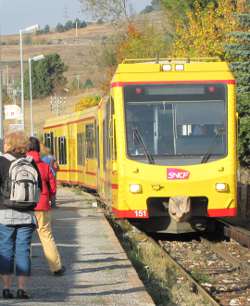
One of the modern air-conditioned Stadler units.
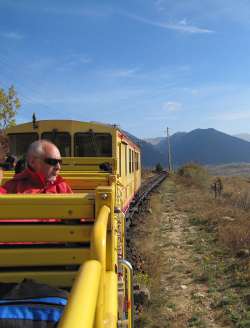
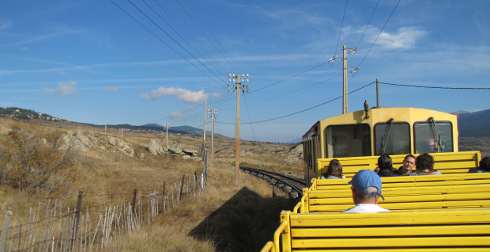
Approaching the summit
Copyright: all text and photos on this website © About-France.com renewed 2025 except where otherwise stated
All photos on this page copyright About-France.com
except view of Villefranche de Conflent: GNU licenced photo by Balakao