Living in France
Living
in France and moving to France
About-France.com
- the connoisseur's guide to France
- Discover France ►
- Essential pages
- Travel in France
- Where to go
- What to see and do
Moving
to France......
Many dream of starting a new life in France, and many make a success of it. But moving to live in a new country is a big lifestyle change and should not be done on a whim.
Many dream of starting a new life in France, and many make a success of it. But moving to live in a new country is a big lifestyle change and should not be done on a whim.
The UPS and DOWNS, and DOs and DON'Ts
French residency, working and retiring to France
A small majority of British voters voted for Brexit, and the UK has now left the EU - much to the despair of many others in Britain, and to the European Union. But "leave" has meant "leave", and UK residents in France have lost many of the rights associated with being citizens of the European Union. These include residency rights, health care rights, work rights, and rights to other social services.However expulsion from France is highly unlikely, and Britons who are not going to be a burden on the French social security system are likely to remain welcome in France.
UK nationals who were resident in France before the end of the transition period can apply for the French equivalent of "settled status", a process that can be done online and at minimal cost. For new arrivals and part-time residents, the situation is less clear. In theory those without residence status can only remain for 90 days in any six month period; beyond that they now need to apply for residency in the same way as nationals of other "third" countries.
For non-EU nationalities, including Americans wanting to move to France, the difficulty or ease of moving to France depends on whether you plan to seek employment, take up a job offered to you, create a business, or just live without working, for instance retire to France.
While the paperwork is sometimes daunting (as it often is in the expat world), those wishing to retire to France, set up a business in France, or take up a job offer, should not find it too hard. Those wanting to retire to France will need to demonstrate that they have a pension and a health-care plan that will allow them to live in France a nd receive necessary medical care without claiming assistance from French social security, to which they are not entitled.
Hotels
and other places to stay in France

Click for best online rates for hotels near the following towns on main routes.
Calais
Reims
Dijon
Beaune
Lyon
Rouen
Orleans
Tours
Limoges
Poitiers
Bordeaux Clermont-Fd.
In 2017, official estimates put the
number of Britons living in France at around 300,000. The real
figure, taking account of second-home owners who are only part-time
residents and are not registered in France for tax purposes, is assumed
to be considerably higher. It is less than the number in Spain; but it
is a different population too. France and Spain attract different kinds
of expats. In Spain, the vast majority of expats, whether from Britain
or other EU countries, live along the Mediterranean coast. In France,
they are spread across much of the country, not only along the coasts.Click for best online rates for hotels near the following towns on main routes.
Reims
Dijon
Beaune
Lyon
Rouen
Orleans
Tours
Limoges
Poitiers
Bordeaux Clermont-Fd.
About-France.com
carries affiliate links and may earn commission
on sales
Moving to France
Though the flow of Britons coming to live in France has ebbed from its peak of some 20,000 a year, many are still packing up and moving out of the overcrowded Brexit Britain in search of more elbow room in the the country just over the water, France. But it has always been the case that up to half of those who decide to move "permanently" to France do not stay more than a year or two, or else give up the "permanent" notion, and become seasonal migrants. The truth of the matter is stark; moving to live in another country can be a traumatic experience for some, so it is essential to take good advice before taking the plunge.Moving house to live in a new country, especially one whose language one does not speak properly, is a major event in anyone's life. And for this reason, it is never advisable to decide to move to France on a whim, on the basis of a happy holiday with great weather and plenty of barbecues and life round the swimming pool. µ
The outdoor swimming-poool may be great from June to September, but for the rest of the year it is likely to remain unused and unwanted. Even in the warmest bits of France, on the Mediterranean coast, winter is a reality, just like snow and rain are. Life in France may be different from life in the UK, but it is still full of the everyday chores, hassles and problems that life can bring anywhere. Those who emigrate to France imagining that they will entirely escape the nitty gritty of life are under a serious delusion, and are among those who are the first to head back home again. UK specialists operating removals to France do not run one-way operations only.
There are two fundamental aspects that need careful consideration before you even think of setting up home in France.
a) Language
b) Culture
Most Brits who think of moving to France have a very poor mastery of the language. GCSE or "O" Level French doesn't get you very far, especially when your French-learning days are lost in the hazy mists of a dim and distant childhood. Anyone who is even thinking of moving to France, let alone working in France, should make a serious effort at learning the language with a reasonable degree of proficiency before looking for property. Of course, the French learned in evening classes or at a language school will not prepare you for all the situations that you will find yourself in once you get round to renting or buying property in France; but at least it will give you a basis on which to work. "Social French" will at least help you enjoy a coffee or a drink with your neighbours, or in the local café, which is a start; but it will not get you very far with the lawyer or the builder - not to mention the tax authorities.
Of course, the better you speak French, the easier it will be to integrate into local society and communities - not to mention getting by with local suppliers, local professionals such as the doctor or the lawyer, and local bureaucracy which is something that even the French often find incredibly fastidious and a big hassle. In short, if you want to make a success of your life in France, speaking French is an essential skill to master. And to master well.
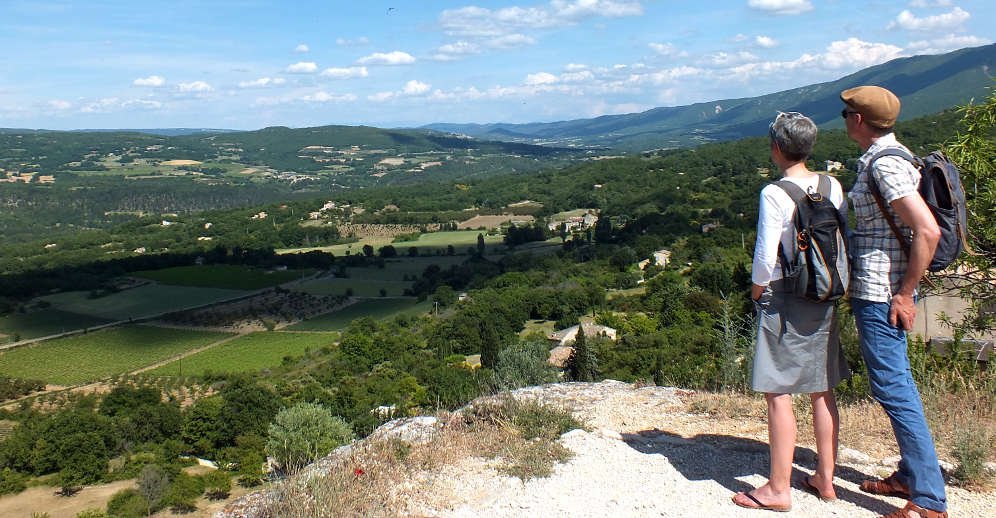
 Many dream of a
place with space and sunshine....
Many dream of a
place with space and sunshine....One word of warning; in recent years, book publishers have tumbled over each other in the rush to bring out books about Brits in France; some of these are written by expats who imagine themselves to be experts on French living because they have lived for two years in the country... or less. At worst these books are opinionated and superficial, if not downright patronising; and even some of the better ones tend to view France either as through rosy-tinted nostalgia for a bygone lifestyle (rural idylls with charming locals in Dordogneshire) or from the standpoint of the wine-swilling yuppy. For a more balanced view of modern France, it is preferable to read something far more informed and better researched, such as Cook & Davie's "Modern France".
Some good books about France ....
There are dozens of books written by British expats or visitors to France; many of them are not worth reading; but some are. One excellent analysis of the life and ways of France is "Sixty Million Frenchmen Can't Be Wrong", by Canadian journalists Jean-Benoit Nadeau and Julie Barlow. It's a chunky book, it does not cover all aspects of living in France, but it should be obligatory reading for anyone thinking of emigrating to France !
Another top rate book is "The discovery of France", by Graham Robb. Though it is as detailed and researched as a good PhD thesis, with the notes and bibliography to go with it, this is a highly readable analysis of rural France, since the eighteenth century, a book that blows apart all those romantic myths about the charm of the old ways and olden days.
Anyone who thinks of moving to live successfully in France, particularly in a rural area, must be willing to adapt to local ways and work with the local system, to change at least some attitudes and preconceptions, and where necessary "go native". When in Rome, do as the Romans. Unless you want to remain largely detached from the local community, or attached just to some diffuse local community of "expats", the best advice is to adapt to local life, and even better, participate in it. It is unfortunate that a proportion of British immigrants living in France have not understood this.
Above all, it is vital to avoid seeming to be condescending towards local customs, habits or slowness. Even if you think some things were done better back in the UK, don't say so - or at least not until you have become a fully accepted member of the local community. It is not just foreigners landing in out-of-the-way parts of France who can make themselves disliked for this reason; whether you are British, Dutch or even just Parisian makes no difference. I know of a small area of France where about a third of the population is now "outsiders" - including a number of Parisians; and for many of the locals, Parisians, Brits, Dutch and other incomers are all bagged together as "outsiders". As an outsider, you must adapt to local ways; do not expect local ways to adapt to you.
Residential and tax status.
According to at least one French property site, "taxes are lower" in France. Taken across the board, this affirmation is complete cobblers. Yes, certain taxes are lower in France, but in overall terms France has one of the highest tax rates in Europe. For example, ostensibly low income tax rates are disguised by the existence of other taxes on income that are not called income tax, but have to be paid on all income. See following paragraph. The downside of high taxes is that generally speaking public services are good, and in many cases free.
If you plan to live 183 days per year or more in France, you will be officially fiscally resident in France. You should thus become a full French taxpayer, as regards income. This concerns your income wherever it may be - including pensions, dividends, unearned income or earned income of any sort from any source in any country of the world. You will not necessarily be worse off in France, unless you have a very high income. If you have a low income, your actual "income tax" in France is liable to be less than in the UK. Half the population of France pay no "income tax" at all. However, French "income tax" does not include the additional "CSG" and "CRDS" taxes, which in everything but in name constitute a second flat rate income tax, currently amounting to 11% on all income, including dividends and savings accounts – in addition to the income tax you pay or do not pay.
If you are fiscally resident in France, you will also by default be subject to French jurisdiction in the event of death. Your estate, including all assets in any other country except property , must be divided up among your heirs in compliance with French inheritance laws, which impose an equal distribution among your direct heirs (children) of the major part of your estate - two thirds of it if you have two direct heirs, three quarters if you have three, etc.. It is impossible, under French law, to leave all your estate to one child, and none to another - whatever mitigating circumstances there may be. As for leaving it all to a home for stray pussy cats or the RSPCA, you can only do that if you have no direct heirs at all.
However since 2015, in line with an EU ruling, all foreign nationals living in France may elect to have their estate distributed to their beneficiaries according to the inheritance laws of their own country. The rules are slightly different for residents with dual nationality, and whatever the situation, residents are advised to check the practicalities out with a notaire.
As a resident with an EU citizenship, you can vote in municipal elections and European elections. You can also be elected to the local council, but you cannot become mayor. You also have access to the French health care system.
Doing up old property in France
Note!
Information from About-France.com on buying and renovating
property is completely objective. This website has no vested interest
in
anyone's buying or renovating property. About-France.com has no links
with any property companies or estate agents.
If you plan to buy a place to live in France, this is probably the best argument of all for learning French first. There are hundreds of French property sites in English on the Internet....... but there are thousands of estate agencies and "notaires" (solicitors) who are not on the Internet, or at least not in English. Click for further information on buying and selling property in France.
If a French property is advertised by an international or UK-based estate agent, it is almost certainly being offered at above-market prices. Sometimes at considerably above the market price for the area. While there are plenty of honest estate agents, there are plenty more whose main aim is to get the best price possible, and if this means pulling the wool over they eyes of unsuspecting buyers from abroad, that is what they'll do.... with glee. Frequently, the owners are in on the game too, having discovered that it is easy to rip off foreigners, who out of ignorance will pay well over the going rate in their area.
One very good word of advice, if you think that moving to France really is for you; rent a property for at least a month in an area that you do not already know, and start looking for properties locally, just to see how you get by. No need to buy one of course, this is just a dummy run.
Surveyors? In the UK, it is customary if not essential to have a property surveyed before buying it. Not so in France,particularly with old rural property. There are a number of obligatory certificates that the seller has to provide, including an audit of the electrical system, asbestos, and insulation; but with an old property one would expect the scores to be low, and the audits are for information purposes only.
A surveyor's remit is to find as much wrong with a property as possible, so that he cannot therefore be sued subsequently for not having noticed a defect. Old rural properties are full of defects, from cracked walls, to sagging floors, damp, dry rot - and even termites in southwest France. But there is a cure for everything, especially when a building is being fully renovated. If the walls are still standing after a century or two, there's unlikely to be any fundamental problem with them, unless the roof has gone. The best advice is to check the place over very thoroughly, survey it yourself, and if possible get a second opionion from someone with no financial interest in your purchase. If the property is cheap, and you like it, buy it before someone else does; there's not too much to lose. If it is not too cheap (and this is increasingly the case), make the closest inspection possible before you sign anything! Remember, a property in France is sold "as is" (French "en l'état") , and once you've bought it, there is no recourse to be had if later on you come across hidden defects that you had not noticed in time !
Renovating: If you want to make substantial alterations to a house, such as changing doors or windows or adding on bits, you have to get a building permit (permis de construire). This document can be obtained from the local town hall (mairie), and must be returned, completed, with a sheaf of annexes, including plans, photos, etc. If the whole property has a floorspace of less than 170 m², you can do the plans yourself. If its over 170 sq.m, you'll have to get them done or at least redone by a registered French architect or building supervisor (maître d'oeuvre). It can take several months before a permis de construire is approved - or sent back for modification.
If you just plan to make changes inside the building (changing partition walls, putting rooms into an old attic, etc) then no building permit is needed. Or at least, it is not customary to ask for one.
However, a word of warning to do-it-yourselfers. If you buy a property in which the electricity supply has been shut down for some time, you will not be able to get reconnected until new wiring, compliant with the latest standards, has been installed by a qualified electrician. That means an electrician duly qualified to work in France. If the electricity supply has not been formally disconnected, then you can just get it reconnected in your name, whatever state it is in.
Unless you have already moved in, the best way to have your property redone is to find a "maître d'oeuvre", a professional whose job is to oversee progress on the site, do the paperwork, and liaise with contractors. But make sure that you find a reliable "maître d'oeuvre"
The messages about house buying are therefore:
1) Preliminaries: Never buy a property in France without first visiting the region carefully, and checking out house prices with local estate agents and notaries.
2) Remember, there are a lot of people out there who are just after your money, and will do all they can to get you to buy a place in France. They'll paint a fantastic rosy picture of moving to France, hoping you'll swallow it. So make sure you take advice from people who have no direct or indirect interest in your move, and be wary of advice from lawyers and banks, very wary of encouragement from estate agents, property magazines, etc., and even that "nice couple" you meet in a French village, who may well have many reasons for wanting to bring in some British neighbours - but are largely motivated by their interests, not yours.
2) Language: The better you speak French, the easier it will be.
3) Surveys: Don't necessarily bother with a surveyor; all properties on the market must now come with an array of attestations covering things like the state of the electrics, the presence of asbestos, the risk from termites (if appropriate) the energy efficiency (not terribly important if it's just a summer cottage you are after... but useful if you plan to live permanently) and more...but do check a property thoroughly before making an offer.
4) Price: Don't forget that the price you negociate does not include taxes and lawyers fees, which will add between 5% and 10%.
5) Selling: Don't imagine that if you come to sell your property, you will necessarily recoup your costs. If you paid over the odds in the first place, you are very unlikely to get back your investment.
Conclusion
If you think that you can make it, and learn to live in France as part of the community, having learned enough of the language to get by with, do so! The writer of this page has lived in France for all his working life, and has few regrets. While administrative red tape can get anyone down at times, and sometimes you may find things infuriating, France is a great country, with lots of great people. Property is generally cheaper, if not far cheaper, than in most parts of the UK, and there is that great asset that so many people are looking for, wide open countryside and space - room to move in.
But there's the French winter too, problems of misunderstanding, distance from friends and family - possibly children or ageing parents. You'll find plenty of cafés, but may miss the pub. If you don't have French health cover, you'll need to get yourself privately insured or else risk paying the bills. Low-cost airlines serve many rural regions, but there's no guarantee that they will continue to do so when oil hits $100 a barrel.... and certainly not at the same low cost. There are lots of things that people often fail to think of before making the move - and that is why so many of them do not stay for long. But sum up the pros and the cons, and make a measured decision. If the answer is yes, then go for it.
About-France.com
Home
page - Site search
- Regions
- Maps of France

►► More topics on French life
| ► ►
Accommodation in France |
| Guide to hotels in France |
| Gites in France |
| Bed and breakfast in France |
| Rural campsites in France |
| Independent hotels in France |