
The French political system
A short guide to the institutions of power in France
Most recent page update; 2026
The French Constitution:
France is a republic; the institutions of governance of France are defined by the Constitution, more specifically by the current constitution, being that of the Fifth Republic, which was set up in 1958 by General de Gaulle. The Constitution of the Fifth Republic provides for a balance between executive power, (the President, often referred to as l'Elysée, in the same way as the US Presidency is often referred to as "the White House"), and legislative power (the National Assembly).The Constitution has been modified several times since the start of the Fifth Republic, most recently in July 2008, when the French "Congress" (A joint convention of the two chambers of Parliament) approved - by 1 vote over the 60% majority required - constitutional changes proposed by President Sarkozy. The 60% majority required for a change to the constitution is a safeguard set up to prevent the type of highly controversial constitutional change that could be engineered by a government with a very small majority, as happened later with Brexit in the United Kingdom.
The Fifth Republic: The fifth republic was largely the work of General de Gaulle - its first president, and Michel Debré his prime minister. It has been amended 17 times. Though the French constitution is parliamentary, it gives relatively extensive powers to the executive (President and Ministers) compared to other western democracies, as was clearly illustrated during the second presidency of Emmanuel Macron.
The executive branch:
The head of state and head of the executive is the President, elected by universal suffrage.
The President of France, as head of state and head of the executive, thus carries more power than leaders of most other European countries, where the two functions are separate (for example in the UK, the Monarch and the Prime minister, in Germany the President and the Chancellor.)
Since 2017, France's president is Emmanuel Macron, who was elected to the post at age 39, the youngest French leader since Napoleon.
Originally, a president of the Fifth Republic was elected for a 7-year term (le septennat), renewable any number of times. Since 2002 the President has been elected for a 5-year term (le quinquennat). Since the passing of the 2008 Constitutional reform, the maximum number of terms a president can serve has been limited to two.
The President, who is also supreme commander of the military, determines policy with the aid of his Council of Ministers (Conseil des ministres). The residence of the President of the French Republic is the Elysée Palace (le palais de l'Elysée) in Paris.
The President appoints a prime minister (currently - 2026 - Sebastien Lecornu) , who forms a government. The residence of the French Prime Minister is at Matignon House (l'Hôtel Matignon) in Paris.
In theory ministers are chosen by the PM; in practice unless the President and the PM are from different sides of the political spectrum (a system known as la cohabitation), PM and president work together to form a government. The President must approve the appointment of government ministers.
The cabinet, le Conseil des ministres, meets on a weekly basis, and is presided over by the president. Ministers determine policy and put new legislation before Parliament in the form of bills (projets de loi); within the framework of existing law, they apply policy through decrees (décrets).
The legislative branch:
The French parliament is made up of two houses or chambers. The lower and principal house of parliament is the Assembée nationale, or national assembly; the second chamber is the Sénat or Senate. Members of Parliament, called Députés, are elected by universal suffrage, in general elections (Élections législatives) that take place every five years - or followi,ng a dissolution of the Assembly by the President. Senators are elected by "grand electors", who are mostly other local elected representatives.The electoral system for parliamentary elections to the National Assembly involves two rounds; a candidate can be elected on the first round by obtaining an absolute majority of votes cast. The second round is a runoff between two or more candidates, usually two.
In 2024, following a snap general election, Emmanuel Macron's grouping of centrist deputies lost its overall majority in the National Assembly, leading to an unprecedented situation of political turmoil in the French parliament, with a succession of prime ministers falling victim to votes of no confidence. The constitution of the Fifth Republic is however set up to protect the presidency from political turmoil in the National Assembly, and President Macxron has soldiered on – weakened, but still in charge.
No individual party has a majority in the Senate, though parties of the right and centre-right have a majority between them .
The judicial branch:
While the Minister of Justice, le Garde des Sceaux, has powers over the running of the justice system and public prosecutors, the judiciary is strongly independent of the executive and legislative branches. The official handbook of French civil law is the Code Civil.Promulgation
of laws:
New
bills (projets
de loi),
proposed by government, and new pivate members bills (propositions
de loi) must be
approved by both chambers, before becoming law. However, by
virtue of Article 49.3 of
the French constitution, a government can
override parliamentary opposition and pass a law without a
parilimentary vote. This does not happen frequently, and in the
framework of constitutional amendments, president Sarkozy
curtailed
the possibility of using 49.3. However, in 2015, Prime Minister Valls had to resort to using 49.3 in order to push the controversial economic reforms of the "Loi Macron" through parliament, in the face of a revolt by hard left members of his own Socialist party. Since 2024, different prime ministers found themselves obliged to use 49.3 to get through key legislation, in the face of opposition from right and/or left.
As in other democracies, Ministers can avoid parliamentary scrutiny of new legislation concerning everyday affairs, by issuing executive orders, known in French as Decrees (des décrets).
Laws and decrees are promulgated when the official text is published in the Official Journal of the French Republic, le Journal Officiel.
The Constitutional Council
The Constitutional Council , le Conseil constitutionnel, exists to determine the constitutionality of new legislation or decrees. It has powers to strike down a bill before it passes into law, if it is deemed unconstitutional, or to demand the withdrawal of decrees even after promulgation. The Council is made up of nine members, appointed (three each) by the President of the Republic, the leader of the National Assembly, and the leader of the Senate, plus all surviving former heads of state.Political parties;
In 2026, France is governed by a fragile ad-hoc coalition of centrist parties, under Prime Minister Sebastien Lecornu. Previous PMs, such as Michel Barnier, were unable to hold their slightly different centrist coalitions together. The current coalition excludes parties of the far left and the far right. Previously, and from 2017 until 2024, France was governed from the centre by a new "Macronist" party initially called "Les Républicains en Marche" (LREM) founded in 2016. In 2022, LREM changed its name to Renaissance
Renaissance - brings together of politicians from the centre left and the centre right, former Socialists and former members of Les Républicains, plus a large number of men and women who only entered politics in 2016 or 2017 and had no affiliation to any other party before that.
The main political parties are:
On the far right: Le rassemblement national formerly the Front National, a far-right political party originally formed by Jean-Marie Le Pen, and now in the hands of his daughter Marine and its upcoming star Jordan Bardella.
On the right: Les Républicains formerly the Popular Union Movement (UMP - Union pour un Mouvement Populaire),
Centre right: the New Centre (Nouveau Centre), and the Union of Democrats and Independents (launched in 2012) l'Union des démocrates et indépendants,
Centre : The Democratic Movement (Mouvement Démocratique, MoDem) . The Modem is allied to Renaissance.
On the left: the Socialist party (Parti Socialiste, PS) .
The Radical left (les Radicaux de gauche - a centre left group)
Unsubmissive France (La France Insoumise - founded by former Socialist Jean-Luc Mélenchon)
The French Communist Party (parti Communiste Français - PCF).
The Green Party (EELV - Europe Ecologie Les Verts)
(See more detailed article: Political parties in France)
France also has some surprisingly resiliant extremist parties on the left and on the right, including the NPA (Nouveau parti anticapitaliste) and the trotskyist Workers' Party (Lutte ouvrière).
Copyright notice: Website and text © About-France.com 2007 - 2026 except where otherwise indicated.
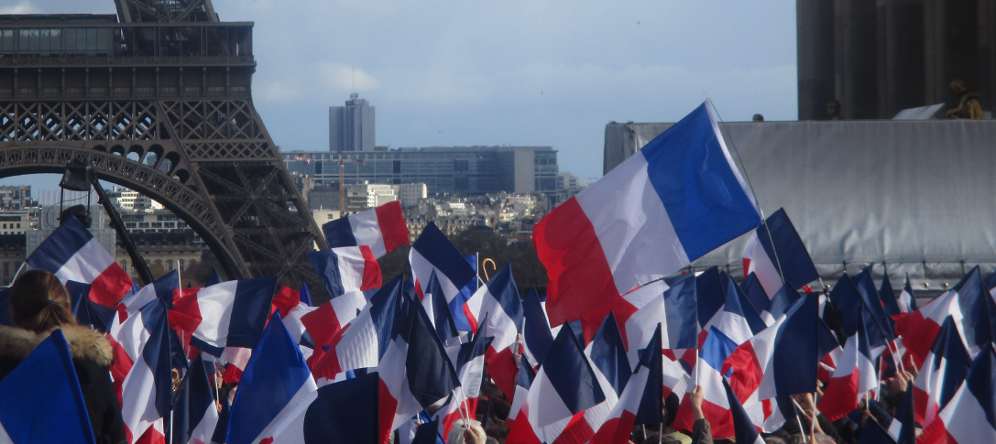
Photo top of page . Political rally in Paris
by Thomon. Creative Commons licence
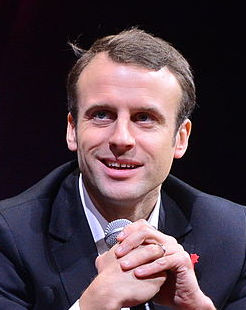
Emmanuel Macron - France's current president
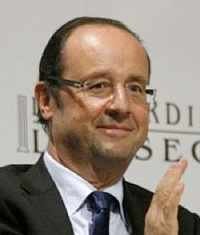
François Hollande, France's last president
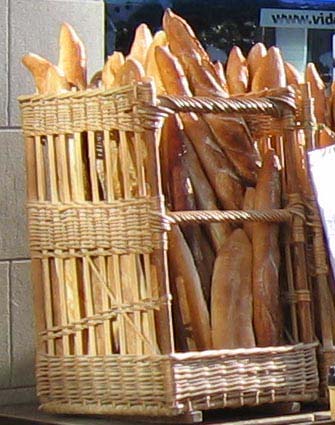
Baguettes - France's emblematic bread. The delicious baguette is an icon of this country famed for its "gastronomy" and good food......
Mont Saint Michel - Normandy

About-France.com
is an independent website that does not track users and does not show
any
personalised advertising, Affiliate links to selected relevant external
partner websites may lead to paymet of a small commission on
sales or bookings generated on
these sites.
| ► Accommodation
in France |
| Guide to hotels in France |
| Gites in France |
| Bed and breakfast in France |
| Rural campsites in France |
| Independent hotels in France |