
Old Aquitaine - an area guide
Southwest France - the former region of Aquitaine
- Explore France ►
- Essential pages
- Travel in France
- Where to go
- What to see and do
About-France.com
- the connoisseur's guide to France
Old Aquitaine, from the Dordogne to the Basque country
Page index : |
Regional overview | Main tourist sites | Access |
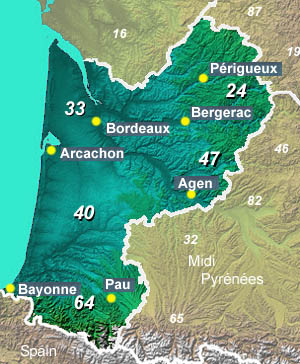 Aquitaine,
capital city Bordeaux,
was one of the great historic
provinces
of
France.
Aquitaine,
capital city Bordeaux,
was one of the great historic
provinces
of
France. This page covers the area that until 2016 was the Aquitaine region of France, now merged into a larger region known as Nouvelle Aquitaine.
Old Aquitaine is one of the largest and most varied regions of France, stretching from the foothills of the Massif Central in the north, to the Spanish border in the south, a distance of over 300 km. In the Middle Ages, Aquitaine was allied with the Plantagenet kings of England, and the region has many historic connections with the British Isles, notably through the wine trade.
On account of its size, Aquitaine is a very varied region; the northwest of the area, comprising the departments of the Dordogne (24) and the Lot et Garonne (47) is made up of gentle hill country, with large areas of vineyards in the lower lying areas, and woodland and mixed farming in the hillier north east. The Dordogne area (click for more details) is famous for its rurality, its gentle valleys and villages, which seem to outsiders to be lost in time, and have become very popular with second-home buyers from the UK and the Netherlands human habitation in Europe, and many prehistoric sites can be found round the area of Lascaux (remarkable caves, a UNESCO world heritage site) and Les Eyzies. Within France, the Dordogne department is more famous for its gastronomic specialities, truffles, foie-gras, walnuts and other mouth-watering delicacies, and is often rerferred to as "le Périgord", the area around the departmental capital of Périgueux.
The middle band of the region, following the line of the Gironde estuary, is low-lying land, and one of the most famous wine-producing areas in France. Bordeaux, regional capital and capital of the Gironde (33) department, is amagnificent city lying at the lowest bridging point on the Garonne river. it is one of France's great seaports, and its historic wealth is reflected in the many fine buildings of the old city, such as the unique eighteenth-century theatre. North of Bordeaux, to the west of the Gironde estuary, lies the area of Médoc, the most prestigious of the region's wine-producing areas; other famous vineyard areas can be found all round Bordeaux, and notably along the valley of the Garonne and its tributaries.
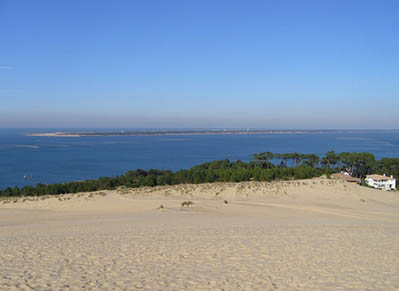
Sand
dunes above the bay of Arcachon
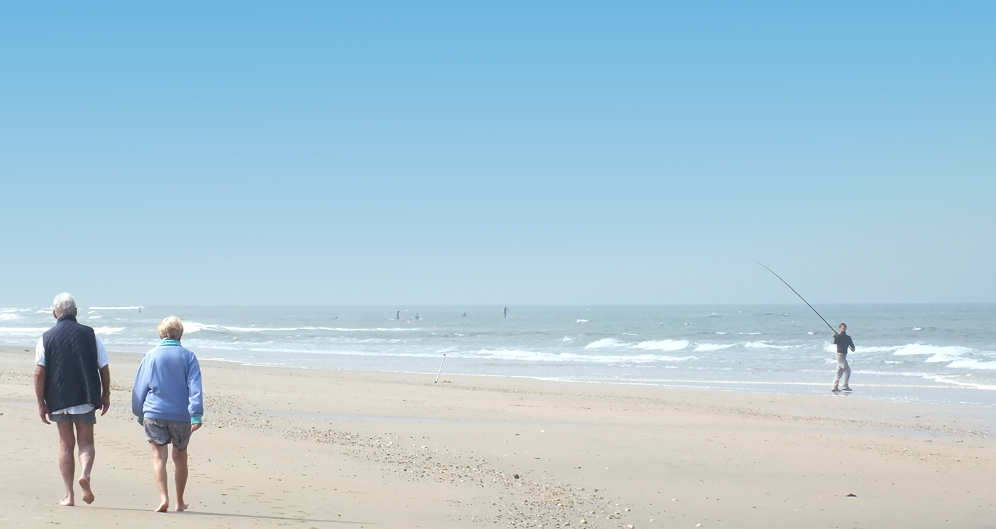
Old Aquitaine boasts over 200 km of sandy shoreline, known as the Côte d'Argent, or Silver coast. With major resorts few and far between, except in at the southern end within fifty kilometres of the Spanish border, this is a coastline with ample room for everyone. The southern end of the coastline, south of Hosségor and Capbreton, is more built up, with the resorts of Biarritz, Bayonne and Saint Jean de Luz among others.
West of Bordeaux, the resort of Arcachon is very popular, on account of its sheltered anchorage, favoured by yachtsmen, and the proximity of the Dune du Pilat, the highest sand dune in Europe.
The southern part of Aquitaine is made up of two distinct areas, the departments of les Landes (40) and the Pyrénées Atlantiques (64). Les Landes is the most heavily forested area of Europe; a low lying area with sandy soil, almost the whole department is covered with pine forests interspersed with small areas of heath and farmland. The forests are popular with nature lovers, ramblers and hunters, and support a major timber industry. Outside the few towns and seaside resorts, the department of les Landes, which until the nineteenth century was renowned as an inhospitable wasteland, is one of the least densely populated areas of France. It is also a department where almost a quarter of all dwellings are second homes. Les Landes is part of the historic area of Gascony.
The department of Pyrénées Atlantiques (64) is essentially composed of the former province of Bearn and the Basque country. It is a very attractive department, offering everything from Atlantic surf on the beaches around St Jean de Luz and Biarritz, to good skiing on the slopes high up in the Pyrenees. The foothills of the Pyrenees are a delightful area, benefiting from a very mild climate, and sufficient rainfall to remain green and luscious through many months of the year. Pau, the departmental capital, is an elegant city that was very popular with the British in the nineteenth century as a thermal resort, and even boasted at one time an English hunt, complete with hounds and redcoats.
Aquitaine is a region that is popular for cycle tourism: two long distance cycle routes, the Atlantic cycleway and the Atlantic-Mediterranean cycle route cross the region. In Aquitaine, both are largely on dedicated surfaced cycle routes, and are flat, as they largely follow the coast or rivers / canals.
Main tourist attractions in Aquitaine
Gironde - Garonne area:
- Bordeaux :
regional capital, a UNESCO world heritage site; remarkable 18th century
and earlier architecture, including the theatre, bridge over the
Garonne, and other buildings. Riverside, streets and markets. Bordeaux Art Gallery has
a large collection,
particularly rich in 17th-19th century French and European art,
including works by Chardin, Greuze, Claude Lorrain, Poussin, Delacroix,
Renoir, Frans Hals, Van Dyck, Rubens, Ruysdael, plus a lesser but
interesting collection of French 19th and 20th century art.
The "Grand Théâtre" is one of the finest surviving 18th century theatres in Europe, and the only one in France to have conserved its 18th century interior - St Emilion: UNESCO world heritage site, famous wine-making city with narrow streets and unique underground 'monolithic' church.
- The Aquitaine vineyards; the chateaux of the Bordeaux, Médoc and St Emilion vineyards. The most famous Bordeaux vineyards are situated northwest of Bordeaux, on the south side of the Gironde estuary.
- Citadelle de
Blaye UNESCO world heritage site, Fortified citadel
guarding the north bank of the Gironde estuary.
-------------------------------- - Agen: interesting art gallery housed in Renaissance buildings. A fine collection of paintings including works by Goya, Tintoretto, Greuze, Corot, Boudin, Sisley and others. The aqueduct carrying the Garonne canal over the river, completed in 1843, is 550 metres long, and is the second longest canal bridge in France
- Bonaguil : fabulous medieval fortress chateau in the valley of the Lot, near Fumel. One of the finest castles in France.
- The Canal du Midi - or at least the part known as the Canal latéral de la Garonne - Europe's oldest canal system, linking Atlantic and Mediterranean. Of particular note is the 539 metre-long canal bridge at Agen, the second longest canal aqueduct in France, carrying the canal over the river Garonne.
- The Bastide towns of Aquitaine: small medieval planned towns, dating from the time of the hundred year's war between France and England. Three of the finest examples in Aquitaine are Eymet in the Dordogne, Montpazier (built by the English), and the hilltop bastide of Montflanquin.
North east of the Garonne:
- Dordogne:
river valley , small villages and towns, prehistoric sites.
- Noteworthy sites: Château de Beynac, on a clifftop overlooking the Dordogne valley. A remarkable castle in a remarkable site. Also nearby the castle of Castelnaud and the riverside village of La Roque Gageac
- Lascaux: UNESCO world heritage site : Remarkable prehistoric caves with paintings. Reconstruction. The original cave is closed to visitors, for conservation reasons. See Prehistoric France
- Les Eyzies : near Lascaux, in the Vézère valley, national museum of Prehistory, plus historic sites and troglodyte houses built into the cliff faces. It was in the Cro Magnon shelter at Les Eyzies that the earliest remains of homo spaiens were discovered in 1868. The Font de Gaume cave is another site with prehistoric cave paintings. See Prehistoric France
- Montbazillac : famous château and vineyard, near Bergerac.
- Perigueux: capital of gastronomy; old streets and buildings, including St Front Cathedral, originally dating from the 12th century. While the Byzantine-style tower is medieval, most of the actual cathedral is a 19th century rebuilding and embellishment of the original edifice.
- Sarlat;
one of the most attractive small towns in France. A fine small French
town that has preserved much of its historic centre, with houses dating
from medieval times and the Renaissance. Market on Saturday morning.
Nearby the Maison Forte
de Reignac
is a fascinating 16th century troglodytic house built into a cliff; it
is remarkably well conserved, and furnished in period style. It is the
last surviving example of a substantial cliff dwelling in France.
► More on the Dordogne
South west of the Garonne:
- Arcachon: popular Atlantic coast resort, with marina and beaches.
- Atlantic coast: many long sandy beaches, stretching over 200 km from Bayonne to the Gironde. This coast, flanking the Bay of Biscay, is known as the Silver Coast, or "Côte d'Argent", and is popular with surfers.
- Basque country: where the Pyrenees meet the Ocean - bracken covered hills, and villages in the distinct Basque style.
- Bayonne: musée Bonnat-Helleu. Impressive collection of European painting, with - among others - works by Goya, El Greco, Ingres, David, Géricault, Ghirlandaio, Botticelli, Tiepolo, Rembrandt, Rubens, and even Constable and Turner .
- Bayonne: Medieval cathedral and cloisters, boat trips on the river Adour, Basque museum, beaches.
- Béarn: area in the foothills of the Pyrenees around Pau & Orthez
- Biarritz, Saint Jean de Luz : popular seaside resorts near the Spanish border.
- Dune du Pilat, highest sand dune in Europe, near Arcachon.
- Laruns, in the Pyrenees south of Pau. Le Petit train d'Artouste. Ten kilometer very scenic narrow gauge railway, running at an altitude of between 1920 metres and 1940 metres (over 6300 ft) above sea level. Access by cablecar from Artouste-Fabrèges.
- Les Landes: largest forested area in Europe, pine forests and heath. Hiking, natural environment, and a good network of cycle tracks.
- Pau: elegant city near the Pyrenees. Impressive medieval castle, birthplace of King Henri IV. The Musée des Beaux Arts is the second best art gallery in Aquitaine, after Bordeaux, and has a substantial collection including works by El Greco, Zurbaran, Rubens, Degas, Corot, Marquet and many more.
- Pic du Midi d'Ossau, 2884m, highest point in western Pyrenees. Skiing, hiking.
- Pyrenees: high mountains on the Spanish border, hiking, climbing, winter sports, scenery - including the western half of the Pyrenees National Park.
- St Jean de Luz : small fishing and pleasure port close to the Spanish border. The 17th century St.John the Baptist church has a very fine ornate gilded altarpiece in the Spanish style. In this church, King Louis XIV was married to the Infanta of Spain in 1660
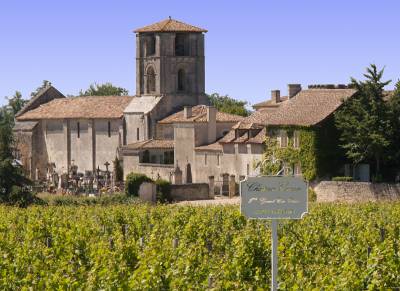
Vineyard at St. Emilion - photo J Menichini
► Stay on a Bordeaux wine estate :
a select choice of some active wine estates in Aquitaine offering cellar visits, wine tasting and hotel or b&b accommodation.- Saint Estèphe, Medoc,: Classic Médoc château on a large estate. Ten bedrooms, fine dining, winery tours.
- Côtes de Bourg vineyard. Château winery with 3 ensuite b&b rooms and pool. Wine tasting and vineyard tours
- Near Bordeaux, beside the Dordogne: Small Bordeaux estate offering bed and breakfast. 3 rooms.
- Saint Emilion: Wine estate chateau amidst the vineyards: four en-suite guest rooms.
- Saint Emilion : Winery with restaurant and four guest rooms in a prestigious Saint Emilion vineyard
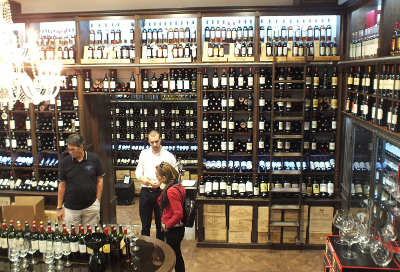
This area produces some of the world's finest wines
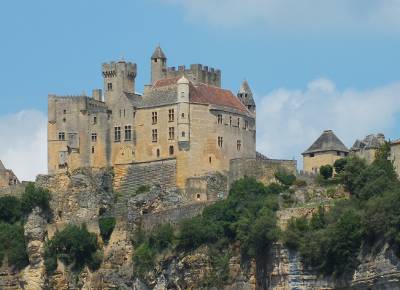
The Château at Beynac in the Dordogne
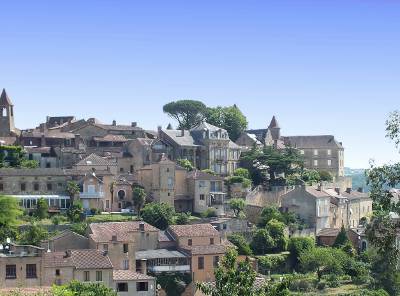
Hillside village of Belvès, in the Dordogne
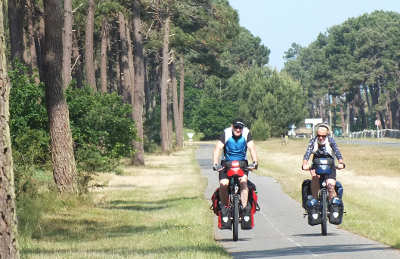
Aquitaine is well equipped in dedicated cycleways, notably on the flat land near the coast.
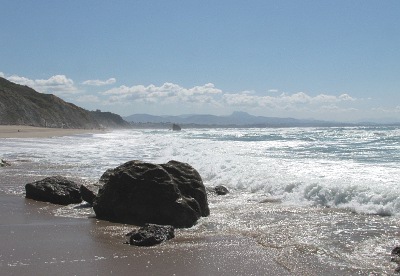
The Basque coast, near Saint Jean de Luz
About-France.com
- Site
search
- Maps
of France
- Contact
Lying in
the southwestern corner of France, Old Aquitaine, the former region of
Aquitaine, is an area famed for
its wine, its beaches and its countryside.
Southwest of Bordeaux and the Gironde, the area is mostly low lying. In the northeast, which includes the Dordogne, the land is hillier country, famed for its gourmet cuisine,its picturesque villages, and its historic sites.
Southwest of Bordeaux and the Gironde, the area is mostly low lying. In the northeast, which includes the Dordogne, the land is hillier country, famed for its gourmet cuisine,its picturesque villages, and its historic sites.
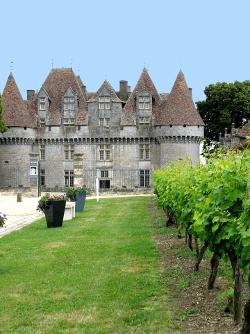
Montbazillac - one of Aquitaine's many famous wine estate chateaux
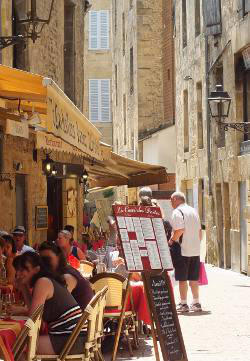
Old Sarlat, in the Dordogne
Travel
information:
Reaching Aqitaine:
By train to
Bordeaux :
TGV from
Paris Gare Montparnasse, or from Lille; train from Toulouse
or Marseille. By car : motorway from the Channel ports via Rouen and Tours, or from Paris.
See Routes to southwest France
By air : to airports at Bordeaux, Bergerac, Pau and Biarritz - or (peripheral) Toulouse. See Flights to France
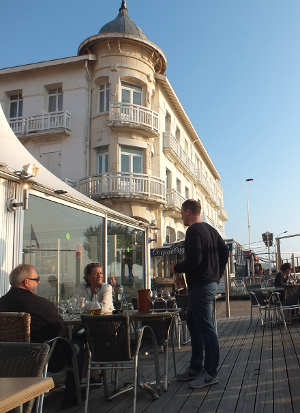
There are
plenty of attractive seaside cafés
An
independent user-supported website, About-France.com is an affiliate
partner of
carefully selected relevant third-party websites,
and may receive a small commission on some transactions made on these
partner sites.
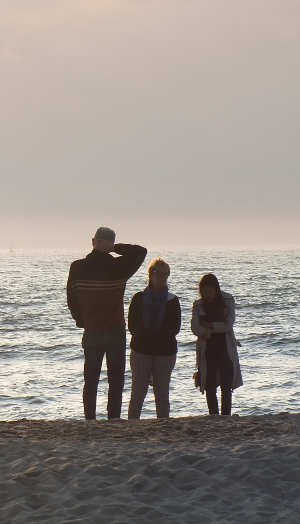
And miles
of sandy beaches
Click here for
low-cost car hire in France
low-cost car hire in France
Text and photos Copyright © About-France.com except where otherwise indicated.
Photos licenced cc Creative Commons when indicated