

The Renaissance in France
A short history of French Art - 2.
About-France.com
- the connoisseur's guide to France
The French Renaissance - Art and architecture in France in the sixteenth century
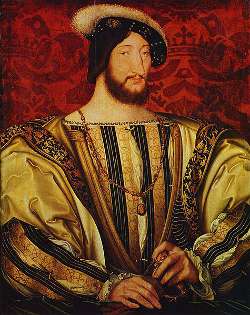 François
1, painted by Jean Clouet
François
1, painted by Jean Clouet (Louvre, Paris).
The earliest Renaissance architecture in France is said to be parts of the Loire valley chateau at Amboise, which King Charles VIII began to rebuild in the "Italian manner" from 1495, employing for this purpose the Italian architect Domenico da Cortona.
It was under François 1, king of France from 1515 to 1547, that Renaissance art and architecture first blossomed in France. Shortly after coming to the throne, François, a cultured and intelligent monarch, invited the elderly Leonardo da Vinci to come and work in France. Leonardo came to live at Amboise, bringing with him paintings and drawings many of which are still in France today, notably at the Louvre, which has the world's largest collection of Leonardo's paintings, including of course the Mona Lisa, known in France as La Joconde.
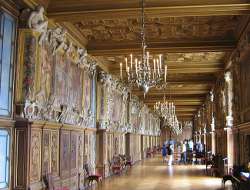
The François 1 gallery in the Château de Fontainebleau
To decorate his royal residences, François brought other artists and craftsmen from Italy, including Benvenuto Cellini; he also imported works of art from Italy. All this rapidly galvanised a large part of the French nobility into taking up the Italian style for their own building projects and artistic commissions. Thanks to the enlightened influence of François 1, the Renaissance took hold firmly and strongly on French soil.
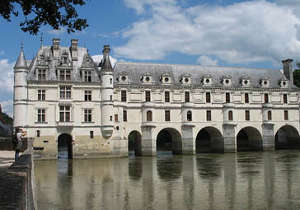 Chateau de
Chenonceaux, on the Cher .
Chateau de
Chenonceaux, on the Cher .The Renaissance took hold, nonetheless, throughout France, and fine Renaissance buildings were put up in towns and cities across the land. In Besançon, capital of Franche-Comté, now France but then part of the Hapsburg empire, Cardinal Granvelle, the Chancellor to François' arch rival the Emperor Charles V (Charles Quint), built himself a small but impressive Renaissance palace which stands to this day. In nearby Burgundy, the château of Ancy le Franc is one of the purest Renaissance chateaux in France. The Renaissance even reached the furthest corners of Brittany, where for instance the mid 16th century chateau de Kerjean is a fine example of French Renaissance architecture.
While it is in architecture and interior decoration that the French Renaissance style is most visible today, the Renaissance also saw the slow development of a French school of art, though Italian artists remained very much in vogue. One of the most extensive examples of Renaissance painting in France can be seen in the decoration of the ceiling vaults of the Cathedral of St. Cecelia (photo top of page) in Albi (Midi-Pyrenees), painted in the early sixteenth century, even before François 1° came to the throne of France. During François' reign, Fontainebleau became the hub of artistic activity, but the Fontainebleau school was the only home-grown school of French renaissance painting. It is best represented by Jean Clouet and his son François Clouet; other important painters of the school include Jean Cousin and Antoine Caron; but apart from the Clouets, none made any great mark on posterity.
It was not until the seventeenth century that French painters were to make a major contribution to the history of art.
The About-France.com history of art in France :
- Art and architecture in Medieval France
- French art in the Renaissance
- French art from Baroque to Rococo - 1590 - 1790
- Neoclassicism and Romanticism
- Naturalism and realism - landscape and life in 19th century French art
- Impressionism
- Post- Impressionism - from Pointillism to Cubism
More about Renaissance France
Copyright
© About-France.com except where otherwise stated.
About-France.com
Home
page - Site
search
- Regions
- Maps of France
- Contact
Photo top of page : Early Renaissance vaulted
ceiling in St. Cecilia's cathedral, Albi.
© About-France.com
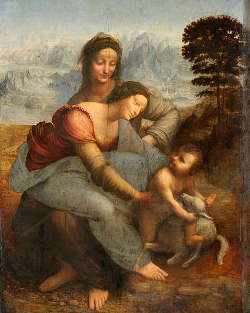
Virgin, child and St Anne - by Leonardo da Vinci, Paris, Louvre
Photos:
Photos Chenonceaux and St.Cecilia's cathedral, Albi: © About-France.com
Other photos are public domain.
About-France.com is a fully independent website affiliated to certain online booking platforms, and may receive a small commission only on bookings made through affiliate sites . This has no effect at all on the price paid by the visitor.
Copyright texts © About-France.com
© About-France.com
France is famed as one of
the world's great centres of art and culture.
The Renaissance was an artistic and cultural revolution that began in Italy in the fourteenth century, reached its peak in the Italian 15th century (known as the Quattrocento), and moved later to other parts of Europe, notably France England and the Rhine valley.
The Renaissance was an artistic and cultural revolution that began in Italy in the fourteenth century, reached its peak in the Italian 15th century (known as the Quattrocento), and moved later to other parts of Europe, notably France England and the Rhine valley.
Virgin, child and St Anne - by Leonardo da Vinci, Paris, Louvre
Photos:
Photos Chenonceaux and St.Cecilia's cathedral, Albi: © About-France.com
Other photos are public domain.
About-France.com is a fully independent website affiliated to certain online booking platforms, and may receive a small commission only on bookings made through affiliate sites . This has no effect at all on the price paid by the visitor.
| ►► Site guide |
| About-France.com home |
| Full site index |
| About-France.com site search |
| ►► Principal chapters on About-France.com |
| The
regions of France Beyond
Paris, a guide to the French regions and their tourist attractions.
|
| Accommodation
in France |
| Guide
to Paris Make
the most of your trip to Paris; attractions,
Paris hotels,
transport, and lots more.
|
| Tourism
in France
The
main tourist attractions and places to visit in France - historic
monuments, art galleries, and more
|
| Planning
a trip to
France
Information
on things to do before starting your trip to France.
|
| Driving
in France
Tips
and useful information on driving in and through France - motorways,
tolls, where to stay....
|
| Maps
of France
Cities,
towns, departments, regions, climate, wine areas and other themes.
|
| The French way of
life
A
mine of information about life and living in France,
|
| A-Z
dictionary
of France Encyclopedic
dictionary of modern France
|
Click here for
low-cost car hire in France
low-cost car hire in France
Copyright texts © About-France.com