
About-France.com
- the thematic guide to France
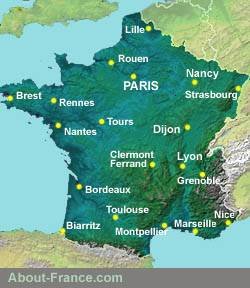
Lying to the southwest of Paris, the Centre region takes in the most
visited
part of the Loire valley, and areas to the north and to the south. As
well as the most popular of the Loire valley chateaux, it also includes
the forests of the Sologne, south of the Loire, and the gentle hills
and valleys of the Berry region, to the south.
| Index: | Regional overview | Main tourist attractions | Further details |
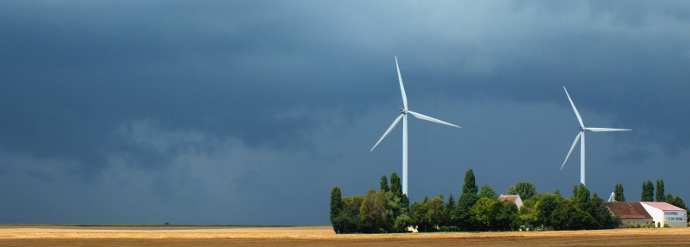
The plains north and
south of the Loire are the breadbasket of France
While it does – just – include the point which is the geometric "centre" of continental France, the region of France known as "Centre Val-de-Loire" does not generally coincide with the
 middle of the country.
It could more aptly be described as being the centre section
of
northern France. It is an area stretching from a latitude slightly
north of Paris, down to the north of the Limousin and Auvergne regions,
and is bordered to the west by Normandy,
the Pays
de la Loire region and Poitou, and to the east
by the Paris region (Ile de France) and Burgundy.
Its regional capital is the city of Orléans.
middle of the country.
It could more aptly be described as being the centre section
of
northern France. It is an area stretching from a latitude slightly
north of Paris, down to the north of the Limousin and Auvergne regions,
and is bordered to the west by Normandy,
the Pays
de la Loire region and Poitou, and to the east
by the Paris region (Ile de France) and Burgundy.
Its regional capital is the city of Orléans.Unlike many other regions, the Centre Val-de-Loire region is not a historic province; it is, as its name perhaps implies, the heart of historic France, the area between the Paris region and the Loire valley that was for many centuries the centre of the kingdom of France – at times when the territory which is today known as France was divided among the kingdoms or duchies of Normandy, Burgundy, Aquitaine, Anjou and others less important. In this respect, the regions of the Centre and the Ile de France are France.
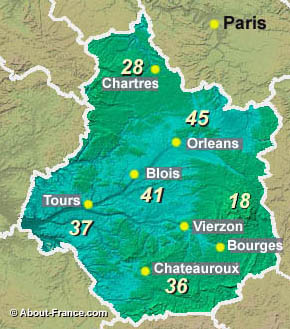
The region is composed of six departments, the Eure et Loir * (28), the Loiret (45), the Loir et Cher (41), the Cher (18), the Indre et Loire (37) and the Indre (36).
In the north of the region lies the area known as la Beauce, one of the two historic breadbaskets of France. This is a gently undulating plateau where vast wheat fields stretch as far as they eye can see.
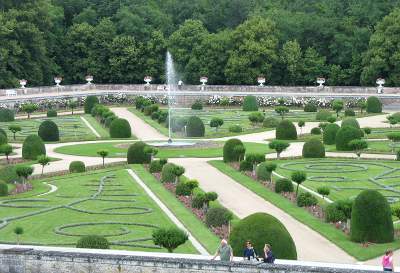
Classically French - gardens "à la française" at Chenonceau
 In the south and south-east, covering
the
departments of the Cher and the Indre, the Centre region rises gently
towards the hills of the Limousin and the Auvergne; this area, known as
le Berry,
is a deeply agricultural area, with mixed farming. Its capital is the
city of Bourges, with
a magnificent medieval cathedral and fine historic centre.
Finally, to the south-west of the town of Chateauroux lies
an area known as La Brenne,
the "area of a thousand lakes", and one of the most important wetlands
in France. As for the exact "centre" of France, it is
generally
accepted as being close to the little town of Saint Amand Montrond,
south of Bourges.
In the south and south-east, covering
the
departments of the Cher and the Indre, the Centre region rises gently
towards the hills of the Limousin and the Auvergne; this area, known as
le Berry,
is a deeply agricultural area, with mixed farming. Its capital is the
city of Bourges, with
a magnificent medieval cathedral and fine historic centre.
Finally, to the south-west of the town of Chateauroux lies
an area known as La Brenne,
the "area of a thousand lakes", and one of the most important wetlands
in France. As for the exact "centre" of France, it is
generally
accepted as being close to the little town of Saint Amand Montrond,
south of Bourges.The northern half of the Centre region benefits, economically, from its proximity to Paris, and by excellent transport links to the capital. Tours is served by TGV, and Orleans by fast express trains; all the major cities in the region also have direct motorway access to Paris. The The cities of the Loire valley have become important centres for the pharmaceutical and high-tech industries, and the north of the region is also a centre for the French cosmetics industry.
As for the exact location of the "centre" of France, several communes in the south of the Centre region - and a some in the north of the Auvergne - are rivals for this title - depending on the criteria used. But according to various criteria, the centre of France lies at some spot in the commune of Saint-Armand-Montrond, in the very south of the Cher department.
Access: by train (TGV) from Paris Gare Montparnasse, Gare d'Austerlitz, or gare de Bercy. Access by road from the UK, via any of the Channel ports, then via Paris or Rouen. The Centre region is crossed by the main motorways between Paris and western / southwestern France, the A10 (Paris-Tours-Bordeaux), the A11 (Paris-Chartres-Rennes), the A71( [Paris] - Orleans -Clermont-Ferrand) , the A77 (Paris-Nevers) and the A20 ( [Paris] -Vierzon-Toulouse).
Air access is easiest via Paris Orly airport, or Tours.
Footnote: the Loir and the Loire are two different rivers. The Loir is a tributary of the Loire.... confusing !
Top sights and tourist attractions in the Centre Val-de-Loire
Extensive sites
- The river Loire (37 / 41 / 45 ) The wide slow-moving Loire is one of Europe's great rivers. The river, excellent for fishing, is bordered by many attractive small towns, and the flat land is good for cycling. There are also many vineyards in the area of Tours.
- Les
Châteaux
de la Loire (37, 41, 45, 18)
- the
castles of the Loire. Many of these are actually on tributaries of the
Loire. The most famous are Chambord,
Chenonceau, Villandry (with its famous gardens) and Azay le Rideau. But
there are many others, including Langeais, Cheverny,
Rigny-Ussé,
Amboise etc.
The Loire valley and its châteaux are classed as a UNESCO world heritage site. - La Sologne: great wooded area, south and southwest of Orleans; formerly favoured as hunting grounds by kings and nobles. It includes many châteaux, most notably Chambord.
Cher area (18)
- Ainay le Vieil - near Saint Amand Montrond. Enchanting small chateau built inside the defensive walls of a medieval fortress which is surrounded by a moat.
- Bourges : Attractive historic centre, with great gothic cathedral, later than that of Chartres; fine medieval sculptures and stained glass; also the famous Renaissance town residence of Jacques Coeur.
- Gargilesse Picturesque village, with the home of 19th century novelist George Sand.
- Meillant North of Saint Amand Montrond Fine Renaissance chateau
- Noirlac near Saint Amand Montrond. Abbaye de Noirlac, one of the Best preserved Cistercian monasteries in Europe, founded on the banks of the river Cher in the year 1136.
Indre area (36)
- La Brenne (36). Area of 1000 lakes, major wetland renowned for its birds.
- Valençay (36). A fine Loire château that is rather further from the Loire than most others.
- Poulaines . Gardens and arboretum. A small private venture that gets very good reviews
Indre et Loire area (37)
- Tours (37): largest city in the region, Tours boasts an attractive historic centre with old half-timbered houses, St Gatien's cathedral, and also a castle. The city art gallery has a small collection including works by Rembrandt, Boucher and Monet.
- Amboise : Attractive small town on the Loire, just east of Tours. the town has three châteaux, including the imposing royal château, and the Clos Lucé, where Leonardo da Vinci spent the last years of his life.
- Chinon (37) Attractive small town, dominated by its large medieval castle, built by King Henry II of England, who was also Duke of Anjou. Henry is buried in nearby Fontevraud Abbey, in the Pays de la Loire region
- Loches (36) Small town guilt around a fine medieval fortress and Renaissance castle. Old city gates, and narrow cobbled streets.
Eure et Loir area (28)
- Chartres (28) - One of the most famous gothic cathedrals in France, famous in particular for its magnificent medieval stained-glass windows.
- Illiers-Combray A village near Chartres Marcel Proust depicted life in Illiers in his novel , arguably the greatest French novel of the 20th century. Illiers was the model for Proust"s Combray, and today has a Proust museum in "la Maison de Tante Léonie". Illiers changed its name to Illiers-Combray in 1971, on the centenary of Proust's birth.
Loiret area (45)
- Briare the Canal bridge. Located at the northern end of the Loire valley canal, and opened in 1896, it was until 2003 the longest navigable aqueduct in the world. It connects the Loire canal to the Briare canal, one of the oldest canals in the world, completed in 1642.
- Orleans (45), Regional capital, a historic city on the banks of the Loire. The centre has many historic buildings, and a cathedral that was rebuilt in the seventeenth century.
Loir et Cher area (41)
- Blois (41) . Historic town on the northern bank of the Loire, with a magnificent Renaissance castle.
- Bourré, near Montrichard. Unique subterranean village, sculpted into the soft local stone. Not old, but very interesting.
- Les Bordes : in the Sologne, reputed to be the finest golf course in France.
- Lavardin, near Vendome. In this village listed as one of the "plus beaux villages de France", discover the remarkable ensemble of medieval frescoes in the village church of St.. Genest
- Zoo Parc de Beauval, in the Loire valley area. Over 4000 animals, including koalas & orang-utangs. the largest wildlife collection in France.
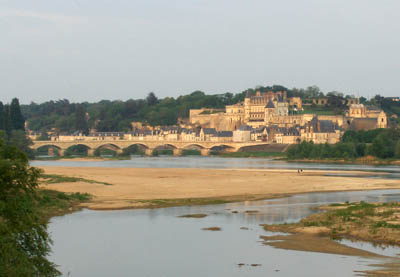
Amboise, on the River Loire Photo Schlabotnik
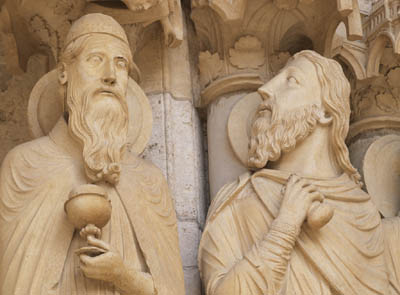
Chartres cathedral - statues on west portal - Photo Turloughmor
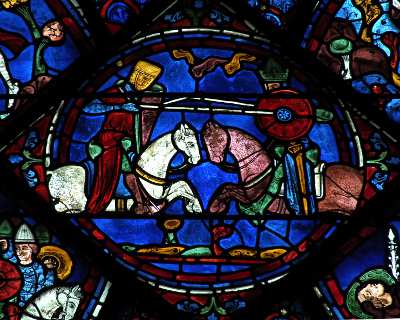
Chartres cathedral - scene from the famous medieval stained glass windows
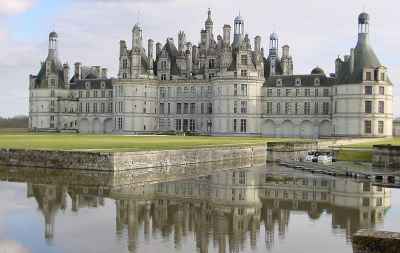
Chateau de Chambord, near Blois - Photo Steiner
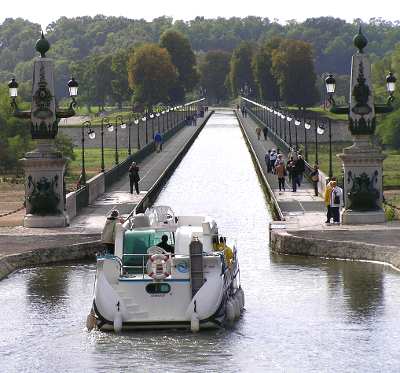
Nineteenth century canal bridge at Briare
Going further: Official Centre region tourism site
About-France.com
Home
page - Site
search
- Regions
- Maps of France
- Contact


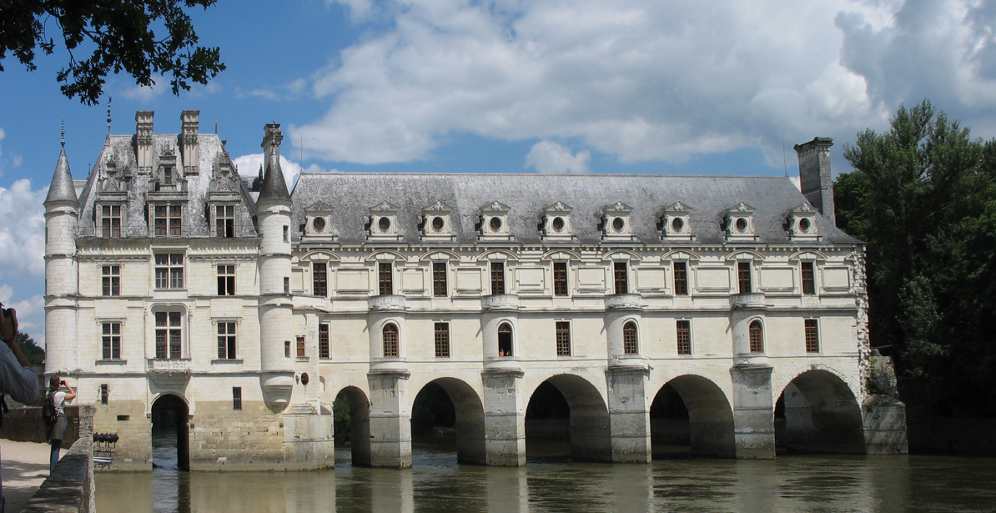
Chateau de Chenonceau - litterally on the river Cher Photo © About-France.com
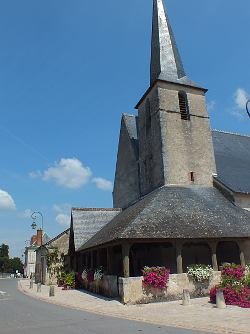
Cheverny, in the Loire valley
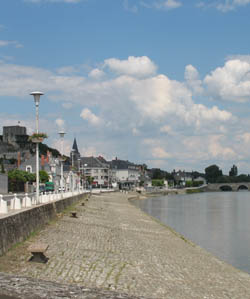
Beside the river Cher
Where
are the Chateaux of the Loire located?
The main Loire valley châteaux are located in areas 41 and 37, in the area between Orleans Blois and Tours. While some are actually on the Loire, others lie to the south of the Loire, or on tributaries such as the Cher.
The main Loire valley châteaux are located in areas 41 and 37, in the area between Orleans Blois and Tours. While some are actually on the Loire, others lie to the south of the Loire, or on tributaries such as the Cher.
► Somewhere to stay.... Check out
Hotels in the Loire Chateaux areaSafe online booking at best rates
Hotels in the Loire Chateaux areaSafe online booking at best rates
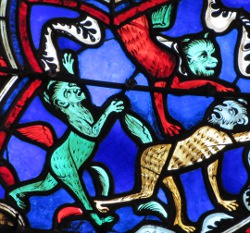
Detail from one of the medieval stained glass windows in Bourges cathedral
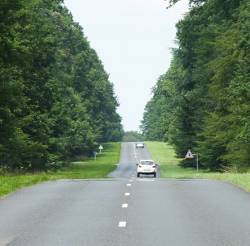
Tranquil byroad in the Sologne
| ►► Site guide |
| About-France.com home |
| Full site index |
| About-France.com site search |
| ►► Principal chapters on About-France.com : |
| Guide
to the
regions of France Beyond
Paris, a guide to the French regions and their tourist attractions.
|
| Guide
to Paris Make
the most of your trip to Paris; Information on attractions, Paris
hotels, transport, and lots more.
|
| Accommodation
in France
The different options, including hotels,
holiday gites, b&b, hostels and more
|
| Tourism in France
The
main tourist attractions and places to visit in France - historic
monuments, art galleries, seasides, and more
|
| Planning
a trip to France
Information
on things to do before starting your trip to France.
|
| Driving
in France
Tips
and useful information on driving in and through France - motorways,
tolls, where to stay....
|
| The
French way of
life
A mine of information about
life and living in France, including
working in France, living in France, food and eating, education,
shopping.
|
Click here for
low-cost car hire in France
low-cost car hire in France