- Explore France ►
- Essential pages
- Travel in France
- Where to go
- What to see and do
The 2027 elections in France -
presidential
and parliamentary - could mark a defining moment in modern French and European history
Click here for an overview of political parties in France.
When the first shots of the 2027 election campaigns were fired in 2026, France once again entered a long period of political angst, at the start of what could be a five-act institutional drama with cliffhangers through to the end. There is just one certainty, and that is that in 2027, France will get a new president, and the Macron era will come to an end. Elected twice in 2017 and 2022, Macron is barred by the constitution from running for a third term, leaving the traditional moderate ruling parties facing an uphill battle to hold on to power in the face of challenges from the populist far right and far left.
1. The Nightmare Scenario: Le Pen vs. Mélenchon.
For moderate voters in France, the primary concern dominating discussion in the media and online is the prospect of the "nightmare scenario", a second-round runoff for the Presidency between Marine Le Pen of the far-right National Rally (Rassemblement National) and Jean-Luc Mélenchon of the far-left France Unbowed party (La France Insoumise). For decades, French voters relied on the “Republican front”, a tradition of tactical voting across party lines, to block the political extremes. However, polls in summer 2026 persistently showed a highly fragmented space in the political centre ground, and no single candidate with much of a chance of overtaking either Le Pen or Melenchon, to secure a place in the second round. A second-round choice between Le Pen’s nationalist and anti-immigration platform, and Mélenchon’s radical economic restructuring and constitutional overhaul, would thus leave voters without a moderate candidate, forcing a historic choice between two diametrically opposed populist visions of the way forward.... but in fact no choice at all, since opinion polls point to a resounding defeat for Mélenchon in the event of a runoff with Marine Le Pen.2. Can anyone unite the centre?
The centre-left and centre-right face major obstacles when it comes to selecting a consensus candidate who can unite both sides. The broad spectrum of the political centre includes figures ranging from former president François Hollande, and former Prime Ministers Édouard Philippe and Gabriel Attal to moderate socialists such as Raphaël Glucksmann, as well as traditional conservatives – a chicken run where egos and rivalries are often more visible than leadership. Conflicting personal ambitions and competing visions for the presidency have prevented a clear and early consolidation, and significant political differences divide the moderate bloc. Points of divergence include fiscal policy, attitudes towards the European Union, the never-ending issue of reforming the age of retirement, and public spending. Unless a single figure emerges, capable of generating the consensus that Macron achieved in 2017, the centre risks splitting its vote in the first round and failing to make it to the second. Some commentators are suggesting that the person most likely to unite the centre around a single candidate is actually Mélenchon, the fear being that Mélenchon's presence in the runoff would hand victory to Le Pen3. If a consensus candidate emerges....
If a single consensus candidate from the political centre manages to overtake Mélenchon (or, in a very unlikely scenario, Le Pen) and secure a place in the runoff, the entire dynamic of the second round changes immediately.Scenario 1. In a second round against Mélenchon, a moderate centre or conservative candidate is liable to absorb a large proportion of the centre-right and centre-left electorate as well as voters from the far right. Moderate voters alarmed by the economic implications of Mélenchon’s proposals on wealth redistribution, withdrawal from key international frameworks and a radical constitutional overhaul would likely rally behind the centrist candidate.
Scenario 2. In a run-off against Le Pen, a consensus candidate will seek to revive the classic ‘Republican front’. Although the effectiveness of this coalition against the far right has waned over successive election cycles, a consensus candidate has a good chance of winning.
4. If not, France enters uncharted territory: Le Pen or Mélenchon in the Élysée
Scenario 3. If Le Pen or Mélenchon emerges victorious from the runoff, France will enter unprecedented political waters. Armed with the executive authority of the French presidency, Le Pen would (try to) act swiftly to change immigration policy, prioritise French citizens over foreign residents in terms of social benefits, and reaffirm national control over European Union mandates. Mélenchon, by contrast, would seek to establish a ‘Sixth Republic’ to reduce presidential powers, freeze the prices of essential goods, lower the retirement age and reform France’s defence alliances and trade relations.
5. Act 2. Rounds 3 and 4 - parliamentary elections and tactical voting
Yet
winning the Presidential Election is only half the battle. Immediately
after the presidential elections, France holds parliamentary elections
to fill the 577 seats in the National Assembly. These parliamentary
elections effectively act as the third and fourth rounds of the
national contest.
Whoever wins the presidential election, the
first round of the parliamentary elections (round 3 in the full
process) will be a chaotic contest involving multiple parties
across hundreds of individual constituencies, where candidates from all
the main blocs compete. As in the presidential election, the top two
(sometimes top three) candidates in each constituency then go through
to the runoff, where
tactical voting comes into play. If a far-left or far-right
president is elected, millions of voters from across the rest of the
political spectrum will resort to tactical voting, in an attempt
to deprive the newly elected president of a majority
in
Parliament, forcing a state of cohabitation and
potential legislative
deadlock. Cohabitation
has happened before, but not with any far-right or far-left
participant. Given the new circumstances that a 2027 cohabitation would
imply, it may or may not be the end of the process.
6. A potential Act 3. Round Five: ‘La Rue’ and popular mobilisation
Faced with a hostile or divided parliament and no legislative
majority,
a newly elected president may be tempted to bypass parliament by
resorting to constitutional mechanisms such as executive decrees or
Article 49.3. Bypassing parliament to enact controversial policies
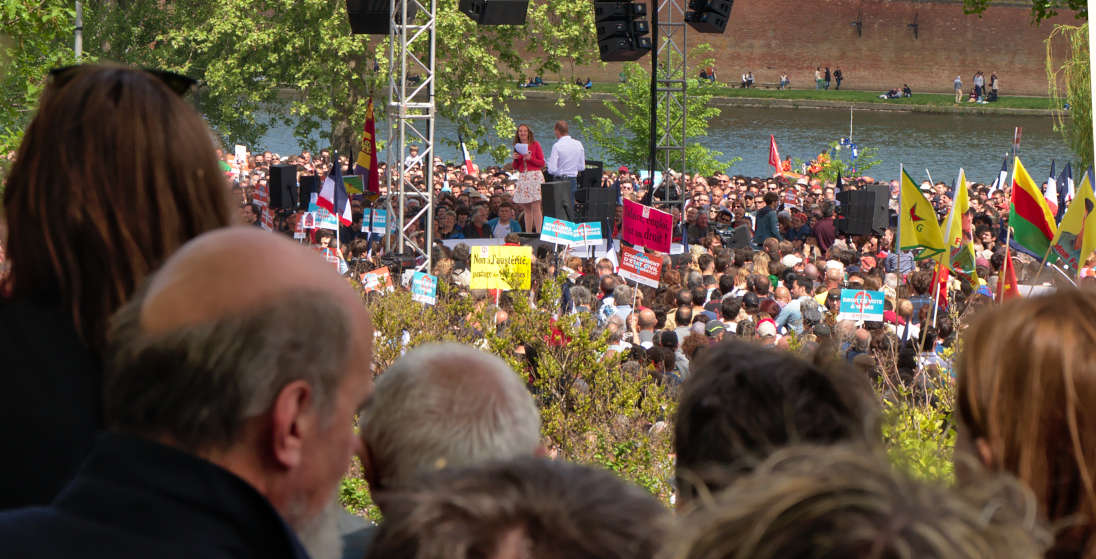
would likely trigger the ‘fifth round’ of French political life: mass
street protests (‘la rue’), mybe a general strikes or and civil
blockades
organised by trade unions, political activists and civic organisations.
In a deeply polarised political climate, executive governance without a
clear parliamentary mandate risks causing serious internal instability,
testing the resilience of France’s democratic institutions in a way
that has not been seen since 1968.
Whatever happens, fasten your seatbelt. 2027 will be an interesting
year in France.