- Explore France ►
- Key pages
- Where to go
- How to get there
- More about France
About-France.com
- the connoisseur's guide to France
A guide to the roads and motorways of France
- Free-flow tolling on French motorways. Toll booths have disappeared from the A13 and A14 motorways (Paris to Normandy) and been replaced by free-flow tolling. This applies even if you just take a short stretch of the A13, notably when exiting Rouen in the direction of Le Mans or Chartres. Free-flow tolling also applies on the A79 across central France (the Central-Europe to Atlantic route) For details on how to pay, see Tolls below
- COVID. Covid vaccination is recommended for all potentially "at risk" people, notably the elderly (over 60s). Masks may remain recommended or obligatory in some places, notably hospitals, doctors' surgeries and some other places.
- Driving license. Drivers from the UK, EU countries, Switzerland,and EEA countries. Your national drivers license is valid for driving in France as a tourist for up to twelve months, and for students studying in France for the duration of their student visa. Drivers with licenses from other countries must have a valid national license PLUS either an official translation into French or an IDP (International Drivers Permit), which can be obtained online. An IDP is recommended, though not required, for drivers with a license issued in the USA (though it is required in some other parts of Europe).
- Low Emission Zones - The French government has abolished Low Emission Zones (ZFEs) that used to restrict access of certain vehicles to certain urban areas. Introduced in 2015, ZFEs were created in order to keep heavily-polluting vehicles out of cities; in the ten years since then, the growth of electric vehicle ownership and the reduction in the number of old polluting vehicles helped improve air quality in France and other countries, and the number of vehicles affected by ZFE restrictions had fallen considerably.
Page index : Jump straight to......
| ►
French
motorway tolls |
► Toll-free routes | ► Avoid Paris | ► Stop for the night |
| ► Accidents | ► Speed limits & cameras | ► Driving laws in France | ► HGVs in France |
| ► Motorway service areas in France - les aires d'autoroute | ► Before driving in France - a checklist | ► Mileage chart - routes to the south of France | ► Channel ferries All the options |
| ► Road numbers & "bis" routes | ► Fuel prices in France and EV recharging | ►Hire a car in France, compare the options | ► |
About-France.com helps you pick the best routes, and avoid the worst bottlenecks and the busiest periods.
You may like to start your planning by visiting pages on Routes from Calais or Routes from Cherbourg and Caen.
PLAN
YOUR
JOURNEY...... AVOID THE BUSIEST WEEKENDS
Summer
2026
Here are the days on which to avoid the French motorway system if you
possibly can. Heavy holiday traffic on these days will lead to delays
and tailbacks across the network, most particularly on the following
motorways: All holiday periods - A1 Lille-Paris, A6 Paris-Lyon, A10 out of Paris
Summer months : A7 Lyon Marseilles, A8 Marseille-Nice, A9 Avignon-Perpignan, A10 Paris-Bordeaux (in parts). A63 around Biarritz,
Winter sports months : Alpine motorways in general.
Official traffic density forecasts:
Green : no problems Orange : delays likely in some placesRed= busy, Black = saturated : delays certain in busy spots, most notably in the Rhone valley south of Lyon, and around Bordeaux.
Note:
"Bison Futé", the French traffic website, predicts
NO busy traffic days at all, in any direction, between
Tuesday 26th May, and Thursday 25th June 2026.
| Southbound | Northbound |
|
|
MORE info ► ► ►
Busiest traffic
days in France
Find
hotels in France

Click for best online rates for hotels near the following towns on main motorway routes.
Calais
Reims
Dijon
Beaune
Lyon
Rouen
Orleans
Tours
Limoges
Poitiers
Bordeaux Clermont-Fd.
Reims
Dijon
Beaune
Lyon
Rouen
Orleans
Tours
Limoges
Poitiers
Bordeaux Clermont-Fd.
About-France.com
is partnered with Europe's leading hotel booking
portal, Booking.com, to bring you the best
online prices
MOTORWAYS OR NOT ?
► Avoiding problems. When driving in France, in spite of the cost, it is generally worthwhile taking motorways (autoroutes) unless you have time to go at a more leisurely pace. However, there are some useful tips to help you cut down on the cost of your trip across France.a) Petrol (gasolene) (fr. essence): don't fill up on the autoroute! Wait until a major intersection near a town or city, and come off the autoroute. You will almost certainly find a hypermarket / superstore within a kilometer or so of the exit, offering cut price fuel. The saving can be us much as 15 centimes per litre.
b) Anyone who intends to do lots of driving in France could find it in their interest to have a diesel car, particularly a modern fuel-efficient model. Diesel fuel in France (often called gasoil, pronounced gaz-warle) used to be about a third cheaper than unleaded, but that is no longer the case; today diesel retails at prices usually marginally lower than unleaded, but it also goes further. See petrol prices in France below for recent updates.
c) Use free autoroutes or dual-carriageways where they exist. See below for details.
See below for ideas on avoiding accidents.
► French road signs:
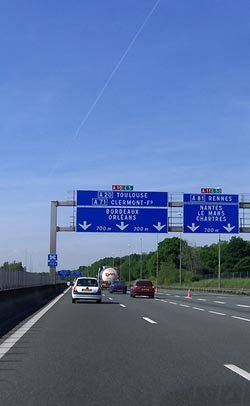
Signs indicating a motorway route (whether on the motorway or pointing to it) are indicated with white lettering on a blue background, as in the picture below left.
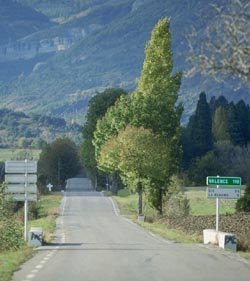
Signs indicating a non-motorway main route (route nationale or other) are indicated with white lettering on a green background, as in

►FRENCH MOTORWAYS:
French motorways, known as autoroutes, are designated with numbers preceded by the letter A (for Autoroute). Thus, when driving to the south of France from Calais, you can either take the A16 autoroute towards Amiens and Paris, or (normally an easier solution) the A26 motorway via Rheims.Most French autoroutes are toll motorways, and entrances to them are marked as such with the word "Péage" (pronounced pay-arje). The normal procedure is to pick up a ticket from a booth as you enter the autoroute (just press the button); tolls are paid either when you leave the autoroute, or else when the toll section comes to an end. In a few places, there are fixed toll points on the autoroute, notably in urban areas or toll bridges.
NEW - Free-flow tolling and how to pay.
The A13 Paris-Normandy motorway and the A79 across central France now use free-flow (flux libre) tolling, without toll booths. Use is detected by numberplate recognition cameras, and drivers have 72 hours to go online and pay, else pay a fine. A13 tolls apply (as they always have done) even to drivers using the motorway for a few kilometres outside Rouen, to reach the A154 for Evreux and Chartres, or the A28 towards Alençon and Le Mans. Payment is on the SANEF website, and you'll need your credit card and numberplate details. You don't have to have a customer account for one-off payments. A79 tolls can be paid in the same way on the Aliaé website, but payment is also possible at payment machines by the motorway entrances. For any free-flow motorway, payment can also be paid by going into one of the 10,000 newsagents or tobacconists in France affiliated to the Nirio network. Find a Nirio payment point .The Free-flow system will eventually be extended to all motorways, removing all toll booths. The next motorway to convert will be the A40 towards Geneva.
Principal signs on French motorway toll gates:

Centre lane: for vehicles with the télépéage transponder OR pay by credit card.
Right lane: all forms of payment - cards and cash
Other signs :
- X - Red cross: closed -
-
 Blue CB
rectangle : debit or credit cards only
Blue CB
rectangle : debit or credit cards only
Choose where to stay in rural
France 
French gite and B&B locator maps
Book directly in English with the owners
Gitelink.com
Many toll-gates are for both card payment (credit card or debit card)
and Telepéage... meaning that if you have a
télépége transponder, you
may still get held up behind people paying by card, if there is a queue.French gite and B&B locator maps
Book directly in English with the owners
Gitelink.com
Cash payment toll-gates (green arrow or pictogram of coins) will provide change – even the automatic ones.
Frankly, for occasional French motorway users, subscribing to the Liber-T system is a waste of money - unless you think that 20 € a year is worth paying in order to save perhaps a total of 10 minutes at the tolls, or are only travelling at very busy periods. On normal days, you can be through a payment booth in a minute or less.... specially with a contactless credit card.
The "Liber-T" charging sensor is available in the UK, but Sanef, the French motorway operators' company, charges higher rates for users applying via its English language website than for applications from its French website - which can only be used by people having a bank account in France.
2026 Motorway tolls in France -
French motorway tolls normally increase more or less in line with inflation each February. French inflation is low, about 1%. The cost of motorway travel for a car without caravan or trailer is about 1 €uro for 10 miles. For example, in January 2025 motorway tolls on the 1060 km trip from Calais to Marseille, via Reims, almost all of it on toll motorways, cost 103.50 €uros, about £88 sterling at conversion rates of the day. Here are the toll costs for a selection of other common journeys that use toll motorways over long distances:
| Sample
selection of motorway tolls : 2026 (for
cars) (For Car + caravan or normal size motorhome ; add about 50%). Truck / HGV toll rates (class 4) : approximately three times the rate for cars. 2026 rates, starting Feb 1st, are estimates based on the announced average increase of 0.86% over 2025 |
|
| From
Calais : Calais - Abbeville (- Rouen). 9.30 € Calais - Paris, via A 16: 23.9 € Calais-Marseilles, via Reims: 104.40 €uros Calais-Bordeaux, via Rouen Chartres & Orléans 62.60 € (886 km. 9¼ hours) Calais-Bordeaux, via Rouen & Le Mans 89,90 € (17 km shorter, 40 min faster) Calais-Toulouse, via Paris 65.40 € Calais-Toulouse via Rouen, Dreux: 42.00 € Calais - Perpignan via Rouen, Chartres & A 71: 69.20 € Calais-Nice, via Reims, Dijon & A39: 124.20 € Calais-Grenoble, via Reims, Dijon, A39: 88.70 € |
From
Le Havre : Le Havre - Montpellier via Chartres & A 71: 55.80 € Le Havre - Bordeaux, via Alençon: 74.30 € Le Havre - Bordeaux, via Paris: 85.00 € Roscoff - Toulouse via Bordeaux: 50.40 € Paris - Nice via Beaune 89.90 € Paris - Bordeaux via A10: 60.70 € Paris - Bordeaux via A10 to Poitiers then N10 via Angoulême: 40.60 € Bruxelles Brussels - Marseilles, via Charleville and Reims: 76.80 € Strasbourg - le Perthus (Spanish border): 88.40 € Freiburg im Breisgau / Mulhouse - Le Perthus: 88.40 € Freiburg / Mulhouse - Montpellier, via Lyon: 67.40 € Freiburg im Breisgau - Bayonne, via Châlon sur Saône, A79, Gueret and Bordeaux: 43.20 € |
The average cost per kilometre depends on what proportion of the journey involves free motorways or other roads. Drivers wanting to avoid French the tolls should remember that it is not necessarily the best solution, particularly in fairly populated areas. Using other roads, with their traffic lights, speed restrictions and roundabouts will mean longer journey times, more fuel consumption and more stress. ... even if you have a satnav to help you along...
Alternatively, check out this low-tolls or no-tolls route to Southwest France and the Spanish border.
► TIP : Ways to
save on motorway tolls when driving to southwest France
Though it is usually easiest and in the end worth it to take direct motorways and pay the tolls, there is one journey where you can make an appreciable saving for just a few extra kilometres.
If driving from Paris to Bordeauxand southwest France, do not follow the A 10 motorway all the way. Leave the A10 at Orleans, following A71 > A20 Toulouse. At Limoges, follow N141 > Angoulême. At Angoulême, follow the N10 for Bordeaux. All but about 60 km. of this alternative route to Bordeaux is on autoroutes or dual carriageway, but after Vierzon, it's all free. Saving: about 36 €uros less in tolls, for a distance of about 15 miles extra.... and cheaper off-motorway petrol if you need it.
Alternatively, check this low-tolls or no-tolls route to Southwest France and the Spanish border.
Click here for a zoomable detailed road map of France.
For more information on French motorway tolls, follow this link to the French motorway network website in English: this site provides a form to fill in, to calculate the cost of a motorway trip through France.
For a detailed route, use the route-finder map and distance calculator page on About-France.com.
Though it is usually easiest and in the end worth it to take direct motorways and pay the tolls, there is one journey where you can make an appreciable saving for just a few extra kilometres.
If driving from Paris to Bordeauxand southwest France, do not follow the A 10 motorway all the way. Leave the A10 at Orleans, following A71 > A20 Toulouse. At Limoges, follow N141 > Angoulême. At Angoulême, follow the N10 for Bordeaux. All but about 60 km. of this alternative route to Bordeaux is on autoroutes or dual carriageway, but after Vierzon, it's all free. Saving: about 36 €uros less in tolls, for a distance of about 15 miles extra.... and cheaper off-motorway petrol if you need it.
Alternatively, check this low-tolls or no-tolls route to Southwest France and the Spanish border.
Click here for a zoomable detailed road map of France.
For more information on French motorway tolls, follow this link to the French motorway network website in English: this site provides a form to fill in, to calculate the cost of a motorway trip through France.
For a detailed route, use the route-finder map and distance calculator page on About-France.com.
►Free motorways and routes avoiding tolls
There are a few free motorways in France, and some long-distance dual carriageways that are up to motorway standard. It is even possible to drive right through France avoiding all tolls - though this is not necessarily the best nor the most economical solution. The two links below show our recommended routes to the South of France avoiding most tolls - and alternatives avoiding all tolls.- ►
toll-free
route to Southwest France and northern Spain
► toll-free route the Alps and the Mediterranean
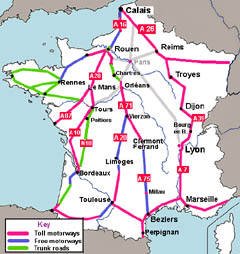
Click map to enlarge
- two thirds of the section on the A16 - A28 route between Calais and Rouen
- the A 84 from Caen to Rennes
- 275 km of the A20 from Vierzon to just south of Brive la Gaillarde (the longest stretch of free motorway in France, and the main Paris-Toulouse route).
- 340 km of the A75 motorway between Clermont Ferrand and Beziers - an
alternate route for people driving to Languedoc and the
Spanish border. Note however the Millau
viaduct has a toll (Toll
prices). Mountain motorway not recommended for caravans or in
winter.
- the motorway between Dunkerque and Lille.
- Most urban and suburban autoroutes in France are also free; and even when they are not, it makes more sense to pay the toll and avoid miles of traffic lights and congestion.
- Main arterial roads west of Rennes, in Brittany
- The N 10 from Poitiers to Bordeaux. See map of routes through France.
► TRUNK ROADS - arterial roads:
These in France are known as "routes nationales". These are trunk roads which, in the absence of an "autoroute", form part of the strategic national road network, such as the N21 from Limoges to Tarbes, or the N13 from Cherbourg as far as Caen.Road numbering in France
"A" roads, such as A71, are motorways, or Autoroutes"N" roads are strategic trunk routes - the National network.
"D" roads are roads whose upkeep is paid for by the local Department, or county. They can be anything from busy local routes or former National routes now downgraded, to the quietest of country backroads.
When driving in France, it is always best to follow destinations rather than road numbers. Following the regionalisation of responsibility for many roads, the result - if you want to travel by following road numbers - is a classic state of confusion; Drivers following the N13 south from Cherbourg lose it at Caen, as it becomes the D 613 thereafter! From Evreux to Mantes the "N 13" signs reappear, but after that it's the D 113....For another example, anyone wanting to avoid the toll motorway by driving along the old "route nationale" to the southwest corner of France, from Chartres to Biarritz, will follow three disconnected sections of main road known as "N 10"; but in areas where the old N10 is now close to a parallel motorway, the road is now signed as "D 910" or the "D 1010". Some old "N" roads now blithely change their number each time they pass from one department to another !!
This is all very confusing for foreign visitors driving in France, but not so much for the French, since with the exception of motorways, they follow a destination, rather than a road number. Destinations via main trunk routes are indicated by the names of towns in white letters on a bright green background, as shown above.
 Note that France also displays European
route numbers where
appropriate; these are marked with a white number on a green
background, and are in addition to the French road number. For example
the A
6 motorway from Paris to Lyon is also marked as
E15
- E15 being a European route running from
Inverness to Algeciras.
Note that France also displays European
route numbers where
appropriate; these are marked with a white number on a green
background, and are in addition to the French road number. For example
the A
6 motorway from Paris to Lyon is also marked as
E15
- E15 being a European route running from
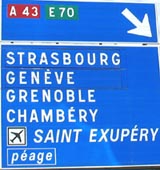
Inverness to Algeciras.In the motorway sign on the right, the A43 autoroute is also indicated as being the E70; the main towns it leads towards are indicated in normal lettering; other destinations, such as airports, are indicated in italics. The word "Péage" at the bottom indicates that this is a toll motorway.
Click for information on Traffic accidents in France
Driving on minor roads in France
"Bison Futé" and driving on the byways of France
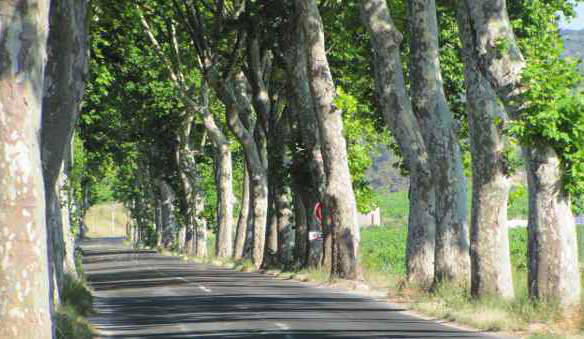 In
bygone times many
great "alignements de platanes" - or avenues of
plane trees - were planted to give shade to travellers on French roads,
specially in the south of France. Though the plane-lined road remains
one of the iconic images of France today, few remain, except for short
sections on country roads, such as here in Languedoc.
In
bygone times many
great "alignements de platanes" - or avenues of
plane trees - were planted to give shade to travellers on French roads,
specially in the south of France. Though the plane-lined road remains
one of the iconic images of France today, few remain, except for short
sections on country roads, such as here in Languedoc."Routes bis"
Sometimes you may see direction signs starting with the word Bis, in italics. These are the equivalent of the British "HR" (holiday route) itineraries, using less crowded main roads. Thus a sign saying "bis Lyon" is an alternative route avoiding the main roads, and generally with less lorry traffic. Bis, in French, means second (as in the prefix bi-).The "Bison futé" (in English the cunning bison) is the motorist who does not follow the crowd, but seeks out less crowded easier roads, the "routes bis", thus the "bis-on". If you see a bison futé sign, it will be directing you either to alternative routes themselves or to an information point. On summer Saturdays, being a cunning bison is often well worth it, unless you love driving in heavy traffic or sitting in traffic jams.
Driving on the backroads of France requires a good map - or a Satnav that allows you to wander off the beaten track; but in many places, it can still make driving a pleasure, rather than a chore
► Avoiding Paris
This is a good idea on most days. When driving from Calais to the south of France, use the A26 motorway via Reims, Troyes and Dijon.If driving to south western and central France, avoid Paris going via Rouen, Evreux, Chartres and Orleans. There is no motorway between Evreux and Orleans, but the road over this section is currently being upgraded to dual carriageway, and over half of it is now complete. Avoiding Paris- click for details and route map
► Avoiding peak periods
If you can avoid travelling on Saturdays between July 10th and August 30th, this is very advisable. On these days, many French autoroutes - and in particular all the main arteries to the south - are liable to reach saturation. The worst bottlenecks are in the Rhone valley south of Lyons, along the south coast, and around Bordeaux.
In January and February, Alpine motorways can get hyper-snarled up with traffic.
Check out the busy holiday weeks
However, outside these periods, Saturday and Sunday are the best days for driving in France, on motorways and arterial roads. Indeed, on these days, HGV's - lorries or trucks - are banned, meaning that unless you get stuck behind caravans or camper vans, combine harvesters or other various slowdowns, driving is relatively hassle-free.
Night driving in France
Driving between the hours of 8 p.m and 6 a.m. can be a good way to avoid the traffic. Motorway driving can be considerably easier at night during peak holiday travel periods. Leaving Calais at 6 p.m., you can be almost half way down France by midnight. Depending on the route you take, you can book a hotel near the motorway near Tours (A10 route) or Bourges (A71 route) or Dijon (A26 route)However it is vital to ensure that you have had sufficiient rest or sleep in the day before setting out on an overnight journey. Cars from the UK and Ireland must have headlight dip deflectors if driving after dark
►HGV restrictions in France
See themed page : HGV information for France
► Petrol (Gas) stations in France
Almost all petrol stations in France accept Visa and Mastercard; however take care with 24h automatic pumps in supermarket forecourts. Many of these do not accept credit cards without integrated chip and PIN number. Most UK cards now have integrated chip and pin, so the times when UK cards did not work in French petrol stations are now history for most travellers. However, if you think you may need to fill up in an emergency while driving in France, check your card out at a supermarket self-service pump well before you run out. If it doesn't work, nip round and join the queue for the pay-at-the counter pumps. Make sure that you don't have to fill up in an emergency using an untested card at an unmanned filling station at night or on Sundays.Fuel prices in France :
Compared to the UK, there is not a big difference, except for diesel which is cheaper. In January 2026 typical supermarket fuel prices in France were :| A95 - SP 95 - E10 (market standard) | 1.65 Euros per litre |
| E85 (biofuel - superethanol) | 0.80 Euro per litre |
| A95 - SP 95 - E5 | 1.62 Euro per litre |
| Diesel - B7 | 1.61 Euros per litre. |
95 - E10 graded fuels (containing 10% of ethanol bio-fuel) are compatible with almost all petrol-engined cars built after 2000; if in doubt check with your supplier. E85 (85% ethanol), which can only be used by FFVs (flex-fuel vehicles), is only available in about 1 filling station out of three.
Note: (There are 3.79 litres to 1 US gallon; but generally speaking cars in Europe are smaller and consume less fuel than cars in the USA.)
EV (electric vehicle) recharging in France :
High-speed lectric vehicle recharging facilities are now available in virtually all motorway service stations, as well as in many supermarket and shopping centre forecourts, and in bays in urban car parks - even in small towns. In 2025, the average price of a fast recharge on a motorway in France was about 0.55 € per KwH, depending on the supplier.... considerably more expensive than recharging at home.Click for information on Traffic accidents in France
► Overnight stops.
Motorway hotels or something else? France is very well equipped in hotels and other types of accommodation. Many of the chains , such as Novotel (3 stars) , Mercure (3 stars), Ibis (3 stars) , Ibis budget (2 stars), Campanile (3 stars) and F 1 (1 star), have outlets clustered near motorway exits, notably near the exits from toll motorways and around towns and cities. The hotel links below list only the French motorway hotels that are really easy to find.Find and book an overnight stop
....
► Click here for hotels beside motorways to west and southwest France.
► Click here for hotels beside motorways to east and southeast France.
► For quiet B&B accommodation, check out the B-and-B in France website.
► Click here for hotels beside motorways to west and southwest France.
► Click here for hotels beside motorways to east and southeast France.
► For quiet B&B accommodation, check out the B-and-B in France website.
Stop to shop...
See the French shopping guide page for useful information if you are planning to stop to shop on your way back home...
To contact About-France.com, please use our contact form :
We are sorry but About-France.com cannot answer questions about individual travel plans.
About-France.com
Home
page - Site search
- Regions
- Maps of France