Routes
through France: click to
enlarge

Quiet
country roads....
Motorways are generally not congested
| New and News |
New
on About-France com :
|
|
Related
pages:
To
contact About France com, send an email to info
"at" about-france.com
(Replace "at" by the
standard symbol, and remove all spaces. This coding is an
anti-spam measure) |
|
Public
holidays in France.
The
following days are public holidays ("jours
fériés") in France, when all or most shops tend
to be shut.
- January 1st, New year's day
- Easter Monday (though not
Good Friday except in Alsace),
- May 1st, Labour Day,
Fête du Travail
- May 8th, Armistice Day
- Ascension Thursday
- July
14th, Bastille Day, Fête Nationale
- August 15th, French August bank holiday
- November 1st,
Toussaint, All Saints' Day
- November 11th, Armistice, first
world war.
- Christmas (though not Boxing Day)
Unlike in the UK, when a
public
holiday falls during a weekend, there is no extra compensating holiday
on the following Monday.
Note that on public holidays,
hypermarkets will generally be shut, so unless you have a chip and pin
credit card that works in French automatic petrol pumps, you'll need to
fill up on the motorway or in normal filling stations. |
|
|
DRIVING IN FRANCE - Info and tips for motorists
It is generally accepted that today's France has an excellent road
and motorway network; compared to the UK, France has the same population spread over
twice as much surface area, which tends to mean less congestion on the
roads, but longer distances to cover.
When
driving in France, don't forget to carry a fluorescent jacket...
All vehicles travelling on French roads must now carry a yellow
fluorescent jacket, that can be put on if the driver has to get out in
an emergency. The jacket must be carried in
the car, not in the boot (not in the trunk), and be readily accessible.
Drivers not carrying the obligatory jacket may receive an instant fine
of up to 130 Euros, if stopped by police. |
► Documents. In order to drive in France, you will need a recognised full driving licence (driver's license), the car's registration certificate (for cars registered in the UK, the V5C certificate), and proof of insurance.
The insurance document is most commonly the "green card", though
a standard insurance document from any EU country provides basic
insurance for your vehicle (third party cover) throughout the Union,
whether or not a green card is provided.
An international driving licence
is not required for short term visitors (up to 90 days) from countries
of the EU, EEA, USA, Canada; however it is either recommended or else
required for visitors from other countries. For specific details, check
with the local French embassy in your country of origin.
For longer stays, standard EU driving licences remain
valid, but holders of driver's licenses from non-EU countries will
probably need to obtain a French licence. Again, check with the French
embassy in your country before coming to France.
► Avoiding
problems. When driving through
France, in spite of the cost, it is
generally worthwhile taking
motorways (autoroutes)
unless you have time to go at a more leisurely pace. However,
there are some
useful tips to help you cut
down on the cost of
your trip across France.
a)
Petrol
(gasolene) (fr. essence):
don't fill up on the motorway! Wait until a major intersection near a
town or city, and come off the motorway. You will almost certainly find
a hypermarket / superstore within a kilometer or so of the exit,
offering cut price petrol. The saving can be us much as 15 centimes per
litre.
b) Drivers
who intend to do lots of driving in
France coud find it in their interest to have a diesel car,
particularly a modern one
which is highly fuel-efficient. Diesel
fuel in France (often called gasoil,
pronounced gaz-warle)
used to be about a third cheaper than
unleaded, but that is no longer the case; today - 2009 - diesel retails
for about 10 to 15 centimes a litre less than unleaded, but
it
still goes further. Many service stations no longer stock the
old leaded petrol, known as "super". See petrol
prices in France below for recent updates.
c) Use
free motorways or dual-carriageways where they exist. See below for
details.
► French
road signs:
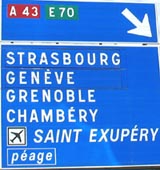
Signs
indicating a motorway
route (whether on the motorway or pointing to it)
are indicated with white lettering on a blue background, as in the
picture left.
Signs indicating a non-motorway main route (route
nationale or other) are indicated with white lettering on a green
background, as in

► French
motorways
French motorways, known as
autoroutes, are
designated with numbers preceded by the letter A
(for Autoroute). Thus, to drive to the south of France from Calais, you
can either take
the A16 motorway towards Amiens and Paris, or the A26 motorway towards
Rheims and Paris. Most
French motorways are toll motorways, and entrances to them
are marked as such with the word "Péage" (pronounced pay-arje).
The normal procedure is to pick up a ticket from a booth as you enter
the motorway (just press the button) , and pay either when you leave
the motorway, or else when the toll section comes to an end. In a few
places, there are fixed toll points on the motorway, notably in urban
areas or toll bridges.
The cost of motorway travel
for a car without caravan or trailer is about 1 €uro for 10
miles.
For example, in May 2008, motorway tolls on the 1060 km trip from
Calais
to Marseille, via Paris, almost all of it on toll motorways, amounted
to 70.7
€uros, about £55. Here are the toll costs for a
selection of
other common journeys that use toll motorways over long distances:
The average cost per kilometre depends
on the proportion of the journey using free motorways or other roads
A sample selection of Motorway tolls in
France: May 2008 (for cars)
(For Car + caravan;
add about 50%). |
Calais
- Paris, via A 16: 17.8 €
Calais-Marseilles, via Paris: 70.7 €uros
Calais-Bordeaux, via Rouen 96.2 €
Calais-Toulouse, via Paris 49.9 €
Calais-Toulouse via Rouen, Dreux: 32.2 €
Calais - Perpignan via Rouen, Chartres & A 71: 46.5 €
Calais-Nice, via Reims, Dijon & A39: 91.4 €
Calais-Grenoble, via Reims, Dijon, A39: 66.6 € |
Le Havre - Bordeaux, via
Alençon: 75.4 €
Le Havre - Montpellier, via Chartres & A 71: 39.2
€
Bruxelles / Brussels - Marseilles, via Reims: 57.1 €
Strasbourg - le Perthus (Spanish border): 62.8 €
Freiburg im Breisgau - Perpignan: 64.3 €
Freiburg im Breisgau - Marseille, via Lyon: 47.6 €
Paris - Nice 66.6 €
Paris - Bordeaux: 49.3 € |
For more information on French motorway tolls, follow
this link to the French
motorway network website in English: this site provides a
form to fill in, to calculate the cost of a
motorway
trip through France.
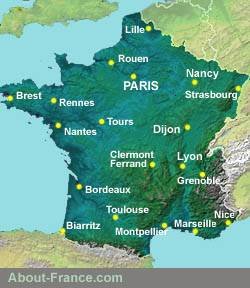
For a detailed route, use the route-finder
map page on About-France.com.
Or see your part of France, or the whole country, on the
About-France.com Maps
of France page.
►Free
motorways in France:
Note
that there are just a few free
motorways in France,
and some long-distance dual carriageways that are up to motorway
standard.
Among free motorways note in particular
- about half of the
section between
Calais and Rouen
- the A 84 from Caen
to Rennes
- 275 km of the A20
from Vierzon to
just south of Brive la
Gaillarde (the longest stretch of free motorway
in France, and the main Paris-Toulouse route).
- the A75 motorway
between Clermont
Ferrand and Beziers
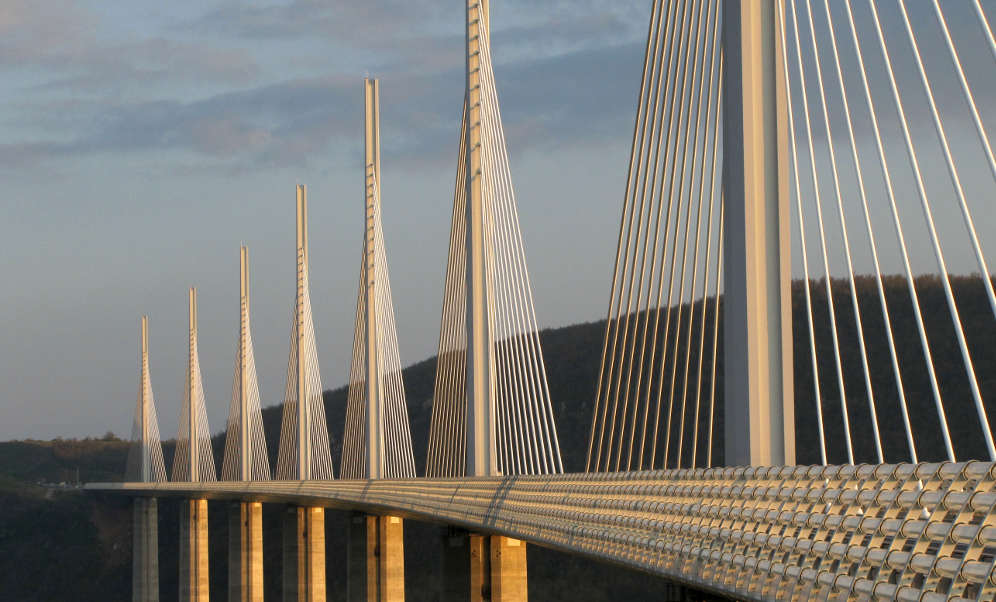
- an alternate route to Languedoc and the
Spanish border. Careful however,
there is a bit of this still missing at the southern end, and the Millau viaduct has a
toll.
-
the motorway between Dunkerque and Lille.
► Major dual-carriageway routes
in France:
For other dual carriageways, check on a detailed map of France.
► Trunk
roads and road numbering
These in France are still popularly known as
"routes nationales".
However, in the framework of "regionalisation",
responsibility for most roads has been devolved to local authorities,
and the concept of "routes nationales" has largely
disappeared.
The only "N" roads that now survive are ones that - in the
absence of an "autoroute", form part of the strategic national road
network, such as the N21 from Limoges
to Tarbes, or the N13 from Cherbourg
as far as Caen.
The result - if you want to travel by following
road numbers - is a classic state of confusion;
Drivers
following the N13 south from Cherbourg lose it at Caen, as it becomes
the D 613 thereafter! From Evreux to Mantes the "N 13" signs reappear,
but after that it's the D 113....For another example, anyone wanting to
avoid the toll motorway and drive along the old "nationale" to the
southwest
corner of France, from Chartres
to Biarritz, will follow three
disconnected sections of main road known as "N 10"; but in areas where
the old N10 is now close to a parallel motorway, the road is
now
signed as "D 910" or the "D 1010". Some old "N"
roads now blithely change
their number each time they pass from one department to
another !!
This is all very confusing for foreign drivers, but not so
much for the French, since France has never used numbering with great
significance,
and it is best to follow a destination,
rather than a road number. Destinations via main trunk routes are
indicated by the names of towns in white letters on a bright green
background, as shown above.
Note that France also displays European
route numbers where appropriate; these are marked with a white number
on a green background, and are in addition to the French road number.
For example the
A 6 motorway from Paris to Lyon is also marked
as
E15 -
E15 being a European route running from Inverness to Algeciras.
In the motorway sign on the right, the A43
motorway is
also indicated as being the E70; the main towns it leads towards are
indicated in normal lettering; other destinations, such as airports,
are indicated in italics. The word "Péage" at the bottom
indicates that this is a toll motorway.
"Bison
Futé"
Sometimes you may see direction signs starting with the word Bis,
in italics. These are the equivalent of the British "HR" (holiday
route) itineraries, using less crowded main roads. Thus a sign saying
"bis
Lyon" is an alternative route avoiding the main roads, and generally
with less lorry traffic. Bis, in French, means second (as in the prefix
bi-).
The
"Bison futé" (in English the cunning bison) is the motorist
who
does
not follow the crowd, but seeks out less crowded easier routes, the
"routes bis", thus the "bis-on". If you
see a bison futé sign, it will be directing you either to
information about alternative routes, or (usually) to the
alternative routes
themselves. On summer Saturdays, being a cunning bison is often well
worth it, unless you love sitting in traffic jams.
► Avoiding
Paris
This is a good idea on most days. To drive from Calais to the south of
France,
use the
A 26 motorway via Reims, Troyes and Dijon.
For south western and central France, avoid Paris by taking the route
via
Rouen, Evreux, Chartres and Orleans. There is no motorway between
Evreux
and Orleans, but the route over this section is currently being
upgraded
to dual carriageway, and over half of it is now complete. Avoiding
Paris- click for details and route map
► Avoiding
peak periods
If you
can avoid travelling on Saturdays
between July 10th and August 30th, this
is very advisable. On these days, many French motorways - and in
particular all
the routes to the south - are liable to reach saturation. The worst
bottlenecks
are in the Rhone valley south of Lyons, along the south
coast, and around Bordeaux.
In January and February, Alpine
motorways can get
hyper-snarled up with traffic.
Check out the busy holiday weeks for 2009
However, outside these periods, Saturday
and Sunday are the
best days for driving
in France, on motorways or "routes nationales" (trunk roads). Indeed,
on
these days, HGV's - lorries or trucks - are banned, meaning that unless
you
get stuck behind caravans or camper vans, combine harvesters or other
various
slowdowns, driving is relatively hassle-free.
►HGV restrictions in France
Most lorries / trucks
over 7.5
tonnes are banned from the French road and motorway network every
weekend between the hours of 10 p.m Saturday and 10 p.m Sunday. This
weekend ban is longer from early July to mid August, when lorries are
banned from Saturday 7 a.m. to sunday 10 p.m. HGV's are also
banned on public
holidays, normally from 10 p.m the night before, until
10 p.m on the holiday itself. The two big summer public holidays in
France are 14th July and 15th August.
Further restrictions apply for HGV access to the Paris area,
(Mondays and day following a public holiday, from 6 a.m to 10 a.m), and
for HGVs leaving the Paris area (Fridays and days preceding a public
holiday, usually from 4 p.m). This means that HGVs cannot transit via
the inner ring road of Paris (boulevard
périphérique)
during these hours.
There are also extra weekend bans on Alpine motorways in February -
though given the traffic jams that are possible here at the time, these
routes are best avoided by anyone not needing to use them - ban or no
ban.
► Petrol
(Gas) stations
Almost all stations accept Visa and Mastercard; however take care with
24h automatic pumps in supermarket forecourts. Many of these do not
accept credit cards without integrated chip and PIN number. If in
doubt, make sure that you
don't have to fill up
in an emergency at an unmanned filling station at night or on Sundays.
The cost of fuel in
France:
France has suffered like any other country from the recent sharop
fluctuations in fuel prices. In mid May 2008, supermarkets were selling
fuel at
around the following price per litre: Unleaded 98 octane; 1.50 Euros,
Unleaded 95 octane: 1.45 Euros; Diesel: 1.40 Euros.
Fuel
price update, April
2009: typical fuel prices in France were;
Unleaded 98 1.06 Euros, Unleaded 95 1.03 Euros, Diesel 0.94 Euros.
(There are 3.79 litres to 1 US gallon; but since cars in
Europe
tend to consume less fuel than cars in the USA, a hire car in France
can cost less per mile to run than a more gas-guzzling car in the USA)
► Speed
limits and other rules
Here are the normal speed limits in France:
- The normal speed limit on French
motorways is 130 km/hr (just over 80
mph). - or 110 km/hr in rain.
- The normal speed limit on dual
carriageways (divided highways)110 km/hr
- The normal speed limit on main roads is
90 km/hr (outside built-up areas)
- The normal speed limit in built-up areas
is 50 km/hr – unless otherwise indicated.
Note:
there
is not necessarily a specific speed-restriction sign at the entrance to
a built-up area, particularly at the entrance to small villages. The |
name-board | at the entrance to a village or
town ( dark blue letters on an off-white background) automatically
indicates a built-up area with a speed limit of 50 km/h, unless
otherwise indicated. Police speed cameras are often set up in villages
where traffic too often forgets to slow down.
Over
the limit? Generally, there is a
small tolerance for drivers exceeding the speed limit
- but be advised that it is best to observe speed limits which are
there for a reason. Until recently, radar traps tended to be stationary
and visible; nowadays, the gendarmerie are using more
and more
mobile radars, in unmarked
cars. Be warned ! Otherwise you may face an on-the-spot fine or - if
your
are more than 50 km/hr over the limit - an instant ban and an
impoundment
of your vehicle.
Speed
cameras
Since 2004, France has discovered the speed camera, or radar
camera. Over a
thousand of these have now gone up on France's roads and motorways, and
you can find the official
French radar speed camera map
of them on Internet. However, do not forget that new radars are being
set up all the time, and that the official map obviously does
not
include the mobile radar cars or the movable stationary speed cameras.
So the
best rule - not to say the most sensible one - is "Do not exceed the
speed
limit".
Mobile
phones:
it is an offence in France to hold and use a mobile phone while
driving. Hands-free use of mobile phones is not illegal. Though many
drivers ignore this rule, traffic police are clamping down on people
holding phones to their ears while driving, and drivers are liable to
an on-the-spot fine.
Minimum
age: The
minimum age for driving a car in France is 18; thus no-one under the
age of 18 can drive a car in France, even if he or she holds a valid
licence in another country.
Wining and
driving
Wine is
available with meals in French motorway service areas - a fact
that surprises a lot of visitors. But don't forget that the drink drive
limit
in France is lower than it is in the UK. The best advice is the same
everywhere;
don't drink and drive.
Overnight stops.
Motorway hotels or something else? France is very well equipped in
hotels and other types of accommodation. Many of the chains , such as Novotel
(3 stars) , Mercure
(3 stars), Ibis
(2
stars) , Etap
(2
stars), and Formule 1
(1
star), have outlets clustered
near motorway exits, notably near the
exits from toll motorways and around towns and cities. Click here for
information on choosing hotels
in France. For quiet B&B accommodation,
check out the B-and-B in France
website.
► What
to do in the event of a road accident in France
If you are involved in any accident involving two or more vehicles, you
will be asked to fill in a "constat amiable" (an amiable declaration)
by
the driver of a French car involved. This is standard
practice.
If possible, call your insurance company at once
on your mobile phone. They may put you in touch with a local French
representative.
If you are involved in an accident involving any
sort of
injury - even
if it is not your fault - you MUST remain until
the
police have come.
Click this link for further information
about doctors,
hospitals and
using the French health service.
Breakdown
or accident:
if your car is immobilised on or partly on the road due to a breakdown
or an accident, you must set up your red warning triangle at a suitable
distance behind the vehicle, to alert approaching traffic to the
hazard. All cars travelling on French roads must carry a red warning
triangle, available from any motoring store, and also a yellow
fluorescent jacket.
Stop to
shop...
See the About-France.com France
shopping guide page for useful information if you are
planning to stop to shop on your way back home...
When driving through France the last thing you want after a day on the
road is to unpack only to repack after one night's rest. Instead of
changing hotels every night, think about renting a timeshare
for a week at a time. This will free you up for mini day trips during
which you can get intimately acquainted with specific regions and
return to your comfortable timeshare at night.
|
|
Copyright notice: Website
and text © About-France.com 2003-2009 except where
otherwise indicated.
|