- Explore France ►
- Essential pages
- Travel in France
- Where to go
- What to see and do
About-France.com
-
the connoisseur's guide to France
Saint Malo - historic port city
On this page| Location and access | Tourist attractions |
| In the area | Local accommodation |
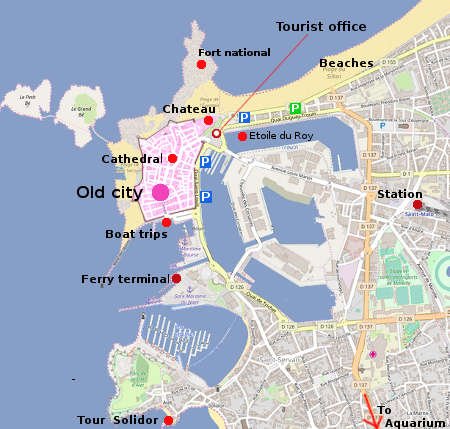
Parking: there is plenty of paid parking off-street and on-street. The blue P markers on the map are short-stay, the green P marker is a long-stay car park. There is no free parking close to the old city, except on Sundays and public holidays.
A bit of history
Built on a rock standing in a naturally defensive position at the mouth of the River Rance, Saint Malo is a city whose roots go back to before Roman times.Today's city got its name from a monk from Llancarfan Abbey in Wales, by the name of Maclovius, a disciple and fellow-traveller of Saint Brendan. Maclovius was one of the many Celts who came over to Brittany - then known as Armorica- during the troubled times of the late Roman era in Britain.
Saint Malo's importance as a seaport developed in the sixteenth century. The city is located in a strategic part of the French coast, the last main Channel port before the tip of Brittany round which all merchant ships from the North Sea and the English Channel had to pass, on their way south. For many ships entering or leaving the Channel, St Malo was a convenient port of call for taking on or dropping off supplies or merchandise; but St Malo was also known for two sefaring specialities.
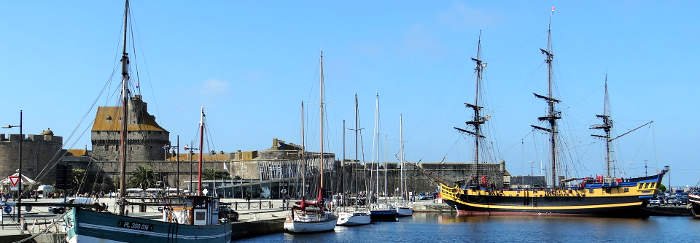
The port of Saint Malo, with the castle and the Etoile du Roy tall ship
Corsairs and explorers
On the one hand it became notorious as a den of pirates, or corsairs ; on the other hand, it became France's leading port for voyages of discovery to the New World.At a time when piracy was pretty much of an accepted way of life on the high seas, St. Malo's corsairs were rightly feared by English or Dutch merchant ships. Just as Queen Elizabeth encouraged Sir Francis Drake to pillage and plunder Spanish ships, French Kings were happy to give the same sort of encouragement to the corsairs of Saint Malo, many of whom became wealthy men thanks to the spoils of piracy.
But St.Malo's most famous seafarer was not a corsair but the explorer Jacques Cartier. Born in Saint Malo in 1491, it was from his home port that Cartier set out on April 20th 1534 on his first voyage of discovery to the New World, where he was to establish "New France" on the Gaspé peninsula of the North American continent, now a part of Quebec. On a second voyage, Cartier sailed up the Saint Lawrence river, as far as a point where a hill rose up on the north bank of the river. He named it "Mont Royal"... or to use the phonetic spelling of the age, "Mont Réal". Cartier is buried in the cathedral at Saint Malo, and today in the old town there is a museum, la Maison du Québec, dedicated to the discovery of Quebec.
In the 17th century, the city's medieval ramparts were consolidated and extended, to protect Saint Malo from attack from land or sea, giving the old city the fine walls that surround it to this day.
Unfortunately, St Malo's defensive walls were quite unable to protect the city from bombardment during the Second World War, both by the Germans and by the Allies, and a large part of the old city was reduced to rubble - though not the ramparts. The rebuilding of old Saint Malo was one of the great heritage restoration projects in the aftermath of the war, and while the old city centre was not rebuilt as it was before, it was built in the same way and the same style, without any inappropriate modern developments to change its skyline.
Tourist attractions - ten things to see and do
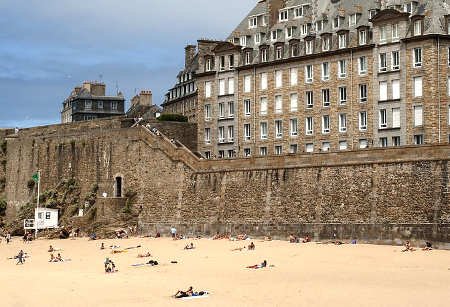
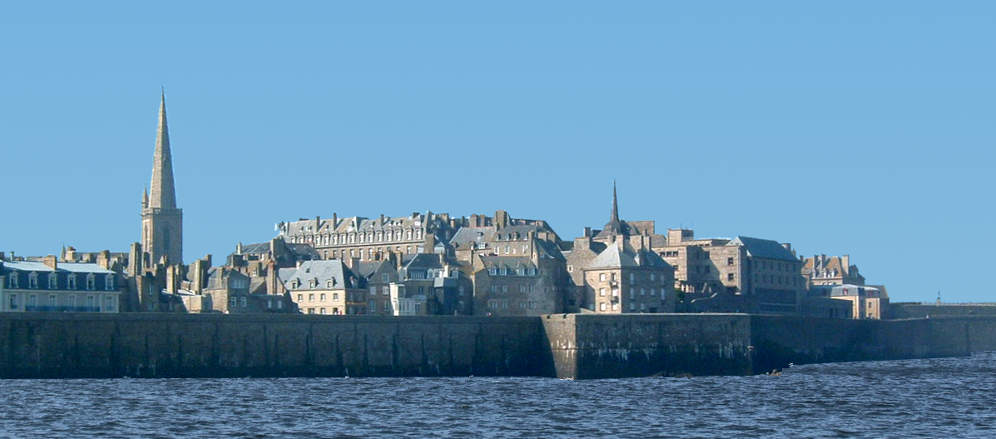
Saint Malo - beach at low tide, ramparts and old city....
- The beaches of Saint Malo The number one tourist attraction of Saint Malo,apart from the historic city, are its fine sandy beaches
- The ramparts. A walk round the ramparts of Saint Malo, a distance of about 2 km, is one of the great urban walks of France. Access is free, and the walkways on top of the ramparts give wonderful views out over the beaches, the sea, the estuary and the harbour. There are steps up to the ramparts at each city gate and by the castle.
- On your way round the ramparts, stop in at the Maison du Québec, telling the story of St Malo's role in the founding of Canada.
- The château. At the northeast tip of the old town,the ducal and royal castle of St. Malo houses the city's historical museum. Climb up to the top of the great keep (le grand dongeon), for the best panoramic views over the city and shoreline.
- The historic centre of Saint Malo is a living city, with residents, shops and services, so it is not entirely traffic free. Access however is strictly limited to the narrow cobbled streets which offer a good selection of small shops, cafés and restaurants.
- The forts. Away from the historic centre, Saint Malo has a number of other sights and attractions. Among these are the 18th century island forts, which are part of the national Vauban UNESCO world heritage site. The Fort du Grand Bé and the Fort National are accessible on foot when the tide is out.
- Boat trips : When the tide is in, the inshore forts are among the destinations of the popular boat trips that operate out of Saint Malo.There is a wide choice of pleasure cruise options, including mini-cruises around Saint Malo, longer cruises along the coast, or simply a trip across the mouth of the Rance to the resort of Dinard on the other side. There are also excursions up the river via the unique Rance tidal power dam, and beyond to the picturesque small town of Dinan.
- The Etoile du Roy. Fora more historic experience, one of Saint Malo's other big attractions ... as long as it is in port.. is the Etoile du Roy, the second largest replica tall ship in France. For most of the year, she is moored in the port, close to the tourist office. The Etoile was originally built as the Grand Turk for the British ITV series Hornblower, and has appeared in several films and TV series.
- Tour Solidor. A little bit further from the historic centre is the Tour Solidor, a fine 14th century keep that now houses the Museum of Saint Malo and its area.
- The Great Aquarium Finally, last but by no means least – indeed the second biggest tourist attraction in Brittany – is the Great Aquarium. With a total capacity of 2.5 million litres, and with 600 species, it is one of the largest aquariums in France, and considered as one of the six best. ► Save time and book online..
Interesting:
opened
in 1966, the tidal power plant on
the Rance was the world's first, and for almost 50 years the world's
most powerful, tidal power station, with a production capacity of 240
Mw. The Rance estuary has the greatest tidal range in France, an
average of 8 metres, with a maximum of 13.5 metres with spring tides.
In the area
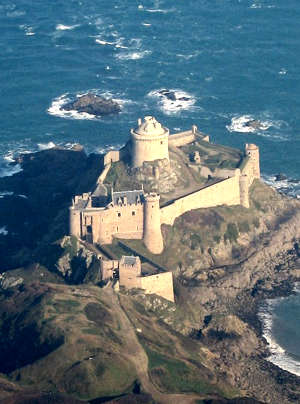
Fort la Latte, near
Cap Fréhel
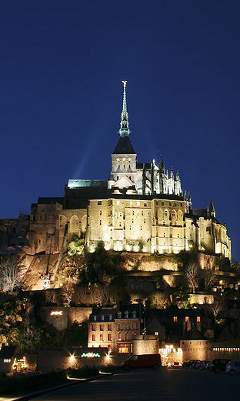
At the eastern end of the Emerald Coast, about 50km from Saint Malo, is le Mont Saint Michel, a fabulous medieval city perched on a rock connected to the mainland by a causeway. One of the most visited tourist sites in France outside Paris, le Mont Saint Michel is classed as a UNESCO world heritage site.
The western end of the Emerald coast is Cap Fréhel,one of Brittany's great beauty spots. Just before Cap Fréhel is the spectacular clifftop castle of Fort la Latte, parts of which date from the 14th century. Fort la Latte is France's equivalent of Cornwall's Tintagel Castle, though much less of a ruin.
Dinard, across the estuary from Saint Malo, is one of France's classic up-market resorts, which became popular in the nineteenth century. It is very different from Dinan, a historic small town with an impressive medieval castle.The historic fortified old town of Dinan sits on a rise overlooking the valley of the Rance below, to which it is connected by a narrow winding cobbled pedestrianized street lined with old stone and half-timbered houses, including plenty of craft shops, boutiques or restaurants.
Twenty km southeast of Dinan, the chateau and park of Bourbansais are worth a visit, particularly for families. From April to September, there are guided visits of the chateau, a 16th - 17th century stately home seven days a week, mostly in the afternoon ; however the gardens and the zoo are open all year. The Bourbansais zoo is heavily committed in programmes for the protection and breeding of endangered species.
Accommodation
Click here for a ►choice of hotels in Saint Malo at best online rates, and the About-France.com hotel selection for Saint Malo and its area.As popular seaside resorts, both Saint Malo and Dinard offer a plentiful choice of hotels, including many located on the sea front. There are several hotels located within the historic centre of SaintMalo, including two four-star hotels and several well-rated two-star hotels. Then there are lots more hotels, of all categories, along and behind the seafront to the east of the historic city facing Saint Malo's principal beach, the Grande Plage du Sillon.
Hotels in or close to the centre of Saint Malo that have their own private parking tend to charge for it; the alternative is paid public parking, which is never too far away.
Outside Saint Malo, towns and villages along the Brittany coast offer plenty of accommodation choices; another popular choice in Brittany is to book a gite, or holiday cottage. For a selection of gites in the area, check out Brittany gites on Gitelink.com .
Location and access
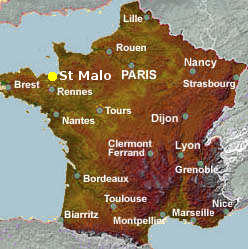
Saint Malo is Brittany, on the northwest coast of FranceAccess :
- By air: Nearest airports: Dinard, Rennes. see Fly to France.
- By train: Saint Malo can be reached from Paris by direct TGV (high speed train) in under 3 hours.. For timetables and online tickets, see Trainline.com .
- By car: Saint Malo is a little under 3 hours' drive from Cherbourg; it is and about 5 hours' drive from Calais, using the motorway via Le Havre and Caen. It is four and a half hours' drive from Paris, via Rennes (A 11) or via Caen (A 10).
- By ferry: there is direct access to Saint Malo by ferry from the Channel Islands and in season by Brittany Ferries from Portsmouth (1 crossing a day).
About-France.com
Home page - Site search -
Regions -
Maps of France -
Contact