
Pau - city guide
Historic gateway to the Pyrenees
- Explore France ►
- Key pages
- Where to go
- How to get there
- More about France
Pau - the historic heart of Béarn
| On this page | Location and access | Sites and attractions |
| In the area | Hotels in Pau ► |
Pau: an elegant historic city with breathtaking mountain views
A short history of Pau
Originally a simple medieval hunting post established around a palisade (pau in the Béarnese dialect), the site grew into the stronghold and capital of the Principality of Béarn, which was absorbed into France in 1620. During the Renaissance, Pau rose to political prominence as the birthplace of the Protestant Henry IV, King of Navarre, who, having converted to Catholicism in order to become King of France, famously championed religious tolerance through the Edict of Nantes. In the 19th century, the city transformed into an internationally renowned winter health resort, attracting wealthy British and European visitors who built lavish villas and established continental Europe's first golf course. The city flourished culturally and architecturally throughout these eras, leaving a heritage of châteaux, grand parks, and elegant boulevards that still define its character today.
The Heart of Pau: the historic Old Town and Boulevard
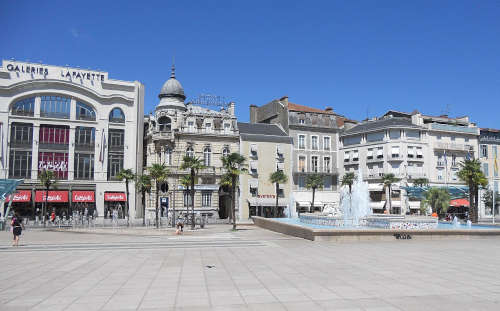
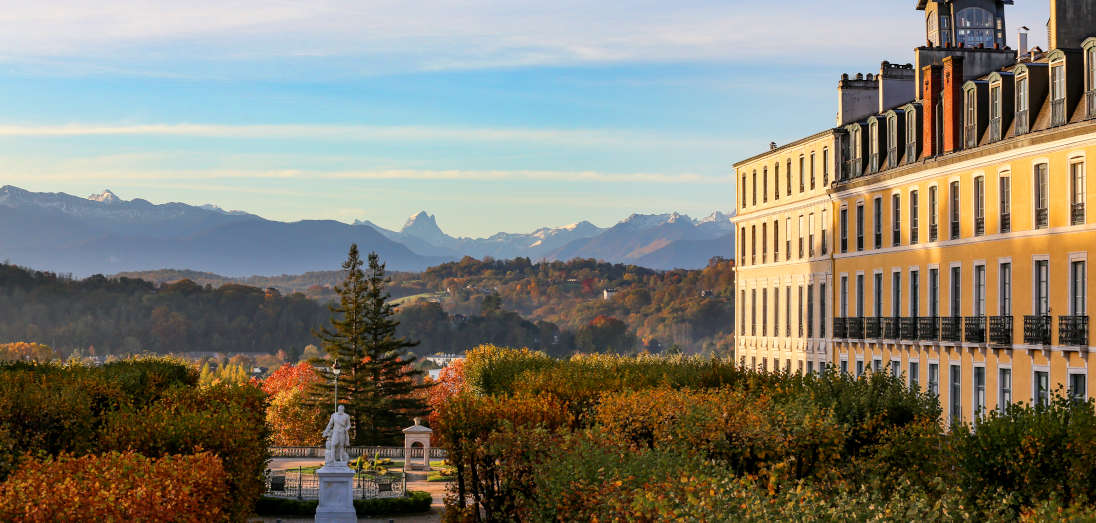
Perched on the edge of a plateau, Pau’s historic centre is defined by Place Clémenceau, the main central square. From here, pedestrianised streets lined with stone townhouses, shops, and cafés lead west to the Château de Pau. Along the southern edge of the plateau, the 1.8-kilometre long Boulevard des Pyrénées connects the castle quarter to the eastern parklands, and on clear days offers magnificent views to the Pic du Midi D'Ossau, 2884 metres, in the high Pyrenees.
Pau and its royal and sporting legacy
Pau has long embraced both its royal history and a pioneering spirit in international sports and leisure. The city is home to the National Museum of the Château de Pau, which has a unique collection of tapestries, Renaissance furnishings, and royal portraits. As a historic hub for aviation and equestrian sports, Pau hosted some of the world's very first aviation meetings and holds a week of prestigious international horse trials each autumn. The city also features lush parks like the Parc Beaumont, with its exotic trees and Belle Époque casino, and maintains a lively calendar of arts, music, and literary events throughout the year. And as a gateway between the Pyrenees and the plains of Aquitaine, Pau features more regularly than any French city other than Paris, on the route of the Tour de France cycle race, hosting stage starts or finishes in 19 of the 27 tours this century.
Sites and monuments in Pau
-
Château de Pau: A striking medieval and Renaissance castle featuring rich historical collections and the famous tortoiseshell cradle of Henry IV.
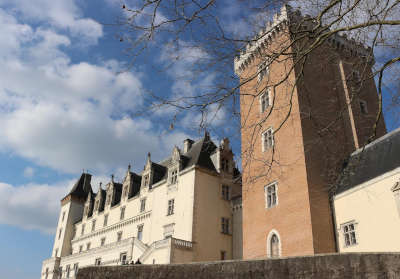
The historic Château de Pau, birthplace of King Henry IV - Boulevard des Pyrénées: A spectacular 1.8-kilometer terrace walk offering uninterrupted panoramic views of the entire Pyrenean mountain range.
- Musée des Beaux-Arts: A fine arts museum established in the 19th century, featuring a collection of European paintings including works by Degas, Courbet, El Greco, and Rubens.
- Funiculaire de Pau: A historic cable railway operating since 1908, connecting the lower railway station directly to the upper town boulevard.
- Parc Beaumont: A beautifully landscaped English-style park with lakes, exotic plants, and the historic Palais Beaumont.
In the area of Pau
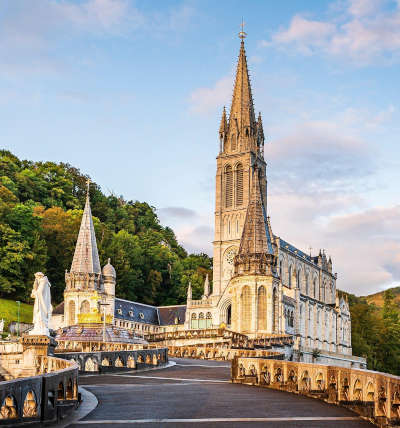
The world-renowned pilgrimage church at Lourdes
- Lourdes (40 km): World-famous Catholic sanctuary and pilgrimage site, nestled dramatically at the foothills of the Pyrenees.
- Local Vineyards (Various): Between Pau and the high Pyrennes hillsides lies the Jurançon wine area, known for its sweet and dry whites, which have been enjoyed since the time of Henry IV. North of Pau lie the vineyards of Gascony, notably Madiran, famed for its dark reds, and the oddly named Pacherenc du Vic Bilh area, with its distinctive white aperitif wines.
- Oloron-Sainte-Marie (35 km): Historic gateway town featuring the UNESCO-listed Sainte-Marie cathedral and traditional Basque-Pyrenean architecture.
- Col du Soulor and Col d'Aubisque (50 km): Legendary Pyrenean mountain passes made famous by the Tour de France, offering breathtaking motoring and cycling routes.
- Salies-de-Béarn (50 km): A charming thermal spa town renowned for its salt springs and picturesque half-timbered architecture built over the river.
- Pyrenees National Park (50–90 km): A vast protected wilderness of dramatic glacial cirques, including the UNESCO World Heritage of de Gavarnie, pristine lakes, and hiking trails home to mountain flora and fauna.
- Saint-Jean-Pied-de-Port (90 km): A picture-perfect Basque village set within red-sandstone ramparts, famously serving as the last staging post in France for pilgrims on Santiago de Compostela trail.
The panoramic view of the Pyrenees from Place Royale
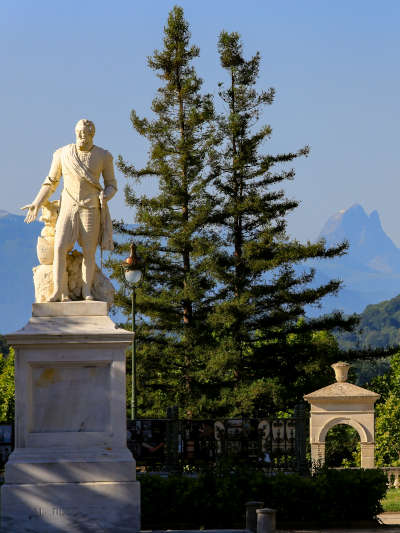
Statue of King Henry IV
- By train:
Pau is well connected by rail (find tickets on Trainline). There are frequent direct high-speed TGV trains from Paris Montparnasse, taking about 4 hours and 15 minutes. Pau can also be reached directly by train from Bordeaux, Toulouse, Bayonne, and Tarbes. The train station is conveniently linked to the city center via the historic funicular railway. - By road:
Pau is easily accessible by car via the A64 autoroute (Toulouse – Pau – Bayonne) and the A65 from Bordeaux. The drive from Bordeaux or Toulouse takes around 2 hours. The city has multiple convenient car parks near the central historic quarters. - By bike:
Pau offers dedicated cycling paths and is a major hub for cyclists exploring regional itineraries and approaching the legendary mountain passes. - By air:
Pau-Pyrénées Airport is located just 15 minutes north of the city centre, offering regular domestic flights to Paris. Tarbes / Lourdes airport, 35 minutes east, has regular summer flights to the UK, Ireland, Poland and other countries.
Pau features an efficient public transport network, including urban buses and the innovative free-to-use Fébus hydrogen fuel-cell bus rapid transit line connecting key city points.
Region: Nouvelle-Aquitaine
Nearby cities: Bordeaux, Toulouse, Lourdes, Bayonne
Nearest airports:Pau-Pyrénées, Tarbes-Lourdes-Pyrénées
Population: 77,000
Main sites: Château de Pau, Boulevard des Pyrénées, Musée des Beaux-Arts, historic old town
Nearby attractions and sites: Pyrenees mountains, Jurançon vineyards, Lourdes.
Where to stay in Pau
The About-France.com selection
from Booking.com
Hotel Parc Beaumont Pau - MGallery
Elegant modern 5-star style hotel overlooking the Parc Beaumont, featuring a spa and indoor pool. Parking available.
Three star hotels: ★★★
Hotel le Roncevaux
Charming hotel located in the historic centre of Pau, close to the castle. Parking available.
Other three-star hotels in and around Pau
Click here for other three star hotels
Two star hotels: ★★
Quick Palace Pau Zénith (Hameau du Vert Galant)
Budget hotel located near the Zenith and sports complex, a short distance from the motorway. Free parking, easy access to the city.
More two-star hotels
Click here for a full list of two star hotels in Pau
Apartments / BnBs
Follow this link for B&Bs and short-stay apartments in Pau
As an affiliate, About-France may receive a small commission on hotel bookings made through Booking.com; this does not affect the price charged.
low-cost car hire in France
Copyright texts © About-France.com
Photo top of page, and photo of Henri IV statue: © Pau Pyrénées Tourisme - P Martin de Barros
Chateau de Pau: Phil Gondas
Lourdes by Martino Phuc
Place Clémenceau: Creative commons 3 photo by Flo 641