
About-France.com
The connoisseur's
guide to France
French life, institutions, society, travel and tourism.
- Explore France ►
- KEY PAGES
- Where to go
- How to get there
- Learn about France
French
grammar
The possessive in French
Expressing
possession and attribution
Different ways of expressing possession in French
Possession can be expressed in French, as in English, in a number of different ways. Like English-speakers, the French use possessive pronouns, possessive adjectives and prepositions designating possession or attribution. The biggest difference is that there is no French equivalent of the apostrophe s structure that is very common in English.1. Possessive adjectives
These correspond to the possessive
adjectives that are used in English, my, your, his, her etc.
However
they
are not used in the same way. Like other adjectives, possessive
adjectives agree with the noun they qualify (i.e. not with the
possessor as in the case of his / her in English
| Forms: | Singular | Plural |
| 1st | mon ma mes | notre nos |
| 2nd | ton ta tes | votre vos |
| 3rd | son sa ses | leur |
Examples
J'aime mon chat.
I love my catJe ne connais pas son père
mais je connais sa
mère
I don't know his/her mother, but I know his/her
fatherIl ne parle jamais à ses
soeurs
He never speaks to his sisters.Notre voiture est en panne.
Our car's broken down.Il a mangé toutes nos pommes.
He's eaten all our applesIls sont très en
colère; quelqu'un a
volé leur voiture.
They're very angry, someone's stolen their car.
2. Possessive pronouns
These correspond to the possessive
pronouns that are used in English, mine, yours, his, hers,
its
etc. Like the possessive adjectives, they agree with the noun
they stand in place of (i.e. not with the
possessor as in the case of his / hers in English).
Important: unlike other pronouns, possessive pronouns include an article - the definite article.
Important: unlike other pronouns, possessive pronouns include an article - the definite article.
| Forms: | Singular | Plural |
| 1st | le mien la mienne les miens les miennes |
le nôtre la nôtre les nôtres |
| 2nd | le tien la tienne les tiens les tiennes |
le vôtre la vôtre les vôtres |
| 3rd | le sien la sienne les siens les siennes |
le leur la leur les leurs |
Examples
*** Remember: you must use the full possessive pronoun,
including its pronoun. You can't say C'est mien for "It's mine.
It has to be C'est le mien (..la mienne).Je vois plusieurs voitures, mais je ne
vois pas la mienne.
I can see several cars, but I can't see mine.La plupart des enfants sont partis, mais
les tiens jouent
encore.
Most of the children have left, but yours are
still playing.Ma valise est rouge, mais la sienne est
noire.
My suitcase is black, but his / hers is black.Mon chat est noir, mais les
vôtres sont gris.
My cat is black, but yours are grey.3. Possession indicated with a preposition
3.1. When the possessor is a noun...When two nouns are linked by a relation
of possession, as in the English expressions my
brother's friend or the
friend of my brother, French has to use a preposition,
normally de, but
sometimes à.
There is no
French equivalent of the English 's (apostrophe
- s ) structure.
This applies to real possession as in my brother's car and also to attribution, as in the president's arrival, or the top of the hill
In cases of attribution, the corresponding preposition in English is not necessarily of, but may be by, or some other preposition
In most cases, the preposition of possession is de. A is occasionally
used, notably in colloquial French. This applies to real possession as in my brother's car and also to attribution, as in the president's arrival, or the top of the hill
In cases of attribution, the corresponding preposition in English is not necessarily of, but may be by, or some other preposition
IMPORTANT - Note that à has to be used when the French expresses the equivalent of the English interrogative pronoun or adjective whose, as in the example below - A qui est ce livre ? C'est à Sarah. De cannot be used in this context.
Examples
The most famous novel by Zola is Germinal.
3.2. De and à implying
different meanings Je ne connais pas l'ami de mon
frère.
I don't know my brother's friend / the friend of
my brother.La voiture de la dame était
en panne.
The lady's car had broken down.Je cherche la maison de Monsieur Dupont.
I'm looking for Mr Dupont's house.Le plus célèbre
roman de Zola est Germinal.
Zola's most famous novel is Germinal /The most famous novel by Zola is Germinal.
L'oncle à Pierre lui a
donné un beau cadeau.
Pierre's uncle gave him a nice present.A qui
est ce livre? C'est à Sarah.
Whose book is this? It's Sarah's.
While de
and à are
interchangeable in many cases, there are other cases in which they
imply different attributive relationships between two nouns.
Une tasse à café does not mean the same as une tasse de café.
Une tasse à café means a coffee cup, a cup in which coffee is served.
Une tasse de café means a cup of coffee.
In other words à implies purpose, while de implies content.
Une tasse à café does not mean the same as une tasse de café.
Une tasse à café means a coffee cup, a cup in which coffee is served.
Une tasse de café means a cup of coffee.
In other words à implies purpose, while de implies content.
3.3. When the possessor is a pronoun ...
In cases of possession where
the possessor is designated by a personal or relative pronoun , not a
noun, the only preposition that can be used is à.
The structure à + pronoun is found essentially in what the French call "compléments déterminatifs". In this particular case, the complement is rendered in English by the use of a possessive pronoun.
This structure is occasionally used for emphasis or to remove ambiguity.
The structure à + pronoun is found essentially in what the French call "compléments déterminatifs". In this particular case, the complement is rendered in English by the use of a possessive pronoun.
This structure is occasionally used for emphasis or to remove ambiguity.
Examples
A qui est ce livre? C'est
à moi.
Whose book is this ? It's mine.Il voyait trois chiens, mais il ne
voyait pas son chien à lui.
He could see three dogs, but he couldn't see his
own dog.Je connais Pierre et Marie, et je
connais sa soeur à elle
I know Pierre and Marie, and I know her sister.
(Without
adding the à elle,
we do not know if it is Pierre's or Marie's sister)L'oncle à Pierre lui a
donné un beau cadeau.
Pierre's uncle gave him a nice present.In cases of attribution where the main entity is designated by a personal or relative pronoun, French cannot express this using a simple preposition + a pronoun. Other solutions must be found. For example there is no parallel in French to the English expression "I'll get to the bottom of it".
Examples
Il escalade la falaise, et il va aller
jusqu'au sommet.
He's climbing the cliff, and he's going to go to
the top of it.Regardez les tableaux, puis
choisissez(-en) les meilleurs.
Look at the paintings, and then choose the best
of them.Le livre était assez
ennuyeux, mais il y avait quelques bonnes parties.
The book was rather boring, though some
parts of it were good.Seulement les meilleurs d'entre nous
vont réussir.
Only the best of us will
succeedPrinter-ready
page
- print or PDF
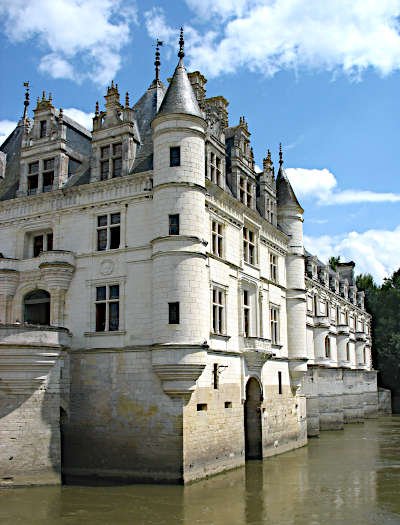
Chenonceaux, one of the Loire valley chateaux



A choice of French
stores & brands that deliver abroad
| ►► French civilisation and culture |
| The regions of France |
| Maps of France |
| France facts and figures |
| The French political system |
| The French economy |
| The French legal system |
| Education in France |
| Health care in France |
| Religion in France |
| The press in France |
| French art |
| A-Z Dictionary of France |
| ►► Site guide |
| About-France.com home |
| Full site index |
| About-France.com site search |
| ►► Principal chapters on About-France.com : |
| The
regions of France Beyond
Paris, a guide to the French regions and their tourist attractions.
|
| Guide
to Paris Make
the most of your trip to Paris; Information on attractions,
Paris hotels,
transport, and lots more.
|
| Tourism
in France
The
main tourist
attractions and places to visit in France - historic
monuments, art galleries, seasides, and more
|
| Planning
a trip to
France
Information
on things to do before starting your trip to France..
|
| Driving
in France
Tips
and useful information on driving in and through France - motorways,
tolls, where to stay....
|
| Maps
of France
Cities,
towns, departments, regions, climate, wine areas and other themes.
|
| The
French way of
life
A
mine of information about life and living in France, including working
in France, living in France, food and eating, education, shopping.
|
| A-Z dictionary of France Encyclopedic
dictionary of modern France - key figures, institutions, acronyms,
culture, icons, etc.
|
Studying the
grammar of a
foreign language is harder for those who are unfamiliar with
the grammar of their own
language... Check out the new acclaimed Descriptive Grammar of English,
a clear compact English grammar available
from Amazon, Waterstones, Barnes & Noble and other good
bookshops.
Photo Futuroscope: Delgana.
Copyright
© About-France.com