
About-France.com
- the connoisseur's guide to France
Brioude - small-town France at its best
| On this page | Location and access | Sites and attractions |
| In the area | Hotels in brioude ► |
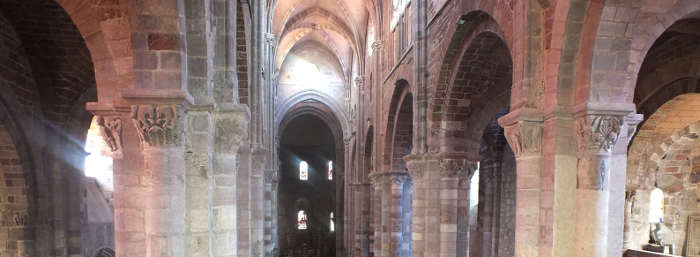
Interior of Saint Julien's basilica, seen from the gallery of the narthex.
The answer is simple. Unless they are located close to big cities, or in particularly popular tourist areas, France's small towns are not well known – however interesting they may be.
The best of France's small towns are for connaisseurs, and Brioude has a strong claim to be at or near the top of the list of interesting and attractive places to visit, for a day trip or for longer.
A short History of Brioude
The town's history goes back to Roman times, when "Brivas" was a small garrison guarding the crossing of the river Allier on the road from Augustonemetum (Clermont Ferrand) to Rouession (near Le Puy). The Roman garrison was located just south of the current town, at a point that is now the pretty village of Vieille Brioude – but nothing remains of the Roman site.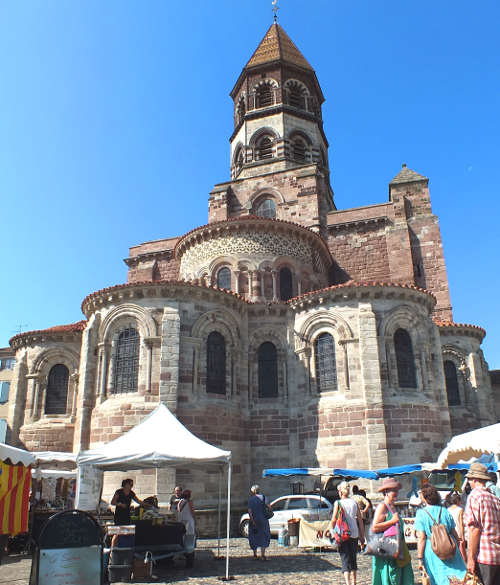
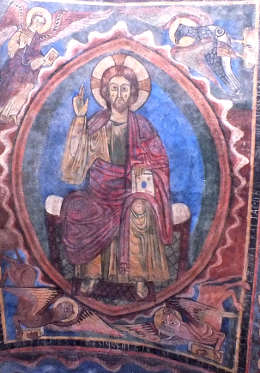
Decorated 12th century romanesque apse of St. Julien's basilica.
The original shrine of Saint Julien dates back to the 4th or 5th century, and by the end of the sixth century it was attracting pilgrims from all over France. By the ninth century, Brioude had become one of the five main cities of Auvergne. The shrine of Saint Julien was protected by an important monastery, among whose canons was Odilon de Mercoeur, a local man, who later went on to build the largest church in Christendom, the abbey church at Cluny in Burgundy.
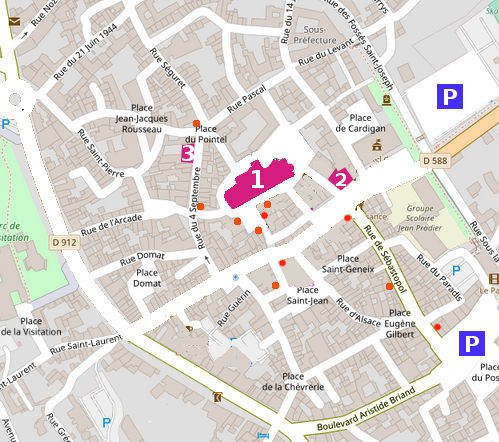 Brioude, the old town.
1. St Julien's Basilica. 2 Doyenné arts centre.
Brioude, the old town.
1. St Julien's Basilica. 2 Doyenné arts centre.3. Lace museum. Orange circles: small art and craft galleries.
The aquarium is 100 metres off the bottom of the map
Though the arrival of a railway in 1857 brought Brioude much closer to the regional capital Clermont-Ferrand, and, from 1867, gave the town a new faster route across the Cevennes to the south, Brioude remained a small town, a local capital with its markets, its fairs, and its mainly agricultural economy. It is in part for this reason that Brioude's urban fabric, with its traditional architecture, was never disfigured by aggressive modernisation in the nineteenth and twentieth centuries.
Attractions and monuments in Brioude
- Saint
Julien's basilica. (Michelin Green guide *** )
The largest romanesque church in Auvergne, mostly dating from the 12th
- 13th centuries. Several details of this historic church are
of particular interest:
a) the fine twelfth-century apse, with delicate polychrome stonework and sculpted corbels on the outside.
b) The remarkable 13th century frescoes, notably those in St. Michael's chapel, which are among the finest and best preserved frescoes of their time in France.
c) The mosaics: small sections of mosaics from the Carolingian era (9th - 10th century) can be seen beside the main altar; but more interestingly, the whole nave floor is covered with a vast and unique 16th century mosaic made of coloured pebbles from the river Allier.
d) The 12th century romanesque capitals, depicting scenes from life and from mythology. Some of these are clearly visible from St. Michael's chapel.
e) Two unusual medieval polychrome statues, one showing Christ with leprosy, the other showing the Virgin Mary in labour.
f) The 19th century reliquary of Saint Julien
g) Contemporary stained-glass windows by Kim en Joong.
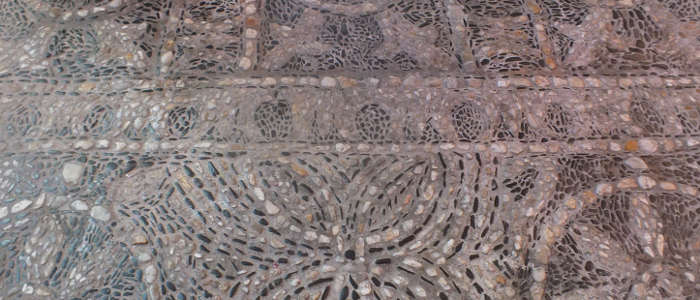
Detail of the huge 16th century mosaic floor in St. Julien's basilica
-
The Deanery - Le Doyenné. Major Summer exhibition 2026 - 4th July - 18th October. Matisse. A unique exhibition showing Matisse's fascination with textiles.
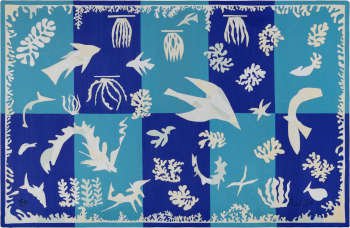 Summer
2026 - Henri Matisse: Dans l'aventure du tissu
Summer
2026 - Henri Matisse: Dans l'aventure du tissu
"Le Doyenné" is a renovated 13th century building that was formerly the residence of the dean and chapter of the Basilica. The main room on the first floor contains a unique 13th century polychrome decorated ceiling, restored in 2017. The Doyenné is now a modern and contemporary arts centre, which opened in 2018 with a significant Chagall exhibition, followed in summer 2019 by an important Miró exhibition. The Picasso exhibition in 2022 was followed in 2023 by Ernest Pignon-Ernest in 2023,Hans Hartung in 2024 and Jean Dubuffet in 2025.
The Miro exhibition was opened in the presence of the artist's grandson, with works brought in from Paris, Monte-Carlo, Madrid and private collections. Asked by the specialist truck-driver who brought paintings up from Madrid, how it was that such an important exhibition was taking place in such a small town, the director of the Deanery centre was at a loss for words. In the end, his answer was very short. "Talent !" - The Lace-making centre. Hôtel de la dentelle. A small museum devoted to the art of lace-making, for which Brioude has a longstanding reputation. In 2029, Brioude will host the Congress of the International Lacemakers' Organisation.
- The Aquarium - A small aquarium presenting the fish and river-life of the Allier, once one of Europe's major salmon rivers. Salmon almost disappeared from the Allier in the 1960s, but are now making a slow comeback.
- Other sites : the narrow streets and small squares of the old town include many historic houses and other buildings dating from medieval times or later. Among these note the Maison de Mandrin, and the 12th century house, with arched windows, on the Place Eugène Gilbert. A plan is available from the Tourist Office.
- The Saturday market. Extensive weekly market, covering streets and squares in the centre of the old town. Farmers' market, local produce, fruit and vegetables, and a range of other stalls.
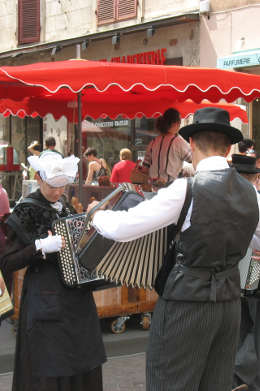
Brioude - arts, crafts and music.
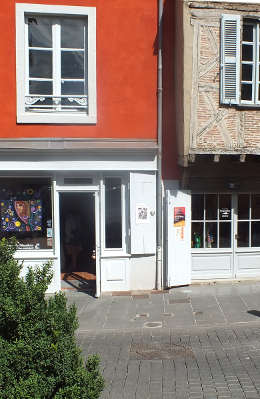
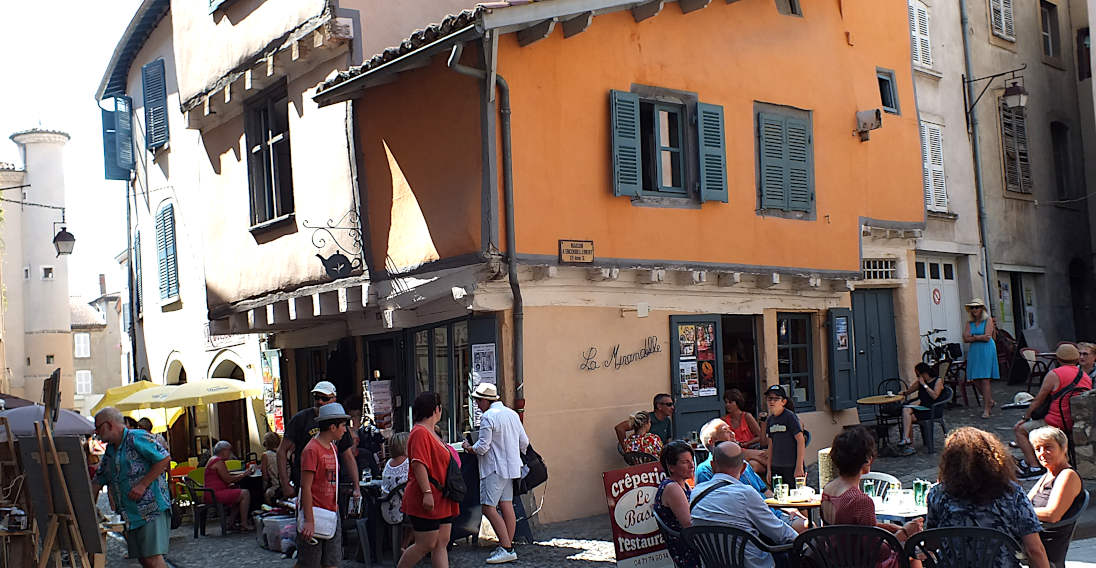
Brioude is designated as one of the "Arts and crafts town" of France. There are a number of small art and craft galleries in Brioude, including the Maison de Mandrin (exhibitions all year), the Mirandelle tearoom (watercolours) , Couleurs Dentelle (lace and objets d'art), and other small galleries. However it is essentially in the summer that Brioude comes to life as an art centre. There are also many more arts and crafts studios and boutiques in the old town, covering a range of fields from lacemaking to stained glass, papier-maché to leatherwork, fashion to jewelery, as well as artists studios.In addition to the Deanery arts centre, every other year (mid July in odd-numbered years) Brioude is home to France's premier water-colour event, the Biennale de l'Aquarelle (website) , with watercolourists from around the world. There are a number of smaller exhibitions in Brioude and surrounding villages.
Music : There is an extensive programme of musical events in and around Brioude in the summer months, with up to half a dozen concerts in St. Julien's basilica, and many more concerts in historic churches and other locations in the surrounding areas. See concert programme . Brioude also each year hosts a couple of concerts in the framework of the renowned La Chaise Dieu festival of classical music.
► For more on Brioude and its area, visit the Brioude - South-Auvergne tourist office
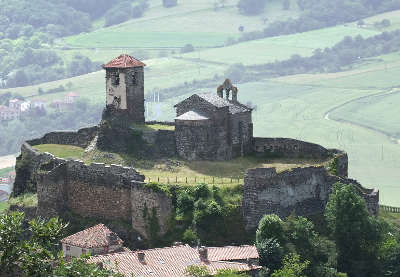
The medieval chateau at Saint Ilpize
1. Within 30 km of Brioude
Brioude is the centre for the beautiful Haut Allier area, a designated "art and history" heritage area covering the valleys of the Allier and tributaries. The area covers the valleys of the Allier, the Allagnon and the Senouire, including two "plus beaux villages de France", and many other and natural historic sites.The Haut Allier is remarkable in that in addition to being a historic heritage area, it is also a stunning natural heritage area, with unspoilt natural environments rich in wildilife, and an area with a rich historic and cultural heritage.
Among the most interesting sites are
- The medieval churches and chapels of the Haut Allier, many of them with historic frescoes from the 12th to 15th centuries. Of particular note are the churches of Auzon, Saint Cirgues and Lavaudieu, which tend to be open every day during the summer months. Lavaudieu also has the finest romanesque cloisters in Auvergne, and a refectory with more rich medieval frescoes.
- Two villages listed as "plus beaux villages de France", Blesle and Lavaudieu. And unlike "plus beaux villages" in better-known tourist areas such as the Dordogne, these villages do not get overrun with tourists
- The medieval castles, notably Paulhac, Léotoing, Domeyrat (visits and activities in summer), Saint Ilpize (free access all year).
- The château of Chaviniac Lafayette, former family seat of the Lafayettes - a must-see location for visitors from the United States.
- Lavoûte Chilhac, with its high fifteenth-century hump-backed bridge over the river Allier, and its fifteenth-century priory church, fronted by the unusual crescent-shaped facade of the eighteenth-century priory. Small ornithological centre.
- Ally, a village located at 1000m, with historic windmills, modern wind turbines, and a gallo-roman tin and antimony mine (underground visits throughout the summer).
- Chilhac, Christian Guth paleontological museum, suspension bridge over the Allier, and remarkable volcanic basalt organ rocks. The nearby Falaise du Blot is a remarkable geological site, and is one of the oldest sites of human habitation in Europe.
- Langeac, a small town with a historic centre, 15th century St. Gal collegiate church
- Other interesting villages include Vieille Brioude, with a romanesque church, a small wine-making museum telling the story of the Haut-Allier's past as a vineyard area.
- Out-door activities The area round Brioude and the Haut-Allier has a dense network of marked hiking trails, cycling routes and mountain-biking circuits. there is also kayaking on the river Allier (several canoe/kayak hire locations - summer only). Ornithology - the Haut Allier is a noted bird-life area.
- Santiago de Compostela trails. St Julian's basilica, Brioude, is a key point on the Via Arverna, one of the historic branches of the Compostela prilgrimage trails, also called the Way of St. James, which are now Europe's most popular long-distance international hiking trails. The most famous of the trails, the Via Podiensis, starts from nearby Le Puy en Velay. Linking Brioude to the Podiensis trail is the GR 470 hiking trail. Baggage portage facilities are available on this and other routes from LaMallePostale.com.
Further afield (less than an hour... from closest to furthest)
- The Allier gorge, south of Langeac, with very attractive villages at Chanteuges (romanesque abbey) and Saint Arcons, and dramatic basalt organ-rock formations at the village of Prades. Tourist train up the gorge in summer from Langeac; normal trains all year.
- La Chaise-Dieu : austere benedictine abbey situated at an altitude of 1000 metres. World-renowned "dance macabre" frescoes and historic tapestries.
- The Auvergne wildlife park at Ardes sur Couze. A mountainside wildlife park, incorporating areas of forest and natural cliffs. Website
- Le Puy en Velay - a historic city whose cathedral and chapel are part of a listed Unesco world heritage site.
- Clermont-Ferrand - the historic capital of the Auvergne region
- The Plomb du Cantal and the Puy Mary - two high peaks in the Massif du Cantal, altitudes over 1700m, the epicentre of the Massif Central. Hiking and mountain activities. Telepherique from the winter-sports resort of le Lioran to the summit of the Plomb du Cantal, open winter and summer
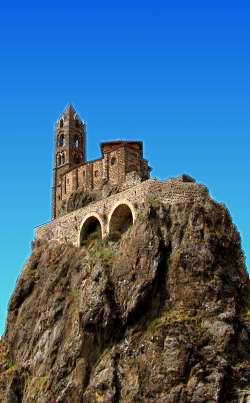
10th century chapel of St Michel de l'Aiguilhe, at Le Puy
- By air The nearest airport is Clermont Ferrand, served all year by flights from Paris and Amsterdam, and for a few months in summer by Ryanair from London Stansted. The nearest major airport is Lyon St.Exupéry ( 3 hrs drive), which has flights all over Europe.
- By train Brioude can be reached by direct train services from Clermont-Ferrand and Nimes. It is on the very picturesque "Cevenol" line between the two cities. Clermont-Ferrand is three and a half hours from Paris. There are also trains from Le Puy
- By car Brioude is 15 km from the A75 (Paris-) Clermont-Ferrand - Montpellier motorway. It is on the N102 linking the A75 with the A7 at Montelimar, via le Puy. It is under 3 hours from Lyon.
- By bike Brioude is a key location on the new V70 Via Allier long-distance cycle route, a delightful north-south cycle route that will eventually be signposted right down to the Mediterranean. At present it is fully waymarked from Nevers, on the Loire, to Langogne near the source of the Allier.
Copyright
© About-France.com except where otherwise stated.
About-France.com
Home
page - Site
search
- Regions
- Maps of France
- Contact