
Bastides of Southwest France
Medieval planned towns
- Explore France ►
- Essential pages
- Travel in France
- Where to go
- What to see and do
About-France.com
- the connoisseur's guide to France
Bastides: a network of medieval towns
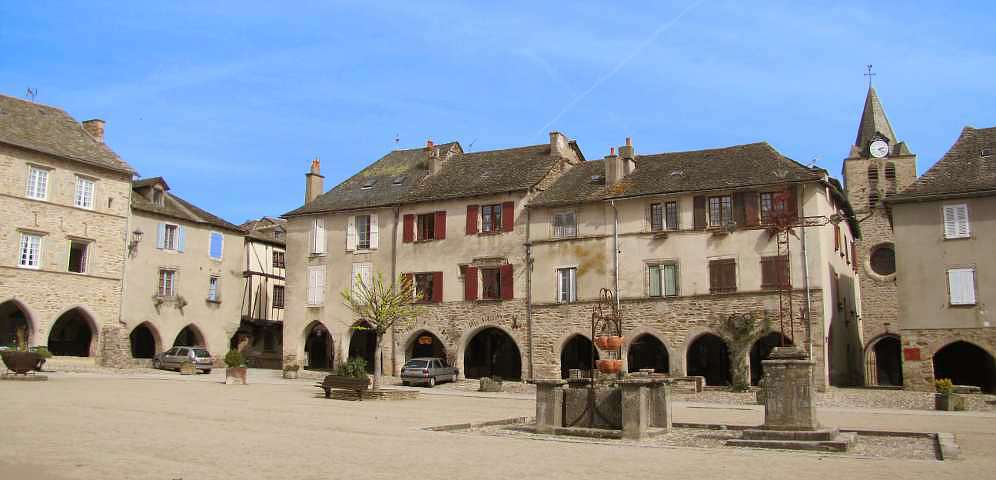
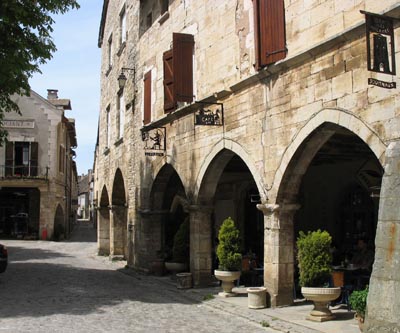 Villeneuve d'Aveyron, a small tranquil bastide.
There are said to be some 500-700 bastides in France, depending on how wide the definition is extended. Most of these are the southwest, and the majority of them were built in the two centuries from 1200 to 1400. At the time, the southwest of France was a frontier region, belonging partly to France, and partly to the kings of England. It should be remembered that until the mid fifteenth century, when the "English" were to all intents and purposes driven out of France, the kings of England, French-speaking, were actually
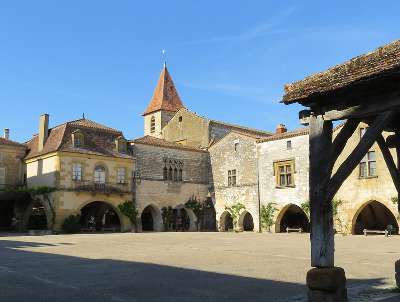 Monpazier, in the Dordogne area.
The large number of bastides in the southwest of France were set up in order to establish a more modern society in what was, at the time, a rather wild and inhospitable part of Europe. The establishment of bastides was a way for rulers to bring the population together in centres which could be more easily controlled and defended than isolated farmsteads or hovels, while helping to develop trade and other activities associated with the town. The bastides, by promoting economic activity, also allowed the lords who founded them to raise more taxes, while ensuring a better standard of living - and also more importantly the status of freemen rather than serfs - for the people who moved into them.
Since they were built at a time of relative peace and prosperity, before the start of the Hundred Years' War, the early bastides were not fortified; however once Anglo-French relations deteriorated into a state of on-off conflict, many bastides were fortified either on the initiative of individual occupants, who built walls at the outer end of their properties, or by the coordinated building of town walls.
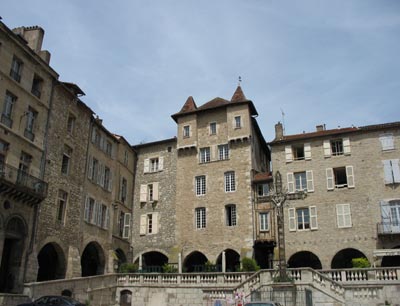 The main square of a large bastide town,
Villefranche de Rouergue
The main square of a large bastide town,
Villefranche de RouergueMost bastides are laid out on a grid pattern, with a central square; while the grid pattern may have been inspired by the
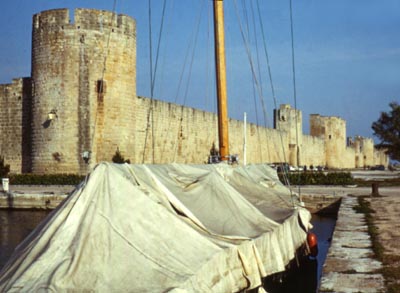 Finely preserved bastide on the
Mediterranean coast : Aigues Mortes, based on an earlier Roman
"castrum".
Finely preserved bastide on the
Mediterranean coast : Aigues Mortes, based on an earlier Roman
"castrum".The main bastide area covers most of Aquitaine and Occitanie regions of France, stretching from the Dordogne to the Aveyron, and down to the Spanish border. The largest concentration of bastides is in the Lot et Garonne department (47), along what was the shifting boderline between the English and the French held lands.
Among the more famous, best preserved or most attractive bastides are:
(numbers are the departmental numbers)
- Dordogne (24): Domme , Eymet , Monpazier, Villefranche du Périgord,
- Gard (30): Aigues Mortes
- Lot (46) : Rudelle
- Lot et Garonne (47): Montflanquin , Montpezat , Villeréal , Vianne , Puymirol,
- Aveyron (12) : Sauveterre de Rouergue , Villeneuve d'Aveyron , Villefranche de Rouergue
- Ariège (09): Mirepoix,
- Landes (40): Labastide d'Armagnac,
- Pyrénées Atlantiques (64): Navarrenx
- Haute Garonne (31) : Villefranche-de-Lauragais ,
- Gers (32): Cologne.
- Gironde (33): Libourne
- Tarn (81): Cordes sur Ciel
About-France.com
Home
page - Site
search
- Regions
- Maps of France
- Contact
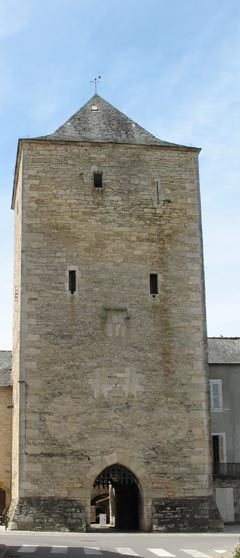
Fortified gateway to a bastide town
Discover
the bastides

Find hotels in or near the most attractive bastide towns.
Aigues-Mortes
Monpazier
Domme
Eymet
Villefranche de Rouergue
Mirepoix
Montflanquin
Villeréal
Labastide d'Armagnac
Cordes sur Ciel
Other areas
Monpazier
Domme
Eymet
Villefranche de Rouergue
Mirepoix
Montflanquin
Villeréal
Labastide d'Armagnac
Cordes sur Ciel
Other areas
About-France.com
is an independent user-supported website that does not track visitors
and carries very little advertising, Links to selected
affiliate partner websites such as Booking.com may generate commission
on sales at no cost
to the user.
Gitelink
France
selected holiday cottagesDordogne / Lot et Garonne
Midi Pyrénées
Lot , Quercy, Aveyron
Click here for
low-cost car hire in France
low-cost car hire in France
Website text and photos © copyright About-France.com 2003 - 2025 unless otherwise stated