
French life, institutions, society, travel and tourism.
- Explore France ►
- KEY PAGES
- Where to go
- How to get there
- Learn about France
Questions about French nouns
French nouns FAQ - 12 key questions and answers
It’s a fact of language that sometimes even the simplest grammar categories can cause big problems for learners. Perhaps that’s not surprising. Nouns make up about 60% of all the words in French, and often they carry not just meaning, but grammatical information too. In French, this information is mostly provided by what we call gender, number, and determiners, three parameters that can sometimes confuse even competent speakers! .
The essentials of French nouns
In French, every noun has a gender, must be either singular or plural, and usually needs a determiner. The answers to the following frequently asked questions provide a clear and simple guide to using nouns in French.
-
What is a noun in French?
A noun is a word that names a person, animal, object, action, or idea. In French, a noun is defined by three things: its gender (masculine or feminine), its number (singular or plural), and its determiner (such as le, une, ma, etc.).
-
Do all French nouns have a gender?
Yes. Every French noun is either masculine or feminine. Gender is a grammatical category, not biological, and must be learned with each noun. The often repeated "rule" that nouns ending in -e are feminine is not a rule at all. It is true that about 75% of French nouns ending in -e are feminine, but the rest are not; just remember un homme un incendie , un village. Subject to a very few exceptions, there are a few hard rules, for instance nouns ending in -age, -ment, and -oir are masculine, while nouns ending in -ion, -ette, -té, -ance/-ence, or -ée are feminine... There are a very few exceptions such as le musée.
-
What about the gender of nouns referring to people?
For nouns referring to human beings, the grammatical gender usually matches the person’s gender: un homme (masc.), une femme (fem.). Some nouns can be either (un / une gendarme), and a few exceptional nouns stay the same gender (une personne is always feminine).
-
Do professions and roles have masculine and feminine forms?
Often, yes. Some nouns change their ending (un boulanger / une boulangère), others keep the same form but change their determiner (un / une gendarme), and some have several possible feminine versions in modern French (e.g. un professeur, une professeur, une professeure, une professeuse). Some profession words have no feminine form; a lady doctor is un médecin, not une médecine.... If it is essential to stress that the doctor is a lady, then une femme médecin or une docteure can be used.
-
How is the gender of objects and abstract nouns determined?
For inanimate nouns, gender is mostly arbitrary. Some endings often indicate feminine nouns (like -ette, -euse), (e.g. une perceuse - a drill ) but many nouns are unpredictable: le coton vs. la chanson. These differences are historical. Sometimes there is confusion, for instance a photocopier in French can be either un photocopieur (based on the English word) or une photocopieuse (based on the French tradition using the feminine -euse ending for machines or tools)
-
How do most French nouns form the plural?
Most nouns add a silent -s in the plural: un homme → des hommes, un tracteur → des tracteurs.
-
Which plural forms are irregular?
There are several irregular plural endings in French:
- -al / -ail → -aux: cheval / chevaux (but festival / festivals)
- -ou: words ending in -ou in the singular usually take an -s, but eight common nouns take -x: bijou, caillou, chou, genou, hibou, joujou, pou
- Nouns already ending in -s or -x in the singular do not change: un tapis / des tapis, un époux / des époux
- English loan words simply take -s: un sandwich / des sandwichs
-
What other ways show that nouns are being used the plural?
Plurality is also shown by the determiner (article, etc) and the adjectives: les grandes idées, plusieurs bons amis.
-
Do French nouns always need a determiner?
Almost always. French rarely allows a noun without one, except in fixed expressions like j’ai peur, or to describe a person's profession or rank, as in Elle est médecin, Il est lieutenant. Articles, possessives, demonstratives, numerals, etc. are normally required. Determiners are often omitted in titles, such as Menu du jour (see photo left/ below) or "Incendie à Notre-Dame", though not in more sentence-like press titles, for instance there's no french equivalent of the classic spoof English headline "Body found in graveyard", which, if used as a newspaper title in French, would be Un cadavre retrouvé au cimetière.
-
Do determiners agree with the noun?
Yes. Determiners must agree in gender and number: la petite maison, les trois enfants.
-
How do I express possession in French?
French does not use the English “’s”. You must use de + noun: La mère de Jean-Jacques. The determiner is la, You can never say something like "Jean-Jacque's mère"
-
Can a French noun start a sentence without a determiner?
Normally no, except for proper nouns (names). Other nouns always requires a determiner. Examples: Picasso était un très grand artiste, but L'homme est un grand artiste.
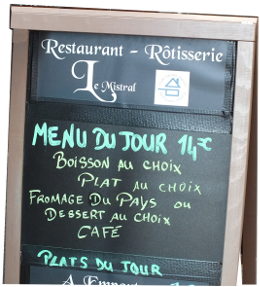
Lots of nouns on the menu...
Discover French food and eating on Eating in France

| ►► French civilisation and culture |
| The regions of France |
| Maps of France |
| France facts and figures |
| The French political system |
| The French economy |
| The French legal system |
| Education in France |
| Health care in France |
| Religion in France |
| The press in France |
| French art |
| A-Z Dictionary of France |
| ►► Principal chapters on About-France.com : |
| The
regions of France Beyond
Paris, a guide to the French regions and their tourist attractions.
|
| Guide
to Paris Make
the most of your trip to Paris; Information on attractions,
Paris hotels,
transport, and lots more.
|
| Tourism
in France
The
main tourist
attractions and places to visit in France - historic
monuments, art galleries, seasides, and more
|
| Planning
a trip to
France
Information
on things to do before starting your trip to France..
|
| Driving
in France
Tips
and useful information on driving in and through France - motorways,
tolls, where to stay....
|
| Maps
of France
Cities,
towns, departments, regions, climate, wine areas and other themes.
|
| The
French way of
life
A
mine of information about life and living in France, including working
in France, living in France, food and eating, education, shopping.
|
| A-Z dictionary of France Encyclopedic
dictionary of modern France - key figures, institutions, acronyms,
culture, icons, etc.
|