
Poitou and Charentes - an area guide
Between central France and the Atlantic
- Explore France ►
- Essential pages
- Travel in France
- Where to go
- What to see and do
About-France.com
- the connoisseur's guide to France
| Page index | Regional information | Main tourist attractions | Stay in Poitou Charente |
Regional profile:
 The
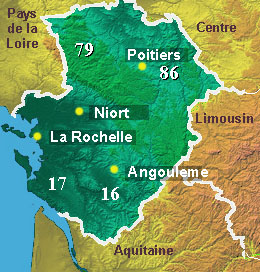
Poitou-Charentes area of western France is not a historic region of
France, but was formed in 1956 from the major part of the old Poitou
area, plus three smaller areas in the south. Until 2015 it was a
region. Now it is part
of
the large region of southwest France known as Nouvelle Aquitaine.
The
Poitou-Charentes area of western France is not a historic region of
France, but was formed in 1956 from the major part of the old Poitou
area, plus three smaller areas in the south. Until 2015 it was a
region. Now it is part
of
the large region of southwest France known as Nouvelle Aquitaine.
In brief, the region covers the central part of France's Atlantic coastal plain, together with a gently undulating hilly area further inland, the first foothills of the Massif Central. In the southern part of the region, extensive vineyards provide the grapes that are used in the production of Cognac and the famous local apéritif wine Pineau des Charentes.
In the north of the area, the departments of Deux Sèvres (79) and Vienne (86) make up the historic Poitou region, centered on the ancient city of Poitiers; the southern part of the area comprises the low-lying departments of Charente (16) and Charente- Maritime (17).
The whole region is largely rural, and even the regional capital Poitiers has less than 100,000 inhabitants. Niort, capital of the Deux Sèvres department, is specialised in financial services, notably insurance, and mail-order, which is surprising for a town of just 60,000 inhabitants; however the town was hit hard a few years back by the collapse of the CAMIF, one of France's big mail order cooperatives, and by the financial crisis in general.
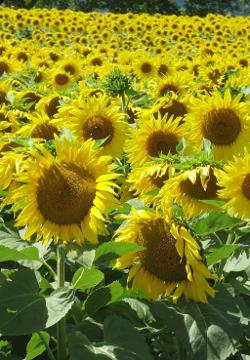 Sunflowers
- emblematic flowers of southwest France
Sunflowers
- emblematic flowers of southwest FranceThe coastal area, including the towns of La Rochelle, Rochefort and Royan, is popular for seaside tourism and also with yachtsmen; there are plenty of long sazndy beaches, however many kilometres of the coastline are given over to oyster beds, oysters being one of the big local specialities. The coastal islands of Oléron and Ile de Ré are famous for their beaches and maritime environment. Some parts of the coastal area lie at or even marginally below sea-level; in Spring 2010, high tides and heavy seas pushed by hurricane Xyntia broke through the sea defences causing serious flooding. As a result of this, some 1500 houses in the Charente Maritime and Vendée departments were demolished.
Main tourist attractions in the Poitou-Charentes area
Area :
- Le Marais Poitevin - Venise verte. "Green Venice" covers much of the sea-level flat land inland from the coast, mostly in Deux Sèvres and Charente maritime. It is an area of slow moving rivers and channels, woods and fields. Boating and kayaking, angling, rambling and riding are among popular activities here. There is a good network of marked cycle tracks and the area is a haven for wildlife.
Charente department
- Angoulème (16) Attractive hill town, with an old but not particularly historic town centre. The cathedral, of romanesque origin, was extensively renovated in the 19th century.
- Aubeterre
sur Dronne:
(16) small town with unusual romanesque "monolithic" church, carved out
of the rock. One of the "most beautiful villages in France" -
consequently full of tourists in busy periods.
- Cognac (16) Visit the great cognac houses, and the cognac and pineau cellars.
Charente Maritime department
- Brouage; the citadel (17). Remarkable 17th century walled garrison town, birthplace of Samuel de Champlain, the founder of Quebec. Once a major Atlantic port, Brouage was abandoned, and survived just as a village on the Charentes fenlands. Off the beaten track, it has remained virtually unchanged, its fortifications rising from the marshes.
- La Rochelle (17); historic Altlantic port city, with medieval fortifications around the old port. The Aquarium at la Rochelle is one of the 20 most visited attractions in France. La Rochelle, which prides itself as the yacht-building capital of France, also has a maritime museum on board a historic ship.
- Rochefort (17). Small city just inland from the coast, once a major naval arsenal. Old naval buildings, including the old naval rope works, and the Maritime museum, with historic collection of model sailing ships, and a shipyard where a replica 18th century frigate, the Hermione, was recently built. Other interesting attractions include France's only surviving transporter bridge (no longer in use), and the unusual House of Pierre Loti, a French 19th century traveller, with its genuine Oriental interiors; and the Museum of historic shops.... a trip down memory lane for more elderly visitors.
- Royan (17) : classic seaside resort. The la Palmyre zoo is one of the best in France. Jardins du Monde offers a discovery of garden styles from round the world, plus a butterfly house.
- Saintes (17). Lying on the river Charente, Saintes was once the capital of the Roman province of Aquitaine. Today a small town, it is most famous for the Roman triumphal arch (Arch of Germanicus) and remains of the Roman amphitheatre and other remains from antiquity. The historic Abbaye aux Dames is the largest example of Saintonge romanesque architecture.
- Saujon (17). Train des Mouettes - the Seagull line - 21 Km from Saujon (between Royan and Saintes) to la Tremblade, along the estuary of the Seudre. Steam trains on weekdays in the holiday period.
- Saintonge: (17) a remarkable ensemble of 11th and 12th century romanesque churches, with magnificent carved porches and stonework. So many villages harbour marvels of medieval heritage, that sometimes they are not even signposted.
- Iles de Ré and Oléron - Popular offshore islands, accessible via road bridges from the mainland.
Deux Sèvres department
- Niort (79). The capital of the Deux-Sèvres department is a classic old French town. Though the outskirts are modern - Niort is home to the major French insurance cooperatives or "Mutuelles" - the old town is a sleepy ensemble of stone buildings dominated by a medieval castle overlooking the river Sèvre Niortaise .
- Parthenay (79) . Small town on the river Thouet, best known for its impressive medieval fortified bridge.
Vienne department
- Chauvigny (86) the town of the five castles. Five impressive castles and a romanesque church make up the medieval quarter of this old town built on a rocky spur beside the river Vienne, just east of Poitiers.
- Montmorillon (86). An attractive small town on the river Gartempe that has recently reinvented itself as a "book town", like Hay-on-Wye in Wales. The town has lots of shops and boutiques around the theme of books and writing, and also three museums and Notre-Dame church which has 12th century frescoes in the crypt.
- Poitiers (86), Regional capital, Poitiers is an old hill-town with an attractive old centre. The city is most famous for its ancient churches, including the medieval frescoes in St. John's Baptistry, reputedly the oldest place of Christian worship in France, and the Notre-Dame la Grande church, one of the most famous and distinctive romanesque churches in France.
- Romagne (86) Near the Futuroscope. Valley of the Monkeys - Vallée des Singes - Over 400 primates from tiny ouistitis to large gorillas live on this 35 acre wildlife park. No cages, no fences. The animals live in semi-liberty on islands, some of them accessible to visitors, others clearly visible.
- Futuroscope (86) A future-based theme park, famous for its variety of high-tech cinemas including IMAX and 3D. ► More details and advanced booking
- St Savin sur Gartempe (86). UNESCO world heritage site, a romanesque abbey church with a remarkable collection of medieval frescoes.
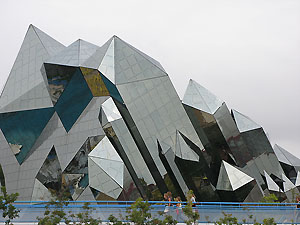
The Futuroscope - Photo St.A
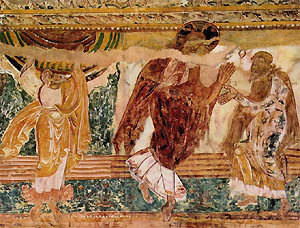
12th century fresco - St Savin sur Gartempe
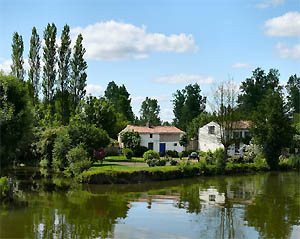
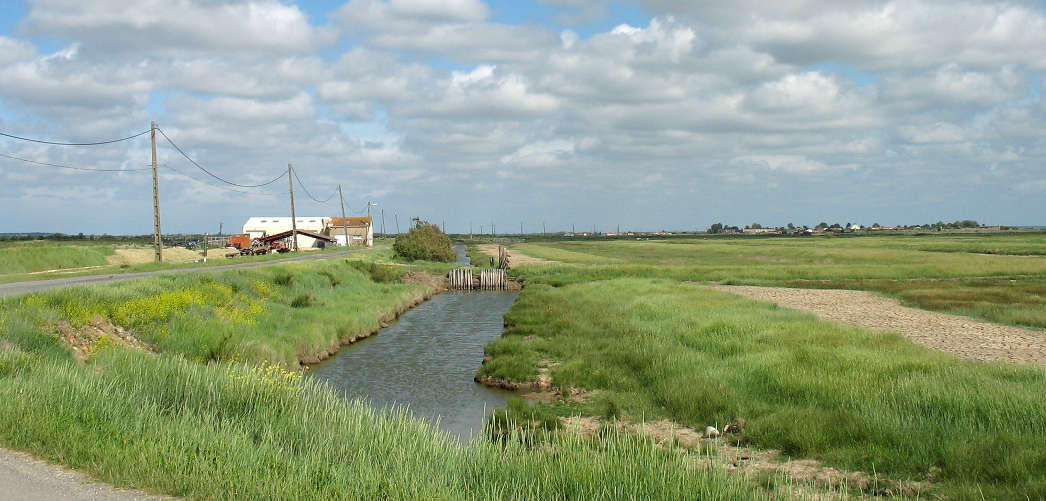
By the river Sèvre Niortaise
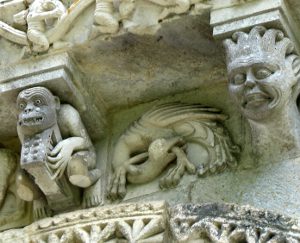
Romanesque sculpture on a Saintonge church
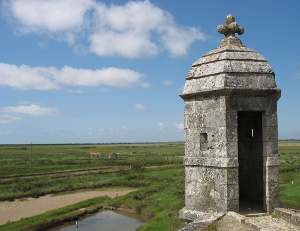
The old citadel at Brouage
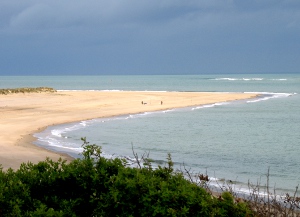
Charente Maritime coast near la Tremblade
Going further: Official Charentes region tourism site
About-France.com
Home
page - Site
search
- Regions
- Maps of France
- Contact
Poitou-Charentes
Practical
information
About-France.com
is
an
independent website that does not track users and carries no
personalised advertising, Affiliate links to selected relevant external
partner websites may lead to paymet of a small commission on
sales or bookings generated on
these sites.
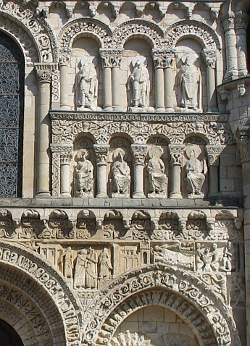
Intricate medieval sculptures on the facade of Notre Dame la Grande, at Poitiers
By
train
(TGV) from Paris Gare Montparnasse or Gare d'Austerlitz.
Access by road from the UK, via any of the Channel ports, then via Paris or via Rouen. The Poitou-Charentes region is crossed by the main motorway between Paris and western / southwestern France, the A10 (Paris-Tours-Bordeaux).
By air Various low-cost carriers fly to La Rochelle, or to airports just outside the region, at Bordeaux, Bergerac and Limoges. See flights to France
Poitou-Charentes has a network of good regional roads, and also a rail
network connecting most towns.
For car hire, compare offers here, selecting your town or airport of arrival
For car hire, compare offers here, selecting your town or airport of arrival
The coastal area of Poitou-Charentes is reputed to be one
of the sunniest regions of France; the whole Poitou-Charentes area
benefits from a mild Atlantic climate.
See Charentes weather
See Charentes weather
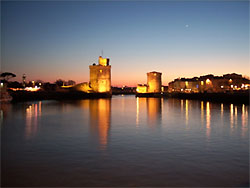
Old port of La Rochelle
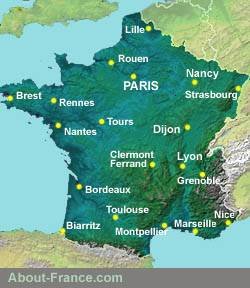
Click here for
low-cost car hire in France
low-cost car hire in France
Texts and photos © About-France.com except:
Photo of Sèvre Niortaise by Dynamosquito