
About-France.com
The connoisseur's
guide to France
French life, institutions, society, travel and tourism.

- Explore France ►
- KEY PAGES
- Where to go
- How to get there
- Learn about France
Nouns in French
Nouns - forms, features, and use
► See also: FAQs about French nouns - 12
essential questions and answers
Nouns
are words that refer to creatures, objects, actions or abstractions.
They are defined in French grammar by their gender
(masculine or
feminine), their number
(singular or plural), and their
determiner.
1. Gender
► All nouns in French have a gender, either masculine or feminine.Animates: When nouns define human beings, the gender of the noun normally corresponds to that of the person or people concerned. Thus un homme (masculine) and une femme (feminine). There are a few exceptions; the most high-profile of these is une personne (feminine), a person, whether the person is male or female.
Many nouns that can either refer to males or to females have masculine and feminine forms. In some cases an identical noun can be used in either gender: example un gendarme, une gendarme (a policeman / woman). In other cases male and females are designated by a masculine and a feminine form of the same word: example un boulanger / une boulangère (A baker, a female baker). In other cases there is little consensus; there is no clear rule in modern French as to whether a female teacher should be referred to as un professeur, une professeur, une professeuse, or une professeure. All four forms are used, even in official documents.
Inanimates: When nouns define objects or abstractions, they still must have a gender. The gender can sometimes be determined (or guessed) by the noun's ending. While there are a few endings which are more or less exclusive to feminine nouns, such as -ette or -euse, the gender of most nouns just has to be learned case by case, and it is not always easy. Why does one say le coton, but la chanson? The reasons are etymological (historic) – but that is of little help: genders just have to be learned.2. Number
► Nouns in French must either be in the singular or the plural. The plural of most French nouns is indicated in written French by the addition of the plural marker, normally "s".This plural s is not pronounced in spoken French.
Examples: un homme, des hommes - un tracteur, des tracteurs.
(Pronunciation note : The 's' is often pronounced before a following noun starting with a vowel, as in the example below)
Particular cases:
- ►
Most - though not all - nouns ending in -al,
or -ail, form their plural
in -aux.
Examples: cheval / chevaux, général / généraux etc. but festival /festivals
As for the French word for garlic, singular un ail, its plural form is des aulx. - ►
Nouns ending in -ou.
Most have a normal plural in -s;
but eight common nouns take their plural in -x
: bijou,
caillou, chou, genou, hibou, joujou, pou.
Examples: un voyou, des voyous, un hibou, deux hiboux. - ►
Nouns ending in
-s or in -x.
These remain unchanged in the plural
Example: un tapis, des tapis - un époux, des époux - ►
Words borrowed from English which would take an -es
in the plural in English just take an -s
in French.
Example: un sandwich, des sandwichs
3. Determiners
► Nouns cannot normally stand alone in French. Except in a small number of (mostly common) fixed expressions, such as j'ai peur, all nouns except proper nouns (i.e. names) – whether in the subject or predicate of a sentence – must be preceded by a determiner (un prédéterminant). This can either be:- an article (le, la, un, etc...),
- a possessive adjective (mon, ma, mes, ton, etc.),
- a demonstrative adjective (ce, cette, etc),
- a quantifying
adjective
(plusieurs,
quelques, etc.)
an interrogative adjective (quel, quelle, etc.), - a numeral
or - in the case of compound nouns - another noun.
► When the predeterminer is an article or an adjective, it agrees in number and gender with the noun.
► Possessive determiners
Unlike English, a noun in French cannot be preceded by another noun in the possessive form, as there is no inflected possessive form for nouns in French. The only possessive determiners are possessive adjectives such as mon / ma / mes, ton / ta / tes , etc.
In English one can say "Rosemary's baby". In French this must be "Le bébé de Rosemary"; in French, the determiner here is Le, not Rosemary's. (Except, of course, in the title of the classic movie which, in France, has always been known as Rosemary's Baby.... but that is English, not French! The movie title could never have been translated as Rosemarie's bébé.)
The determiner comes at the start of the noun group in French. It may be followed by one or more adjectives, from among those adjectives which, in French, precede or can precede the noun.
Examples:
The determiners are in bold
type.
Ma grande idée !
My big idea !
Le premier grand orage de l'été.
The first big storm of summer / Summer's first big storm..
Cette dame et sa très vieille tante.
This lady and her very old aunt.
Vingt-cinq belles filles.
Twenty-five beautiful girls.
Les trois plus grands écrivains de l'histoire.
The three greatest writers in history.
Quelle belle histoire!
What a lovely story!
Plusieurs bons amis / Plusieurs de mes bons amis
Several good friends, / Several of my good friends.
Ma grande idée !
My big idea !
Le premier grand orage de l'été.
The first big storm of summer / Summer's first big storm..
Cette dame et sa très vieille tante.
This lady and her very old aunt.
Vingt-cinq belles filles.
Twenty-five beautiful girls.
Les trois plus grands écrivains de l'histoire.
The three greatest writers in history.
Quelle belle histoire!
What a lovely story!
Plusieurs bons amis / Plusieurs de mes bons amis
Several good friends, / Several of my good friends.
4. What follows a noun ?
► There is no need for anything to follow a noun; in French grammar a noun group can be considered complete as long as it has a determiner and a noun.► However nouns can be and often are followed by adjectives. Indeed, most French adjectives follow the noun. Example: un livre intéressant. See Adjectives
► Nouns can also be followed by (postmodified by) a prepositional phrase such as a possessive form with de. Example: Le livre de mon voisin.
► Nouns can also be completed by a subordinate clause, such as a relative clause.
Examples: Le livre que j'ai lu. Le livre à acheter.
Printer-ready
page
- print or PDF
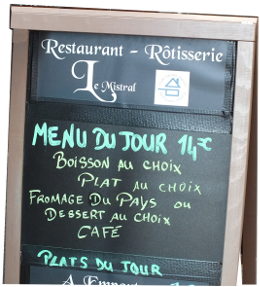
Lots of nouns on the menu...
Discover French food and eating on Eating in France



A choice of French
stores & brands that deliver abroad
| ►► French civilisation and culture |
| The regions of France |
| Maps of France |
| France facts and figures |
| The French political system |
| The French economy |
| The French legal system |
| Education in France |
| Health care in France |
| Religion in France |
| The press in France |
| French art |
| A-Z Dictionary of France |
| ►► Site guide |
| About-France.com home |
| Full site index |
| About-France.com site search |
| ►► Principal chapters on About-France.com : |
| The
regions of France Beyond
Paris, a guide to the French regions and their tourist attractions.
|
| Guide
to Paris Make
the most of your trip to Paris; Information on attractions,
Paris hotels,
transport, and lots more.
|
| Tourism
in France
The
main tourist
attractions and places to visit in France - historic
monuments, art galleries, seasides, and more
|
| Planning
a trip to
France
Information
on things to do before starting your trip to France..
|
| Driving
in France
Tips
and useful information on driving in and through France - motorways,
tolls, where to stay....
|
| Maps
of France
Cities,
towns, departments, regions, climate, wine areas and other themes.
|
| The
French way of
life
A
mine of information about life and living in France, including working
in France, living in France, food and eating, education, shopping.
|
| A-Z dictionary of France Encyclopedic
dictionary of modern France - key figures, institutions, acronyms,
culture, icons, etc.
|
Studying the
grammar of a
foreign language is harder for those who are unfamiliar with
the grammar of their own
language... Check out the new acclaimed Descriptive Grammar of English,
a clear compact English grammar available
from Amazon, Waterstones, Barnes & Noble and other good
bookshops.

Copyright
© About-France.com