
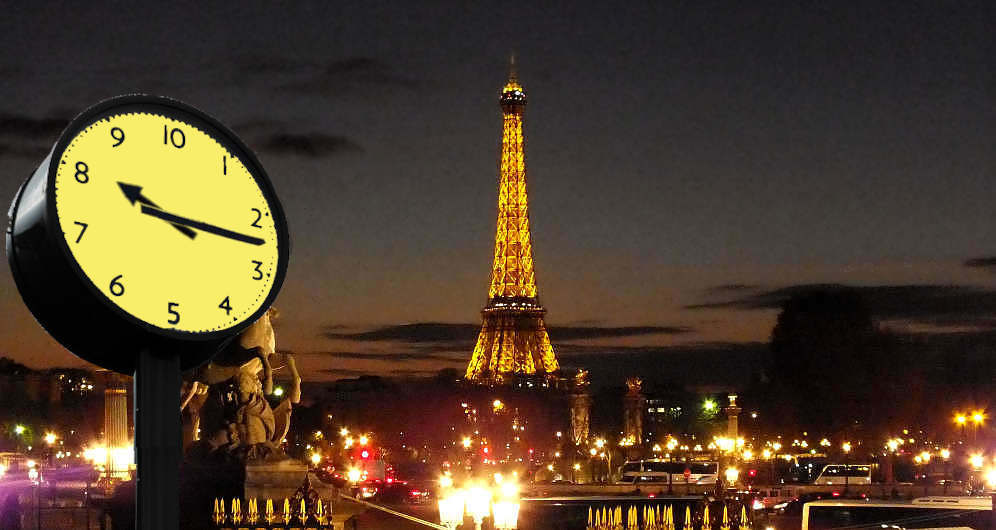
France to adopt Metric Time
First metric clocks go up in nation's capital
- Explore France ►
- Essential pages
- Travel in France
- Where to go
- What to see and do
About-France.com
- the connoisseur's guide to France
Paris April
1st.
2022 - AFCFrance will officially become the first country in the world in modern time to adopt metric time, according to a surprise announcement made yesterday evening on national television news, and confirmed by a spokesman for President Macron.
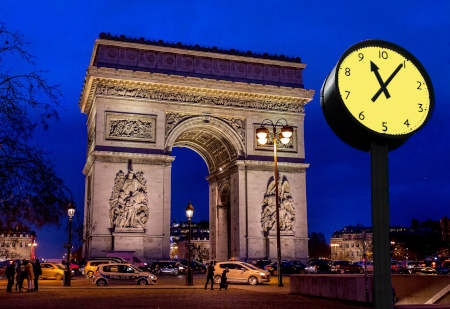
Municipal employees have already begun putting up metric clocks at key Paris locations, such as at the Arc de Triomphe
Even as the news was going out on national television in France, the wraps were being removed from the first metric clocks already covertly installed at key tourist locations in Paris by a team from the city hall. "We need the world to see that France is still a revolutionary country !" said mayor Annie Dalgo, who is also the Socialist Party's candidate in the upcoming French presidential elections.
Critics have reacted swiftly to news of the plan, claiming that the switchover to metric time will lead to panic and confusion on a par with the Millennium bug, and should not be introduced in a hurry; but in Paris a senior member of the official National Time Metrication Coordinating and Organising Committee, the CNOCTM, confirmed that the change to metric time has now been approved by France's highest arbiter, the Constitutional Council.
Under the plans first put forward in 1791 by Alphonse Touta-Leurre, a Corsican watchmaker who rose to prominence in Parisian scientific circles in revolutionary France, days in France will be subdivided as from next year into ten metric hours, and each hour divided into one hundred metric minutes. However plans to name these units Meurs and Centimeurs have been shelved in spite of the possibility of confusion following the changeover. A secret poll carried out by Paris-based Ipsos suggested that changing the names of the units as well as the units themselves would lead to even greater confusion.
A memorandum on preparing for the changeover will be circulated in the coming month to all local authorities and the directors of all public institutions in France. It requires clockfaces on all public buildings, and timepieces in all public services to be prepared for the changeover by February 1st next year at the latest. Clock faces on historic monuments are however exempt from the changeover, and will continue to show 24-hour time as part of France's national heritage. A research team at the ENSMM digital micromechanics school at the university in Besançon, France's historic watchmaking capital, is believed to have perfected a patch to update the software of most digital clocks and watches manufactured since 2005, except for those made in China.
Commenting on the changeover, which for over a year has been the subject of secret negotiations between leading French industry chiefs and the directors of major public services, a senior executive of the French rail service SNCF said: "We are quite confident that we will be fully prepared for this historic change in which France will lead the world. This is a very positive step forward, and as far as the railways are concerned, people will feel that the trains are faster, even if this is not the case. For example, from April 1st next year, the TGV (high speed train) service between Paris and Lyon will take under an hour, compared to two hours with the present system."
But questioned on a late-night French TV show, a spokesman for Air France, who had no prior knowledge of the project, expressed considerable alarm. "I do not think that this is a very sensible plan. Ooh la la. But imagine the confusion we will have in the skies over France. Unless everyone adopts this new metric time, we will have planes leaving from Frankfurt at 8 o'clock in the morning, and reaching Paris at 4 o'clock in the morning the same day. It will be crazy! No no no, I cannot believe that France will do this alone. "
Contacted by P Geest, a correspondent for French television news channel LCI, European Commission Weights and Measures Directorate spokesman Hengst Driyfødder suggested that Brussels may block moves by France to take a unilateral decision of this nature. " I don't think that France will be able to take such an important decision without EU approval, " he observed. "It might be better to postpone the changeover for a year or two, so that all countries in the European Union can move over to metric time together. Maybe on April 1st 2024."
The change in brief :
with a day divided into ten,
not twenty-four, hours, and an hour made up of 100 minutes ...
6 a.m. becomes 2.50, 9.30 a.m will be 3.96, Midday will be 5.00, 6 p.m. will be 7.50. and so on.
6 a.m. becomes 2.50, 9.30 a.m will be 3.96, Midday will be 5.00, 6 p.m. will be 7.50. and so on.
And if you're still incredulous about this.... the idea is not as strange as it might seem, and France did actually use metric time, or decimal time, for two years in the Revolutionary period, from 1793 to 1795; the day was divided in to ten hours, and each hour into 100 minutes. The system was scrapped in 1795 when France introduced the Republican calendar, which was used until 1806. This calendar divided the year into twelve months (years started with the Autumnal equinox), and each month was divided into three decades. The months had names derived from the farming calendar or from the weather, and included Vendémiaire, Brumaire, Floreal and Thermidor. .
| Useful Paris information | |||
| Paris airport connections | Budget Paris | Paris transport | |
| Main Paris tourist attractions | The Velib bike hire system | The quarters of Paris | |
Copyright © About-France.com April 2022
About-France.com
Home
page - Site
search
- Regions
- Maps of France
- Contact
►
Paris is one of the most
visited cities in the
world. But there's more to Paris than just the Louvre, a trip on the
Seine, and a ride up the Eiffel
Tower.... which are the stock of most
package tours to Paris.
About-France.com, the website for independent travellers, is packed with reliable and useful information about not just Paris, but the whole of France, covering much more than just the top tourist sites.
Check out all of the thematic "best of" pages.... best cities, best rural areas, best museums and lots more.
Discover loads of useful information about life in France, eating out, discovering French wine, driving in France, taking the train... or discovering the most interesting small towns . About-France.com has it all.
About-France.com
is an independent user-supported website that does not track visitors
and carries very little advertising, Links
to carefully selected affiliate
partner websites may generate commission on sales at no cost
to the
user.About-France.com, the website for independent travellers, is packed with reliable and useful information about not just Paris, but the whole of France, covering much more than just the top tourist sites.
Check out all of the thematic "best of" pages.... best cities, best rural areas, best museums and lots more.
Discover loads of useful information about life in France, eating out, discovering French wine, driving in France, taking the train... or discovering the most interesting small towns . About-France.com has it all.
In
an emergency
in Paris:
24
hr chemist / pharmacies:in Paris:
a) 84, av des Champs-Elysées 75008, tel
0145 62 02 41
b) 6, place Clichy 75009, tel
0148 74 65 18 .
English-speaking pharmacies:
British Pharmacy
62, Avenue des Champs-Elysées
75008 Paris
0143 59 22 52
British-American pharmacy,
1 rue Auber, 75009
0142 65 88 29
English-language crisis line;
SOS-Help
Daily 3 pm - 11pm
01 46 21 46 46
Ambulance:
Call/phone: 15
Hospitals:
Hertford British Hospital: 3, rue Barbès, 92300 Levallois-Perret
Tel 0146 39 22 22
American Hospital of Paris
63, Bd Victor Hugo
92200 Neuilly-sur-Seine
0146 41 25 25

More useful pages
Paris metro map with pdf
View or print out a plan of the metro system in the central area of Paris..
Paris metro map with pdf
View or print out a plan of the metro system in the central area of Paris..
The
Louvre museum, and its glass pyramid.