
French wines - a short guide
An introduction to the wine areas of France
- Explore France ►
- Essential pages
- Travel in France
- Where to go
- What to see and do
About-France.com
-
the connoisseur's guide to France
The main wine growing regions of France
Alsace winesSituated on the lower eastern slopes of the Vosges mountains, in the Rhine valley between Strasbourg and Mulhouse, the Alsace vineyard is rather different from any other French wine growing area. Like the region of Alsace itself, the wine culture here is steeped in a Germanic tradition, producing mostly dry or fruity white wines, the most popular being Riesling, Sylvaner and the very fruity Gewurztraminer.The rules of Appellation contrôlée - and more recently of Appellation Protégée (AOP) are not applied in the same way in Alsace as in the rest of France. In Alsace, wines are produced under a simple "Alsace" appellation, after which the next most important element to be indicated, and the most visible word on the label, is the grape variety or "cépage", Sylvaner, Riesling, Gewurztraminer, Edelzwicker, Pinot or a few others. Smaller areas do not have their own appellations, though with many Alsace wines, the name of the village or vineyard from which it comes will also be indicated. See also Vendanges tardives. Lorraine, also in north east France, produces mostly Vin de pays white wines, in the Meuse and the Moselle. Bordeaux winesWith Burgundy and Champagne, the Bordeaux region of Aquitaine is one of the three most famous French wine-producing regions. Historically, its fame is at least in part due to the fact that of these three big grape-growing areas, the Bordeaux vineyard is the only one with immediate access to the sea, an advantage that has enabled it to be France's major wine exporting region for many centuries.In 1152, when queen Eleanor of Aquitaine married the English king Henry II, the Aquitaine region became economically integrated 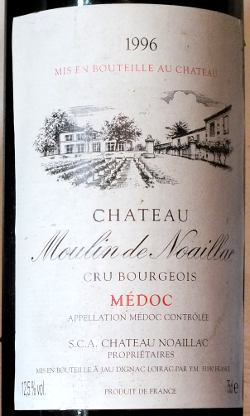 into
the
Anglo-Norman world, the Bordeaux region becoming the main supplier of
wine for England. This historic wine exporting tradition helped
Bordeaux to develop far stronger commercial links in the ensuing
centuries, firmly establishing Bordeaux wines, often referred to
generically in English as "clarets", on the international market. into
the
Anglo-Norman world, the Bordeaux region becoming the main supplier of
wine for England. This historic wine exporting tradition helped
Bordeaux to develop far stronger commercial links in the ensuing
centuries, firmly establishing Bordeaux wines, often referred to
generically in English as "clarets", on the international market.The Bordeaux vineyard is centered round the port city of Bordeaux , along the estuary of the Gironde, and the rivers Garonne and Dordogne. It is a large vineyard, and the geo-specific appellation "Bordeaux" covers an area stretching some 100 km both north-south and east-west. While the appellation contrôlée covers Bordeaux wines of medium quality from all over this region, many if not most of the top quality clarets grown in the overall area benefit from more specific and distinctive area appellations, such as Médoc , Graves or Saint Emilion, and even more local appellations such as Pauillac, Graves and Saint-Estèphe. Unlike other French wine-growing areas apart from Burgundy, the Bordeaux area operates classifications of many of its top wines, notably those from the Médoc and Saint Emilion vineyards. The best estates in these areas have the right to sell wines designated as grand cru. Below the grand crus come other high quality wines designated as cru bourgeois. Tip: 2009 is said to be an exceptionally good vintage year. Médoc winesAmong the Bordeaux vineyards, Médoc deserves a special mention. The Médoc, an area south of the Gironde estuary to the north west of Bordeaux, is the home of many of the most prestigious French wines. Among the famous appellations produced in this area are Saint Estèphe, Margaux, Saint Julien and Pauillac. It was in 1855 that the wine producers of the Medoc region classified their 61 best wines according to a league table of "grands crus", ranking from "Premier Cru" to "Cinquième Cru". These grands crus are generally reputed to be the greatest of all French wines, and naturally their prices generally reflect this status. Obviously, if you buy an estate bottled wine from a chateau with grand cru status, (and of course they are all estate bottled), you can be pretty sure of getting a top quality wine. But take care! Even a grand cru wine can go off if it is not matured and cared for in the best conditions.Other areas of south-west FranceInland and southwards from the Bordeaux / Saint Emilion regions, there are a number of less well-known wine growing areas, many of them producing quite good wines at very reasonable prices. These include Bergerac, Cahors, Gaillac and Marcillac (all Appellation Contrôlée wines) , or Côtes du Tarn or Vin de Pays du Lot. While Marcillac is a small area, the vineyards of Cahors, Gaillac and Bergerac are quite extensive, and best known for their reds. The Cahors area produces some of the richest and darkest red wines in France, principally using the Malbec grape variety, sometimes referred to as "purple wine". However the Bergerac wine producing area is also known for its white wines, including some strong sweet aperitif wines such as MontbazillacTowards the Pyrenees, there are some surprisingly good white wines from the vineyards of Jurançon and Béarn, notably from the Gascony vineyards of Pacherenc-du-Vic-Bilh, reputed for its distinctive aperitif wines, and the vineyards of Madiran which produce a well-known red. Bourgogne (Burgundy)The vineyards of the Burgundy region cover a narrow strip of land on the eastern slopes of the hills running south-east from the Burgundian Capital, Dijon. The heart of the Burgundy wine growing region is the historic city of Beaune, where the autumn wine sale in the historic "Hospices" building is one of the high points of the wine year. Burgundy wines are classified on four levels, the lowest being the generic "Bourgogne" appellation. Selected areas of the Burgundy vineyard have their own classifications, such as Côtes de Beaune. Within these, there are smaller areas, villages and groups of villages, reputed to produce higher quality wine, such as Mersault, Pernand Vergelesse or Aloxe Corton . Finally, at the top of the pyramid, there are the "grands crus", such as Clos Vougeot, with its mere 51 hectares of vineyard. Finding ones way around Burgundy wines is sometimes a daunting task. The best Burgundy wines are the reds, the best of which can keep for a good 20 to 30 years. However, Burgundy also produces some top quality, though not too distinctive, whites. It is often said that generic burgundies "Bourgogne Rouge" or Bourgogne Passetoutgrains" white are overpriced and not particularly good value for money.A good tip: 2003 is said to be one of the best vintages for many years. Visit: Check out hotels on the Burgundy wine trail ►Beaujolais:
South of the Burgundy region, bordering the Rhone valley vineyards,
a large area round Beaujeu produces a light red wine known as
Beaujolais, paradoxically one of the most famous French wines. This is
a wine that does not usually keep for very many years, and over the
last fifty years it has been successfully marketed as a "vin primeur",
or young wine, to be drunk after just a few weeks of maturing. But the
success of Beaujolais Nouveau - launched on the market each year on the
third Thursday of November - has more to do with clever marketing than
with any enduring quality of the wine.
|
||||||||||
| Wine growing regions | Wine: understand the label | Value for money |
WINE TOURISM
Stay
in French wine regions
Champagne
Dijon
Beaune
Rhone valley
Avignon
Narbonne
Tours
Cognac
Medoc
Bordeaux
St Emilion
Click
for best
online rates for hotels in the heart of France's main wine regions
Alsace
Champagne
Dijon
Beaune
Rhone valley
Avignon
Narbonne
Tours
Cognac
Medoc
Bordeaux
St Emilion
About-France.com
is
partnered with leading hotel booking portals, Booking.com
and Hotels.com,
to
bring you the best online prices
Selected wine estate accommodation
► Bordeaux wine estate hotels and b&bs :
a selection of some active wine estates in the Bordeaux wine area offering cellar visits, wine tasting and hotel or bed and breakfast accommodation.- Saint Estèphe, Medoc,: Classic Médoc château on a large estate. Ten bedrooms, fine dining, winery tours.
- Margaux, Medoc,: Margaux grand cru chateau Upscale chateau b&b on a 52 hectare Margaux Grand Cru wine estate. Cellar and vineyard visits
- Côtes de Bourg vineyard. Château winery with 3 ensuite b&b rooms and pool. Wine tasting and vineyard tours
- Near Bordeaux, beside the Dordogne: Small Bordeaux estate offering bed and breakfast. 3 rooms.
- Saint Emilion: Wine estate chateau amidst the vineyards: four en-suite guest rooms.
- Saint Emilion : Winery with restaurant and four guest rooms in a prestigious Saint Emilion vineyard
► Burgundy vineyard hotels & B&Bs
Stay in the heart of the Burgundy vineyards, and enjoy some of the world's finest wines.- Burgundy chateau B&B Refined B&B in a 16th century chateau and winery. The domain produces red and white burgundies which are aged in the cellars
- Chateau
hotel among the vines
Set among the Mersault vineyards, this four-star hotel with fine restaurant is an ideal base for discovering the great wine heritage of Burgandy - Boutique hotel in Puligny-Montrachet The Maison d'Olivier Leflaive produces a range of top quality Burgundy wines. Their hotel in the heart of Puligny-Montrachet provides wine tastings and vineyard visits.
- Four star hotel in the heart of old Beaune occupying 14th to 18th ceutury buildings In the historic centre of Beaune 300 m from the historic Hospice. Gourmet restaurant. Onsite parking.
► Champagne wine estate hotels & B&Bs
Stay on a wine estate in the Champagne wine area, and enjoy wines made by your hosts- Champagne vineyard B&B Near Reims, five spacious rooms in small Champagne winery. Well situated for Champagne vineyard tours.
- Champagne
Domain B&B
Top guest reviews for this B&B with 4 guest rooms on the premises of the Domaine Sacret, a small champagne house in Ay, near Epernay. Champagne tasting. - B&B
at Epernay champagne house
The André Bergère champagne house, in the middle of Epernay, has B&B rooms and apartments. Free onsite parking
► Stay on a Provence wine estate
- Hotel in historic winery A manor house located among 32 hectares of vineyards of the Fontenille estate, in the Luberon hills. 17 ensuite rooms. Gourmet restaurant, pool, wine tasting .
- Three-star
hotel on wine estate
Situated near Gigondas on the Côtes du Rhone wine trail, domaine de Cabasse offers guided visits of the vineyard and wine-testing. Gourmet restaurant, pool. - B&B
on 18th century wine domaine
Between Aix and Fréjus. Small historic winery with conservatory of old vine varieties. Wine tasting. Spring-water natural pool. 3 B&B rooms. Meals by arrangemen
About-France.com
Home
page - Site search
- Regions
- Maps of France
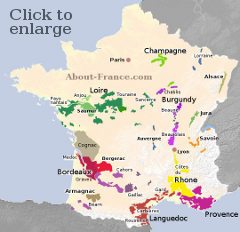
There
are ten major wine regions in France, plus a number of smaller
areas. Indeed
there is commercial wine production in every region of France, except
for the regions bordering on France's north coast.
Sparkling wines are produced in Champagne, of course, but also in Burgundy, Alsace, the Jura, the Loire and the Languedoc. Apart from in champagne, they are called by the names mousseux or crémant.
Types of French wine
There are just so many different types of French wine, and given the climatic and geological differences between different French regions, this is hardly surprising. Most wine growing areas produce a mix of reds, whites and rosés, and maybe some sparkling wines too; but generally speaking the more northerly wine areas, Loire, Jura, Alsace, are famed for their whites, while the southern vineyards - Bordeaux, Languedoc, Côtes du Rhône, are best known for their reds. Burgundy is famed for its reds and its whites, while Provence and the lower Loire are well known for their rosés.Sparkling wines are produced in Champagne, of course, but also in Burgundy, Alsace, the Jura, the Loire and the Languedoc. Apart from in champagne, they are called by the names mousseux or crémant.
French wine in a world market
For hundreds of years, France basked in the reputation of being the world's greatest producer of wines. Today, that reputation is being rivalled by other wine-growing nations on four continents, and the French wine industry is facing new challenges. Since the low of 2003, the French wine industry has been trying to reinvent itself, producing new wines for a changing world and European market, while continuing to provide the world's greatest wines, produced on estates with perfect conditions and centuries of winegrowing tradition. For those who know how to choose, and know something about wines, France still offers some of the greatest wines, with the greatest variety, and - yes ! - excellent value for money, even from the main wine areas.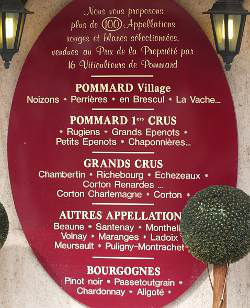
Top quality wines on sale in the village of Pommard, Burgundy
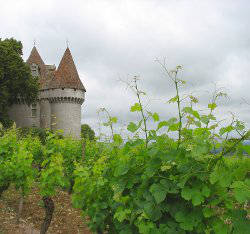
Chateau de Montbazillac, near Bergerac
Discover
other wines.
Discover the wines of California . California is now the world's fourth wine producing area, after Italy, Spain and France.
Discover the wines of California . California is now the world's fourth wine producing area, after Italy, Spain and France.


Then let France come to you
♥�? Check out
some French
stores that deliver to your country
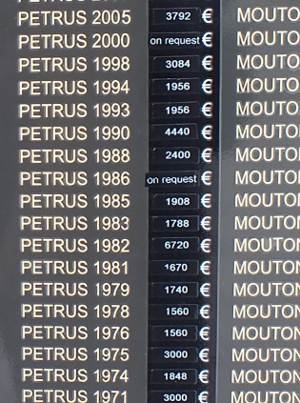
Price list outside a top-class wine merchant in the Bordeaux region. Note the price of a bottle of Petrus 1982.... at 6720 €. Not for ordinary mortals.
An
independent website, About-France.com is an affiliate partner
of
selected travel service websites,
and may receive a small commission on sales generated after users click
through to a partner site.