
- ► Essential France
- ► Practical visitor info
- ► Where to go
- ► What to see and do

An
A-Z
Dictionary of France
E
E
E 111 former European health card, used by European Union citizens for health cover in France and other EU countries. E111 has now been replaced by the EHIC card.
Eau d'Evian, see Evian below
Ecole des Mines - A "grande école", one of France's prestigious engineering schools, founded by King Louis XVI in 1783; originally specialising in mines, it today trains experts in various fields of civil engineering. Its full name is the École Nationale Supérieure des Mines de Paris . See Higher Education in France
Ecole Maternelle - Kindergarten: France has a strong tradition of pre-school education, and Ecoles Maternelles are open to pupils from the ages of 2 to 6 (the start of compulsory education). About a third of French children start going to kindergarten at the age of 2, and almost all children attend ecole maternelle between the ages of 3 and 6.
Ecole Normale - Name formerly given to teacher training colleges in France; their main purpose was the training of future primary school teachers (instituteurs). Today future teachers are trained in IUFM - Institut Universitaire de Formation des Maîtres.
Ecole Normale d'Administration, see ENA.
Ecole Normale Supérieure : Top French "grande école" in the field of arts and letters and sciences. See Higher Education in France
Ecole
Primaire or Ecole
Elémenatire
:
Primary school, for the education of pupils between the ages of 6 and
11. There are five classes. In some small rural primary schools,
teachers may still take several classes together. For further details
see Primary
& secondary education in France.
EDF -
Electricité de
France,
the leading French power company. Formerly a nationalised utility, EDF
is now a public company, in which the French government is the major
shareholder. EDF has expanded its activities into many European
countries, including Britain, though was very reluctant to give up its
monopoly over the electricity distribution market in
France. EDF is the second largest energy company in the world
in terms of stock-market capitalization. In France, over 85% of the
electricity produced by EDF comes from nuclear power generation.
Education nationale : the French state education system, and the largest employer in France. Teachers and administrative staff with tenured jobs in the state education system are classed as fonctionnaires, or civil servants. Counting tenured employees and those with short-term contracts (contractuels), the EN has some 1.1 million employees, including about 850,000 teachers. The Education Nationale is administered centrally by the MEN (Ministère de l’Education Nationale), and on a regional basis through Académies, each one presided over by a Recteur.
EELV : Europe Ecologie Les Verts. Political movement / party that emerged between 2008 and 2010 when the Green Party expanded to form an alliance including other militant environmental groups thatwere until then outside politics. See Les Verts
Eglise
Catholique:
France is often described as a “Catholic" country;
but this description
is not technically true. Since 1905, there has been a strict separation
of church and state in France, and France is officially a secular
(laïc) republic. See laïcité.
Nevertheless, Catholicism remains the main religion of France to this
day. In 1999, slightly over half the French population claimed to be
Catholic, though only about 12% of the population are churchgoers.
There are 15 archbishoprics in the
French Catholic church, plus the Catholic archdioceses of Strasbourg
and Metz, which for historic reasons are directly dependent on the
Vatican. Since the revolution, church buildings have belonged to the
nation, and to this day their upkeep is the responsibility of local
authorities.► For
more information see Religion
in France
Eglise Réformée de France : the main French protestant church, of Calvinist inspiration. The ERF isclosely associated with the other main Protestant church in France, the Lutheran EELF, Eglise Evangélique Luthérienne de France (French Lutheran Evangelical Church) which is particularly present in the area of Montbéliard, a Protestant stronghold in eastern France.
EHPAD : Residence for elderly people in need of care. Care home with medically trained staff. EHPADs can be run by local authorities or public bodies, private companies or non-profit associations. The cost of accommodation is paid by the family, and may be subsidised for those with insufficient resources. In 2019 43% of EHPADS were in the public sector, and the total number of people being cared for was just under 600,000. With the ageing of the population in France, the number of places available is expected to increase to over a million by 2050.
Eiffel Tower, see Tour Eiffel
Elitism
: In spite of
the national commitment to the principles of Liberty, Equality and
Fraternity, France remains marked by traditions of elitism that are
ingrained in the very fibre of society. The French Revolution was
supposed to have done away with privileges and elites, and usher in an
age of greater equality; in the event, it – and subsequent
upheavals –
changed the nature of the elites in France, without making a great
impact on the underlying system. Indeed, the notion of
‘republican
elites’ is one that was fundamental in the shaping of
post-Revolutionary France.
In terms of local power, the role of
local notables – important figures
–
remains strong. Notables frequently
fulfil multiple roles in local administration and structures, sometimes
combining these with elected positions on a regional or national scale,
giving them and their close supporters a considerable degree of power.
(See Cumul des mandats).
They are frequently referred to as les elites locales.
The process of devolution in France, set in motion in 1982, has had the
effect of strengthening the power base of local elites.
The French education system, while
offering a good quality non-selective education to all children at
lower levels, is increasingly elitist towards the top, particularly
when it comes to preparing for higher education. Many classes
préparatoires, particularly those
preparing
students for entrance to the top institutions of higher education,
called Grandes Ecoles,
are very selective, and the selection
process – and for that matter the system itself –
often disfavours
students from humble or poorer backgrounds. The Grandes Ecoles
themselves, tailor-made to the needs of the nation, train the future
leaders and decision makers in specific fields of the public or private
sector, producing very close networks of former students, that make the
British concept of the “old-boy network" seem
rather informal.
Places in the top grandes
écoles and
some other institutions are highly sought after, as graduates from
these schools are seen in France as a sort of caste, membership of
which is highly recommended, if not essential, for anyone wanting to
reach the top. The classic example of this is the ENA,
Ecole Normale d’Administration, the Grande Ecole designed to
train top
civil servants and future political leaders. In the corridors of French
power, many if not most of the top positions are occupied by Enarques
, graduates of the ENA. In 1967, Jean-Pierre Chevènement
– himself an Enarque,
and later to be Minister of the Interior under François
Mitterrand –
coined the word Enarchie, to define the French
system of state elites. In an anti-elite move, President Macron,
himself a graduate of ENA, abolished the school and replaced it with a
new less elite copy called the INSP (National public service institute).
As for business elites, a 2006 review in the
Economist observed that they “often seem to owe more
allegiance to the
group from which they are drawn than to the international corporations
they work for."
Elysée, Palais de l': Paris, official residence of the President of France, located on the Rue du Faubourg St.Honoré, near the Champs Elysées. Most of the weekly Cabinet meetings are held in this presidential palace, and it is from the presiential office that French presidents tend to make televised broadcasts to the nation. The annual presidential Garden Party is held in the gardens of the Elysée Palace on Bastille Day.
Emmaüs, les Communautés d', : Associations for the reinsertion of long-term unemployed and social misfits, founded by Abbé Pierre, the Emmaüs Communities specialise in the collection and treatment of second-hand paraphernalia. Emmaüs centres will take almost anything, and either recycle it or else sell it; the centres are popular with bargain hunters and people looking for furniture and bric-à-brac at knockdown prices.
Emmental: a popular type of pressed cheese, made mainly in the east of France, in the Franche Comté and Lorraine regions. Very recognisable on account of the big round holes, Emmental is not an appellation contrôlée cheese.
ENA, the
Ecole Normale
d'Administration, one of France's top "grandes
écoles".
Founded in 1945, the ENA was set up as a school, open to all, for the
training of uncoming generations of
hauts fonctionnaires (top
civil servants) to run France's public sector. However the
school also trains future leaders of industry, and many top French
politicians, including four presidents, are alumni of the
school. Originally located in Paris,
the ENA is now in Strasbourg, the capital of Alsace. The network
of graduates, known as Enarques,
is one of the cosiest and most influential old-boy (and old-girl)
networks in France.
In 2019, responding to years of criticism that the ENA has
outlived its function and is now perceived as an instrument for the
benefit of the elite, President Macron, himself an alumnus,
pledged to abolish it, and it closed its doors in 2021, replaced in
2022 by the
Institut national du service public (INSP).
Enarque, Graduate of the Ecole Normale d'Administration. See ENA.
Engie : Until 2015 known as GDF-Suez, Engie is the world’s third largest energy company, founded in 2008 from the merger of GDF and Suez. With a 35.7% stake, the French state is the largest single shareholder in the company. The company employs almost 200,000 people, almost half of them in France. It is the largest purchaser and distributor of gas in Europe. GDF-Suez is a CAC 40 company.
ENS : See Ecole Normale Supérieure
Eoliennes : Wind turbines, see Parc Eolien.
Epoisses Soft cheese, made in northwest Burgundy
Equipe, l'
France's
leading daily sports newspaper, and one of the biggest-selling dailies
in France.
Erignac, Claude, 1937-1998. Fench senior civil servant assassinated by Corsican nationalists in 1998. As prefect of the Corsica region, Erignac represented, for Corsican nationalists, a symbol of French colonial power. He was gunned down by Corsican extremists in Ajaccio one evening in February 1998, and is the most high-ranking victim of nationalist violence on the island. After a controversial investigation and trial, a group of nationalists were found guilty of murdering Erignac. One of the accused, Yvan Colonna, claimed his innocence, and went into hiding for four years, before being recaptured and sentenced to life imprisonment in 2009.
Erika
Name
of the Italian-managed Maltese-registered tanker, on charter to the
French oil company Total-Fina-Elf, that ran aground and sank off the
Brittany coast in 1999, causing one of France's largest oil spills and
environmental disasters. At least 150,000 birds died as a
result of the spillage of heavy oil, that affected beaches from the
Charente to the Finistère.
Espace, The original European "monospace" vehicle, first produced in 1984 by Renault. The initial concept for the Espace was actually conceived in the Rootes/Chrysler design facility in Coventry, England; this facility was associated with Chrysler's French subsidiary, Matra-Simca. When Chrysler sold their UK operations to Peugeot, the latter were not interested in the monospace project, so Matra teamed up with Renault, who eventually went ahead with the project and launched what has since become one of the company's flagship models.
ESSEC : École supérieure des sciences économiques et commerciales . One of France's world-class business schools, the ESSEC is based in Cergy Pontoise, in the suburbs of Paris. It has a branch in Singapore. Entry to ESSEC is highly selective. The school ranked 5th in the Financial Times world ranking of executive business schools for 2019
Est Républicain, l' the main daily newspaper in central eastern France, published in Nancy, in Lorraine.
Est, Gare de l' Paris mailine railway terminus, serving cental eastern France. Since 2008, and the opening of the TGV de l'est, the Gare de l'Est has become the fourth Paris mailine rail terminus offering TGV services. See rail travel in France.
Estafette : The iconic French delivery van, produced by Renault from 1959 to 1980.
EURL - Entreprise Unipersonnelle à Responsabilité Limitée : type of French microcompany, a limited liability company formed by a single person, allowing an individual to benefit from a simple corporate structure without the complexities of creating a full company.
EUROPE 1
Popular private commerical radio station, currently
specialising in news and talk. Originally set up in 1955 as a private
radio broadcasting from the Saarland (Germany),
at a time when broadcasting in France was a state monopoly,
the station was soon brought under indirect government control when the
Sofirad company took a controlling stake; but Europe 1 retained a
degree of editorial independence that the official state broadcasters
did not have. Today Europe 1 is again a private broadcaster,
now controlled by the Lagardère
group. In 2007, its pop music partner station Europe 2 was
renamed Virgin Radio, under a franchise agreement with the Virgin group.
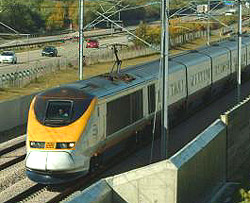
Eurostar
International high-speed train, running between London and
Paris, and London and Brussels.
Evian, Accords d' Agreement, signed in 1962, putting an end to the Algerian war. The agreement , signed between the French government and the Algerian National Liberation Front, led to Algerian independence, while giving France the right to maintain a certain strategic presence in the country for 15 years. France's withdrawal from Algeria, after 130 years of colonial domination, was the subject of bitter argument in France, and France narrowly escaped falling into civil war over the issue. The Algerian crisis lasted from 1954 to 1962, and led in 1958 to the collapse of the Fourth Republic, and the establishment of the Fifth Republic under General de Gaulle. It was de Gaulle who masterminded the package that achieved consensus at the Evian talks. Evian is a town in the French region of Rhone-Alpes, standing on the French shores of lake Geneva.
Evian, Eau d’: Evian mineral water, reputed to have been filtered for centuries beneath the Alps, is the leading mineral water in France, and the world’s leading export product in its field. Evian water has been bottled since 1826. The Evian bottling company is today part of the Danone group.
Express, l' Weekly independent French newsmagazine, founded in 1953 by Jean-Jacques Servan-Schreiber and Françoise Giroud, on the model of the American Time magazine. Originally a centre-left magazine, l'Express moved to the centre right in the early 1980's. Many prominent French journalists and writers have at times been involved with L'Express; they include Jean Paul Sartre, Raymond Aron and Christine Ockrent.
Extremism : While extremist and populist
parties have
flourished in the twenty-first century in many developed
nations, France has long been a country with a surprising
level of
tolerance of
extremism. For
instance, until the rise of the Socialists in the 1970s, the Communist
Party was the major party of the left in France. After its popularity
faded in the 1980s and 1990s, many French voters moved their sympathies
to other parties at the extremes of the political spectrum, left-wing
parties on the left, and the surging Front National on
the right. In the first round of the 2002 Presidential elections,
virtually a third of all votes cast went to an extremist candidate, on
a turnout of 71% of the electorate.
Almost 20% of votes went to the Front National
or ex-FN candidates, and 13.81% was split among four trotskyist or
communist candidates. While this can be seen in part as a form of
protest vote, or lack of confidence in mainstream political parties, it
also illustrates the degree to which France remains a polarised
society.
In the first round of the 2015 Regional elections,
the FN
took 27.73% of the vote, more than any other party.
Extremism has long historic roots in
France, going back to absolutism and the collaboration of the Vichy
régime
on the one hand, and the excesses of the French Revolution on the
other.
Although
the French Revolution degenerated into the vicious blood-letting of la
Terreur (1792-1794) with its state-sponsored assassinations and all the
trappings of a modern fascist state, the Revolution remains the
founding event of modern France, and support for mass protest and
street violence, born out of memories of the barricades of
1798,
remains stong to this day, a factor that has allowed parties of the far
left and the far right to acquire credibility and popular support more
easily than in most other democratic states.
However the success of extremist parties in 21st
century France can also be attributed to the fact
that mainstream political parties on the left and on
the right have done their bit to strenghten their credibility.
Conservative parties have a long history of assimilating
centre-left and socialist parties with the Communists and other
far-left parties, while the Socialists have persistently sought to make
political capital by portraying the mainstream conservative parties as
the natural bedfellows of the far right. The paradoxical
result was to give credence and respectability
to extremist parties and leaders such as Jean Marie Le Pen
of the National Front, or Arlette Laguiller
of Lutte Ouvrière.
Furthermore, in their keenness to
demonstrate even-handedness, French television stations and
the media have persistently given coverage to charismatic politicians
of the left and the right, turning people such as Le Pen, Laguiller or
more recently Olivier Besancenot,
and the new generations of Le Pens, into popular chat-show guests.
.
Check out the About-France.com
Online French Grammar
Free, full , clear explanations and lots of examples
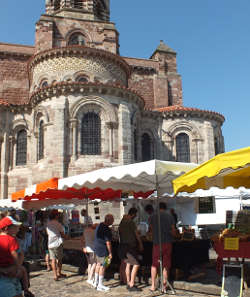
E is for Eglise catholique - the Catholic church
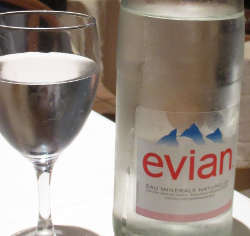
E is for Eau d'Evian - Evian water
E is for Eurostar