

Visiting France - planning a trip
Visiting France - 1 The essentials
- Explore France ►
- Key pages
- Where to go
- How to get there
- More about France
Site
search
About-France.com
What are you looking for ?
What are you looking for ?
About-France.com
- the connoisseur's guide to France
| On
this page ► Essential info |
Passport or visa? | France by car | Flying to France |
| Health insurance | Money | Other points |
On
other pages ► In
more detail.....
More vital info to help you prepare the specifics of your trip, such as.....
Visiting Paris or other top tourist cities, the French regions, the best of rural France, finding a cottage for hire or a hotel, how to travel round France by car or by train, visiting vineyards, shopping and more generally where to go and what to see in France....
More vital info to help you prepare the specifics of your trip, such as.....
Visiting Paris or other top tourist cities, the French regions, the best of rural France, finding a cottage for hire or a hotel, how to travel round France by car or by train, visiting vineyards, shopping and more generally where to go and what to see in France....
First
things first: preparing your journey

Coronavirus information (updated
for 2024)
Covid has not disappeared, and visitors arriving in France from abroad are recommended to be vaccinated and in possession of a vaccination certificate. Within France, there are no covid restrictions in place, except in certain places of risk, such as hospitals, where a mask may be required. The situation can change at any moment.
For more information, see Covid requirements in France
Covid has not disappeared, and visitors arriving in France from abroad are recommended to be vaccinated and in possession of a vaccination certificate. Within France, there are no covid restrictions in place, except in certain places of risk, such as hospitals, where a mask may be required. The situation can change at any moment.
For more information, see Covid requirements in France
- Passport or ID card? Citizens of the European Union can travel to France on a national identity card, if they have one. EU citizens who do not have an ID card, and citizens of other countries, must be in possession of a valid passport. Visitors from non-EU countries may need a visa, depending on the length of stay and their country of origin. Visas are not required for citizens holding residence status in any other "Schengen" country, whatever their nationality. For the purposes of a short trip (less than 90 days), visas are not required for visitors from the United States, Argentina, Australia, Brazil, Chile, Japan, Mexico, United Kingdom, New Zealand, Venezuela and several other countries. For a full list of visa requirements for short or longer stays, visit the official French visa info website in English.
- Travelling
to France by car:
(Click here for ► Driving in France).
Travellers coming from the UK: it is
usually sufficient to just turn up at a ferry port or the channel
Tunnel, and buy a ticket for the next crossing. However, this is not
advisable in the peak holiday season, or at busy weekends. Besides, it
is often possible to shop around and get a cheaper price, if you book
in advance. Click here to compare
ferry price offers and book online.
Driving to France from
most other neighbouring countries (Belgium, Luxembourg, Germany, Italy,
Spain) is no problem at all, as customs and border controls
have been abolished within the Schengen area, and traffic flows
seamlessly across these borders. Customs and passport controls may slow
down traffic across borders from Switzerland, though this is not
usually the case. The border crossing from Andorra can be very slow, if
customs decide to check cars for contraband, notably duty-free
cigarettes, as they often do.
Driving license. Drivers from the UK, EU and EEA countries can use their national license in France for up to a year. Drivers with licenses from the USA can also do so, but are recommended to have an IDP too. Drivers from other countries must have a valid national license PLUS either an official translation into French or an IDP (International Drivers Permit)), which can be obtained ► here. - Reaching
France by air:
From the UK and Europe. There are more than twenty regional airports in France, with flights from the UK and other countries. For further information, check out the flights to France page. - Flights
from North America. The airline with most direct flights from
North America to France is Air
France which has direct flights from a dozen or more cities
in North America . For transatlantic passengers, or
passengers from other
continents, the general point of arrival in France will be Paris
Charles de Gaulle (CDG) airport. Nice airport is served by
Delta from
JFK.
Geneva airport, which has flights from the US and Asia, lies on the
French-Swiss border, and has a direct exit to France. Brussels, Zurich
and Luxembourg airports are also within easy striking distance of
France. Check out options and best value flights on Expedia.
For visitors from Canada or NE United States, Air Transat has direct and relatively good value flights from Montreal to Basel-Mulhouse, Bordeaux, Lyon, Marseille, Nantes and Toulouse, as well as Paris.
For flights to France from Australia, Asia-Pacific area and all other long-haul flights to France, consult your travel agency or online ticketing websites for options and prices.
- Currency : France uses the Euro. The easiest way to get holiday money (and often the cheapest) is to withdraw euros from an ATM (hole in the wall, cash dispenser) on arrival in France, or even from a Euro dispenser in the departure area at a major UK airport. Most French ATMs accept foreign cards (Visa, Mastercard, Maestro, etc). (See page on Banks and paying for things in France). Note: If your bank / credit card account is not in Euros, you will pay a commission on each transaction – withdrawal or payment. Commissions are proportionally greater the smaller the transaction, so it is not advisable to use your card regularly for a lot of small transactions. You will pay less (maybe quite a bit less) by withdrawing enough cash for a day or two from an ATM, then paying in cash.
- Health : visitors are strongly advised to make sure that they have health insurance cover before travelling to France or any other foreign country. For France, UK visitors should obtain the Global Health Insurance Card (GHIC), which has replaced the old EHIC form but provides just the same cover; further details on the About-France.com health cover in France page.
Other points
Find
hotels
in France

Click for best online rates for hotels in French towns and cities.
Calais
Paris
Reims
Dijon
Beaune
Lyon
Rouen
Orleans
Tours
Poitiers
Bordeaux
Montpellier Nice Clermont-Fd.
Click for best online rates for hotels in French towns and cities.
Paris
Reims
Dijon
Beaune
Lyon
Rouen
Orleans
Tours
Poitiers
Bordeaux
Montpellier Nice Clermont-Fd.
About-France.com
is
partnered with Europe's leading hotel booking portal, Booking.com, to
bring you the best online prices
- Accommodation
and hotels :
There are hundreds of internet sites offering direct booking for hotels, but beware of sites supposedly offering the "cheapest deals". Check out a few sites before you book. Visit the hotels page for information on French hotels, else our information on Paris hotels, or the interactive holiday rentals maps on Gitelink.com for information on renting a cottage, or bed and breakfast.
- Paying
in advance; gites, small hotels, campsites. If you need to
make a deposit for accommodation, some premises will accept credit
cards or Paypal; but for those that do not, it is usually possible to
make an "IBAN" transfer (also known as an electronic funds transfer),
which is quite simple and not expensive. Ask
your bank for details.
- Driving
in France :
Technically, if you are driving a car registered in
another European Union country, you do not
need a green card (international insurance card) to travel to Europe,
just your national car insurance certificate. However, it may well be
that your standard national insurance only provides you with
third-party cover once abroad; check with your insurer. Extra
comprehensive cover can be obtained from your normal insurer, or from
an outside source such as the AA. Click
here for more information
about driving and motorways
in France or on driving
south from Calais
- Mobile phones / cellphones: if you want to continue using your national mobile phone while abroad, you may need to enable international use by contacting your operator. Since Brexit, many UK phone operators have reintroduced roaming charges; consult your operator for details. See more details for using US cellphones in France.
- When
to visit France : The
best times of year are, of course, between April and October: July and
August tend to be very busy in most tourist areas. The Spring and the Early Autumn are a
great time to visit France, if you are not bound by the requirements of
school term dates or work.
Climate change: with summer heatwaves increasingly common in the south of France, there is an upsurge in spring and autumn tourism among those who are not bound by school holiday calendars. The tourist industry is fast adapting to cater for them, with sites and restaurants extending their summer season until the end of September, or even later. - For day trips to France from the UK compare the options available.
Continue now with part 2 : Choosing a holiday
Holiday
travel insurance:
It is highly recommended, and in some cases obligatory, to be insured when you travel. Many people have existing policies, or even credit cards, that include travel insurance, but it is always a good idea to check. Make sure that you have accident and emergency cover, including civil third party liability cover (for humans, as well as your car).
It is particularly important and usually necessary to take out special insurance if you plan to do anything out-of-the-ordinary while on holiday, such as winter-sports or other types of sport.
It is highly recommended, and in some cases obligatory, to be insured when you travel. Many people have existing policies, or even credit cards, that include travel insurance, but it is always a good idea to check. Make sure that you have accident and emergency cover, including civil third party liability cover (for humans, as well as your car).
It is particularly important and usually necessary to take out special insurance if you plan to do anything out-of-the-ordinary while on holiday, such as winter-sports or other types of sport.
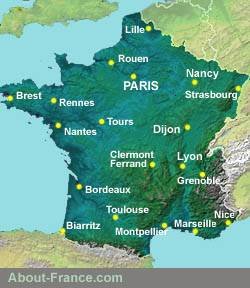
Practical
information pages designed to help you
prepare your holiday in France, decide when and where to go, what to
take with you, where to stay and how to get there
Planning
a trip to France.
Other useful pages.
Other useful pages.
- Holiday week planner
- Public holidays in France
- French school holiday calendars 2024
- Climate and weather
- Preparing your trip (this page)
- Choosing a type of holiday
- A weekend in France - 10 ideas
- The most interesting cities
- France on a limited budget
- Cheap travel offers
- Travel to France and getting round France
- Driving in France
- Is France safe ?
►► More topics on French life
An
independent user-supposted website, About-France.com is an affiliate
partner of
carefully selected relevant third-party websites,
and may receive a small commission on some transactions made on these
partner sites.

► More accommodation
Guide to hotels in FranceBed and breakfast in France
Rural campsites in France
Independent hotels in France