Historic monuments in France
The most interesting and most visited historic monuments in France
- Explore France ►
- Essential pages
- Travel in France
- Where to go
- What to see and do
About-France.com
- the connoisseur's guide to France
| Historic monuments and other attractions : subject index | ||
| Most visited monuments | Historic French cities | Historic areas |
| Best cities | Best museums & galleries | Tourism by theme |
| Top tourist attractions | Monuments by region | Theme parks |
 Official
historic
monument logo
Official
historic
monument logo
Top sites: the most visited historic monuments in France
(Source French national statistical office: includes only monuments visited primarily for historic and cultural interest, rather than other reasons.)
The top twenty most visited monuments in France
 Notre
Dame Cathedral, Paris (free)
Notre
Dame Cathedral, Paris (free)- Sacré Coeur basilica, Montmartre, Paris (free)
- Gardens of the château de Versailles, near Paris (free)
- The Louvre, Paris
- The Eiffel Tower, Paris
- The Georges Pompidou centre and museum of art, Paris
- Notre Dame Cathedral Strasbourg (free)
- La Villette science museum, Paris
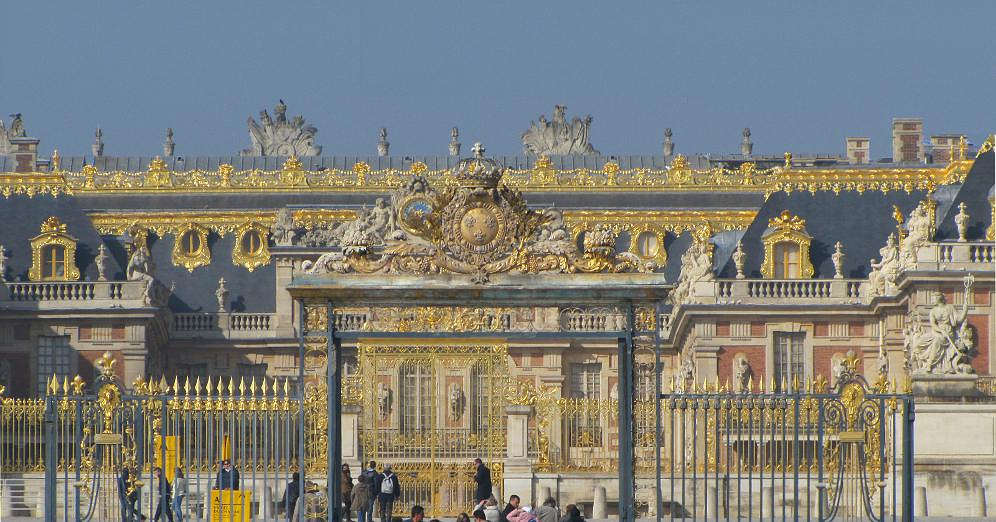
- The château de Versailles, near Paris
- Mont Saint Michel, Normandy
- Musée d'Orsay, Paris
- Les Baux de Provence, near Avignon
- Village of Riquewihr (Alsace) (free)
- St. Malo (Brittany) (free)
- Notre Dame cathedral, Reims (Champagne) (free)
- Notre-Dame cathedral, Chartres (Centre-Val-de-Loire) (free)
- The Pont du Gard (near Nimes, Languedoc)
- The Arc de Triomphe, Paris
- Palace of the Popes, Avignon, Provence
- Basilique de Vézelay, Burgundy (free)
►
Here are a few more major monuments that are just as worth
visiting as any of the above:
The cathedral of St. Cecilia in Albi (Midi Pyrenees), the Chateau de Chenonceaux (Centre - Loire valley), the Royal saltworks at Arc et Senans (Franche comté), the walled city of Carcassonne (Languedoc), the cathedral at Amiens (Picardy).... , the amazing Caverne du Pont d'Arc museum in Ardèche (prehistoric cave paintings) and so many more.
For details by region, see Tourist attractions in France by region
The cathedral of St. Cecilia in Albi (Midi Pyrenees), the Chateau de Chenonceaux (Centre - Loire valley), the Royal saltworks at Arc et Senans (Franche comté), the walled city of Carcassonne (Languedoc), the cathedral at Amiens (Picardy).... , the amazing Caverne du Pont d'Arc museum in Ardèche (prehistoric cave paintings) and so many more.
For details by region, see Tourist attractions in France by region
Historic French cities
Find
hotels
in France

Click
for places to stay in or near....
Paris
Nimes
Arles
Strasbourg
Nice
Lyon
Bordeaux
Rouen
Chartres
Tours
Poitiers
Besançon
Other areas
Here
are the six most visited historic city centres among the major cities
of France. Each of these cities is a regional capital, has a
rich
historic centre, and is very much worth the visit during a holiday in
France or for a weekend break. Nimes
Arles
Strasbourg
Nice
Lyon
Bordeaux
Rouen
Chartres
Tours
Poitiers
Besançon
Other areas
About-France.com
is
partnered with Booking.com, to
bring you the best online prices
- Paris
: one of the greatest concentrations of historic monuments on Earth.
Click for historic monuments in Paris - Lyon : a historic ensemble, without any particularly great historic monument; the quays along the Saone have a similar ambiance to the banks of the Seine in Paris.
- Strasbourg : Old quarter, including "Petite France", half-timbered hoses, canals, and famous medieval cathedral
- Nice : the "old town" is a classic Mediterranean town in the Italian style; it was Italian until the eighteenth century. Very narrow streets, piazzas, old churches, and the famous flower market.
- Rouen: historic city centre, half timbered houses, great gothic cathedral, interesting mediaval clock tower.
- Bordeaux: great historic city centre, much of it dating from the eighteenth century.
Click for more ideas on the most interesting and attractive historic cities in France
Historic areas with rich collections of monuments :
While the richest concentration of historic monuments can be found in Paris, the vast majority of historic monuments lie in the regions. And there are thousands of them .....
Here is a short themed selection: From north to south.
 Northern France The great gothic
cathedrals
Northern France The great gothic
cathedrals
See Best cathedrals in France.
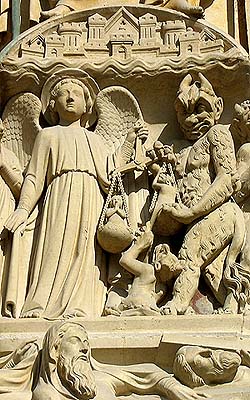
In the 11th and 12th centuries, a new style of architecture developed in the kingdom of France. In the great cities of the kingdom, Paris, Chartres, Reims, Amiens, Rouen, Beauvais, bishops and benefactors vied with each other to put up the finest greatest cathedrals in the new style, which we now call "gothic". Photo: Notre Dame de Paris.
Main regions: Champagne, Ile de France, Picardy, Normandy- Northeastern
France: Military fortifications
From the 16th century to the 20th, France was constantly wary of invasion from the east. As a result, eastern France offers many magnificent examples of military fortifications, from Vauban's fortifications at Neuf Brisach or Besançon, to the bastion at Sedan of the few remaining traces of the Maginot Line.
Main regions; Lorraine, Alsace, Franche-Comté - Northwestern
France: medieval castles and fortresses
 In
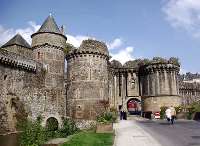
medieval times, the kings of France, and their vassal dukes, such as
the dukes of Normandy, Anjou and Burgundy, built massive fortresses to
ensure their feudal power and demonstrate their strength. Though
impressive medieval keeps can be found all over France, the northwest
quarter is particularly rich. Among the most famous are the great
castles at Angers Loches or Chinon (Loire valley),
the castles at Fort-la-Latte, Fougères (photo) and
Suscinio (Brittany),
or Falaise and Chateau-Gaillard (Normandy)
In
medieval times, the kings of France, and their vassal dukes, such as
the dukes of Normandy, Anjou and Burgundy, built massive fortresses to
ensure their feudal power and demonstrate their strength. Though
impressive medieval keeps can be found all over France, the northwest
quarter is particularly rich. Among the most famous are the great
castles at Angers Loches or Chinon (Loire valley),
the castles at Fort-la-Latte, Fougères (photo) and
Suscinio (Brittany),
or Falaise and Chateau-Gaillard (Normandy) - Central
France - The
châteaux of the Loire Valley
See Châteaux of the Loire.
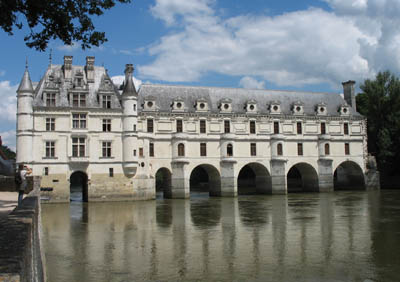 A
hundred miles southwest of Paris, the Loire valley, at the time of the
Renaissance,
was covered by large expanses of forests, royal and
aristocratic hunting grounds. Beginning in the fourteenth century,
kings, princes and noblemen built fabulous castles and stately homes
here, to entertain their guests and friends. Among the most famous and
most visited are Chambord, Chenonceau (picture), Azay le Rideau,
Amboise and
Blois; but there are dozens more to choose from, big and
small, some of them still occupied as family homes.
A
hundred miles southwest of Paris, the Loire valley, at the time of the
Renaissance,
was covered by large expanses of forests, royal and
aristocratic hunting grounds. Beginning in the fourteenth century,
kings, princes and noblemen built fabulous castles and stately homes
here, to entertain their guests and friends. Among the most famous and
most visited are Chambord, Chenonceau (picture), Azay le Rideau,
Amboise and
Blois; but there are dozens more to choose from, big and
small, some of them still occupied as family homes.
Regions: Centre, Pays de la Loire - Central France
- the Châteaux and towns of Burgundy.
Burgundy offers a rich concentration of historic monuments, including a large number of châteaux, but also historic towns and some of the oldest churches in France, as St. Philibert in Tournus, the cathedral at Autun, and the pilgrimage basilica at Vézelay. Region: Burgundy  Central southern France: the romanesque churches
of the Auvergne
Central southern France: the romanesque churches
of the Auvergne
Auvergne is another region where medieval architects and craftsmen built hundreds of decorated churches and chapels; many still survive. From the tenth century chapel of St. Michel de l'Aiguilhe in Le Puy, to the great romanesque basilicas of Brioude or Issoire with their decorative medieval stonework, and countless small village churches, the area is rich in monuments dating from medieval times.
Region: Auvergne.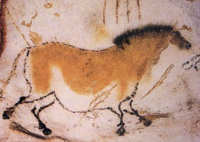 Southwest France: The
prehistoric caves of the Dordogne
Southwest France: The
prehistoric caves of the Dordogne
Caves and cave paintings; including Lascaux, the Grotte de Villars near Brantôme, Font de Gaume, and Les Combarelles. At Lascaux, visitors go down into a perfect replica of the original caves, which have been closed to the public for reasons of conservation. In other sites, the original caves, with their paintings and carvings, can be visited. there is a major museum at Les Eyzies.
Region: Aquitaine. Further information: see Prehistoric France and River Dordogne area.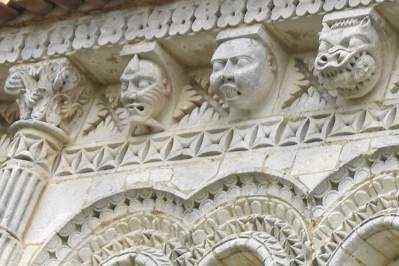 Southwest France The romanesque
churches of the Saintonge
Southwest France The romanesque
churches of the Saintonge
Around the 12th century, villages vied with each other to produce the most ornate sculped doorways, capitals and corbels. A good map is needed to discover many of these gems; there are so many of them in this area, that some are not even signposted. Photo: corbels on a Saintonge village church
Region: Poitou-Charentes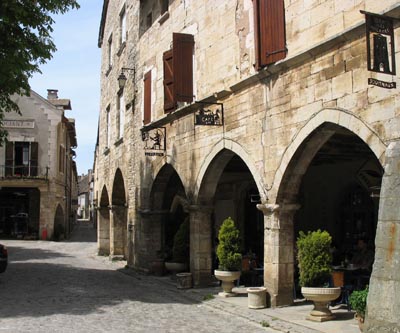 Southwest France: the bastide
towns
Southwest France: the bastide
towns
In the thirteenth and fourteenth centuries, the plains of central southwest France were very much France's weak underbelly. The area was very sparsely populated, and liable to attack, not just from a possible Moorish invasion out of Spain, but from Aquitaine which at the time belonged to the Kings of England. In order to populate the area and make it safer, both the French and the English built up networks of small fortified towns and villages, many of which survive to this day as small - even tiny - townships with fortifications and many old buildings.
Regions: Aquitaine, Midi-Pyrenées. More details: see bastide towns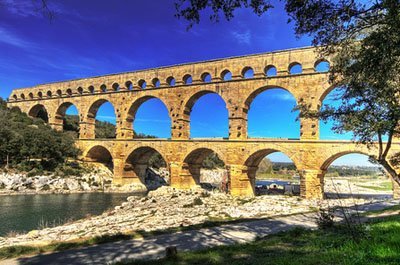 The south of France Roman sites in Provence and
Languedoc
The south of France Roman sites in Provence and
Languedoc
The area now known as Provence was in roman times "Provincia", the most prized province of the Roman empire. The Romans stayed for several centuries in this area, long enough to populate it with a concentration of towns and cities as dense as the area round Rome itself. Amont the magnificently preserved monuments are the Pont du Gard Roman aqueduct, the Roman arenas of Nimes and Arles, the Maison Carré in Nimes, the Amphitheatre and triumphal arch in Orange, and many more. See Roman France .
Regions: Provence, Languedoc. More details: Provence heritage
Tourism in France by theme:
To make the most of a holiday in France, follow these links for a thematic approach to touring in France, and the main things to see and do in the French regions:
- Prehistoric France - the best sites
- Roman France - the best sites
- Best medieval cathedrals
- Great medieval fortresses in France
- Renaissance and classic châteaux
- Loire
valley châteaux
- The best art galleries and museums in France
- Industrial and transport museums
- Living history museums (coming)
- Scenic railways and steam railways in France
- First world war sites and memorials in France
- The French coast and beaches
- Wine regions of France
- Beautiful villages in France
- Paris historic monuments
- Aquitaine - includes Bordeaux & Dordogne
- Auvergne
- Brittany
- Burgundy
- Centre Val de Loire region
- Franche-Comté
- Grand-Est – Alsace
- Grand-Est – Champagne
- Grand-Est - Lorraine
- Limousin
- Hauts-de-France – Nord–Pas-de-Calais
- Hauts-de-France – Picardy
- Occitanie region – Languedoc-Roussillon
- Occitanie region – Midi Pyrénées
- Normandy
- Pays de la Loire region
- Poitou Charentes
- Provence
- Rhone-Alpes region
A short guide to the regions of France
It would be
impossible
- and indeed pointless - to draw up a list of all the
historic
monuments in France. The aim of this guide is to help
visitors,
tourists and anyone else, to discover the essential historic heritage
of France, and - through the regional guides - some of the less
well-known sites and monuments. But this can only be a start.
Ultimately, to make a full discovery of all the historic monuments - listed and unlisted - that an area has to offer, it only local knowledge, handouts from local tourist offices, and personal experience that can really produce the results.
Ultimately, to make a full discovery of all the historic monuments - listed and unlisted - that an area has to offer, it only local knowledge, handouts from local tourist offices, and personal experience that can really produce the results.
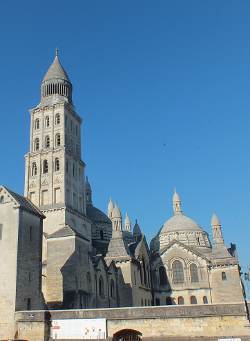
St Front's cathedral - Perigueux. The Byzantine-Romanesque tower is the oldest cathedral tower in France, nearly 1,000 years old
This page covers continental France but does not include historic monuments in French overseas departments and territories . In no way is it a complete guide. While all of the "most visited" historic monuments in France are among the best and most interesting historic monuments that France has to offer, there are also many other magnificent historic monuments that are off the beaten track, and consequently far less visited than they would be if, for example, they were just outside Paris.
Click here for
low-cost car hire in France
low-cost car hire in France

Places
to stay
Hotel search
Gites and holiday cottages
Bed and breakfast in France
Rural campsites in France
Hotel search
Gites and holiday cottages
Bed and breakfast in France
Rural campsites in France